
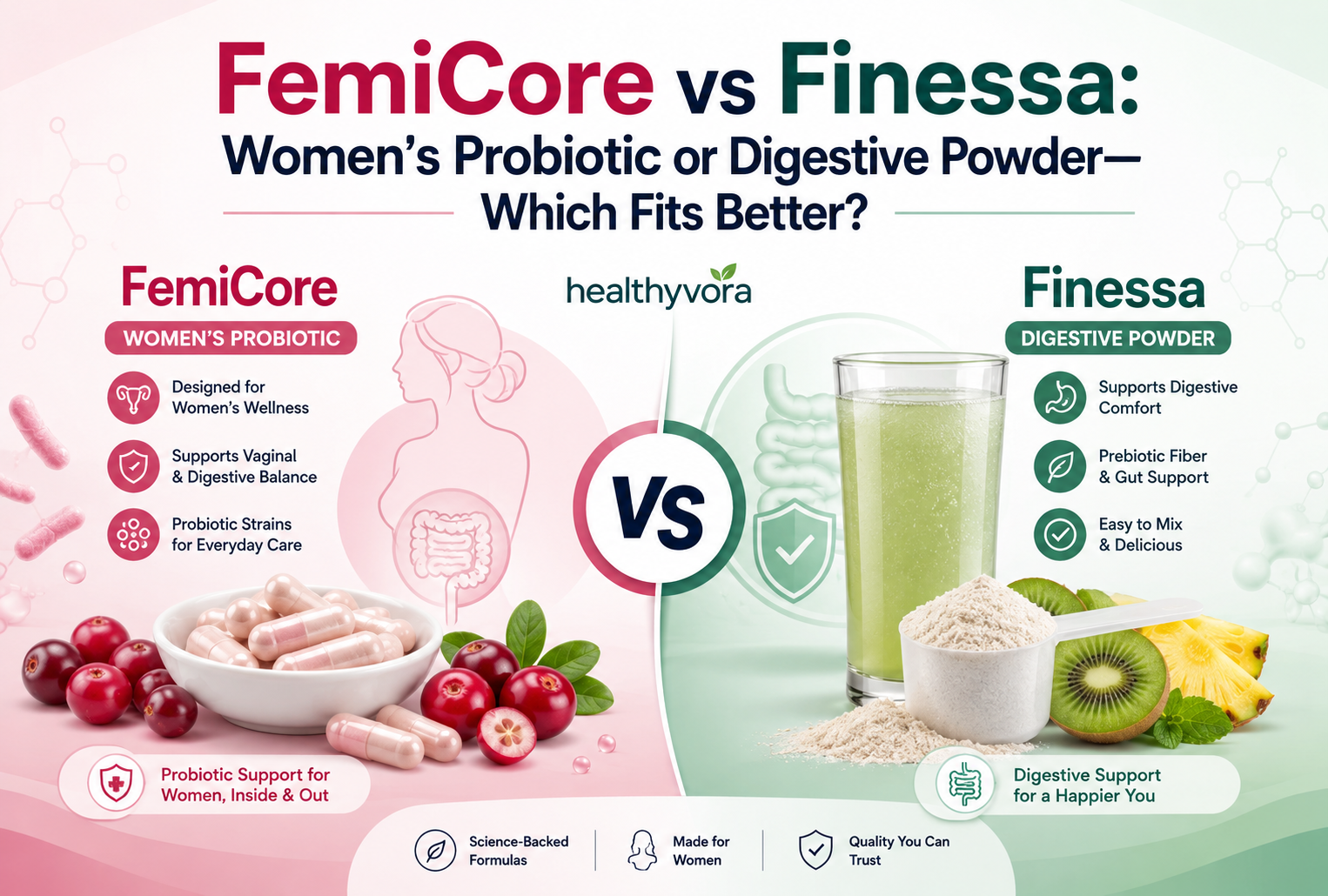
FemiCore vs Finessa: Women’s Probiotic or Digestive Powder—Which Fits Better?
FemiCore fits better when your main priority is women-focused urinary, vaginal microbiome, and feminine wellness support in a convenient capsule. Finessa fits better when you want a broader digestive powder containing probiotics, prebiotic ingredients, fruit polyphenols, and digestive botanicals. They are not equivalent formulas, and neither is automatically the better supplement for every person. This healthyvora comparison examines their labels, formats, ingredient transparency, safety considerations, and intended uses so U.S. shoppers can decide which approach more closely matches their needs.
Order Now
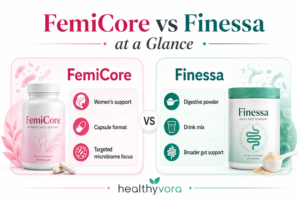
FemiCore vs Finessa at a Glance
FemiCore is primarily positioned as a women’s urinary and microbiome supplement. Its label combines four botanical ingredients with five named Lactobacillus strains in a once-daily capsule. Finessa is a flavored powder intended for broader digestive and wellness support, combining fruit and vegetable powders, prebiotic ingredients, digestive botanicals, liver-focused herbs, and several probiotic organisms.
The simplest distinction is this: FemiCore is the more targeted women’s formula, while Finessa is the more comprehensive digestive powder. However, Finessa also contains cascara sagrada, an ingredient traditionally used as a stimulant laxative, so its digestive profile deserves more careful consideration than that of a standard probiotic powder.
| Comparison Point | FemiCore | Finessa |
|---|---|---|
| Primary positioning | Women’s urinary, bladder, vaginal microbiome, and feminine wellness support | Digestive, gut, metabolic, and general wellness support |
| Format | Capsule | Mixable powder |
| Suggested use | One capsule daily, preferably with a meal | One scoop mixed with water or another beverage, generally in the morning |
| Servings per container | 30 | 50 |
| Probiotic information | Five named strains, but no CFU amount shown on the reviewed label | Five billion CFU at the time of manufacture, plus a separately listed Akkermansia ingredient |
| Prebiotic component | None clearly identified on the reviewed label | Fructooligosaccharides and resistant dextrin |
| Notable botanicals | Cranberry, bearberry, mimosa pudica, and berberine | Ginger, cinnamon, cascara, dandelion, turmeric, milk thistle, artichoke, and licorice |
| Women-specific design | Yes | No; marketed to adult men and women |
| Best practical fit | Women prioritizing urinary and feminine microbiome support | Adults seeking a drink-based, multi-ingredient digestive routine |
| Main caution | Contains berberine and bearberry; medication and pregnancy screening are important | Contains cascara sagrada and multiple botanicals; not a simple everyday probiotic |
Order Now
What Is FemiCore?
FemiCore is a once-daily capsule formulated around women’s urinary and microbiome wellness. The reviewed Supplement Facts panel lists a 350-milligram herbal blend and a 50-milligram probiotic blend.
The herbal blend contains mimosa pudica seed extract, cranberry extract standardized to 30% proanthocyanidins, bearberry leaf extract, and granular berberine hydrochloride extract. The probiotic portion lists five strain-designated organisms: Lactobacillus crispatus LCr86, Lactobacillus acidophilus LA88, Lactobacillus plantarum N13, Lactobacillus gasseri LG08, and Lactobacillus casei LC16. :contentReference[oaicite:1]{index=1}
What FemiCore is designed to support
FemiCore’s marketing and label language focus on urinary-system health, bladder support, feminine balance, and microbiome balance. That makes it more specialized than a standard probiotic marketed only for bowel regularity or occasional bloating.
The presence of specifically identified Lactobacillus strains is useful because probiotic effects can differ by strain rather than simply by bacterial species. NIH guidance explains that probiotic organisms should ideally be identified by genus, species, and strain, and that the effects observed with one strain should not automatically be attributed to another. :contentReference[oaicite:2]{index=2}
A transparency limitation to understand
Although FemiCore identifies its five strain codes, the reviewed label does not disclose a colony-forming unit count. It lists the probiotic blend by weight—50 milligrams—rather than stating how many live organisms are expected per serving or through the expiration date.
This does not prove that the formula is ineffective. It does mean shoppers cannot make a complete potency comparison with probiotic products that publish both strain identities and guaranteed CFU counts.
What Is Finessa?
Finessa is a powdered dietary supplement designed to be mixed into water, a smoothie, or another beverage. Its label presents a much broader formula than FemiCore, with separate polyphenol, gut-health, liver-health, and probiotic blends.
One scoop provides 10 calories and three grams of carbohydrate. The formula contains a 1,000-milligram polyphenol blend, a 755-milligram gut-health blend, a 450-milligram liver-health blend, a probiotic blend labeled as five billion CFU at the time of manufacture, and a separately listed Akkermansia muciniphila AH39 ingredient. :contentReference.
Finessa’s polyphenol blend
The polyphenol portion includes beet root, black currant, pomegranate, raspberry, strawberry juice, cranberry, blueberry, purple carrot, and acai berry ingredients. These components make Finessa feel more like a broad superfood-style wellness powder than a narrowly targeted probiotic.
Finessa’s gut-health blend
The digestive blend contains cinnamon, ginger, cascara sagrada extract, deglycyrrhizinated licorice root, and fructooligosaccharides. Fructooligosaccharides function as prebiotic carbohydrates that can be used by microorganisms in the digestive tract. NIH distinguishes prebiotics from probiotics: probiotics are live microorganisms, while prebiotics are substrates that gut microorganisms can use.
Finessa’s probiotic blend
The Finessa label includes Lactobacillus, Bifidobacterium, Bacillus, Clostridium, and Streptococcus organisms. Some strain identifiers are disclosed, including Bacillus coagulans BC99, Lactobacillus acidophilus LA85, Bifidobacterium lactis BLa80, and Lactobacillus reuteri LR08.
However, its five-billion-CFU statement is qualified as the amount present at the time of manufacture. NIH notes that probiotic counts can decline during a product’s shelf life and that labels are more informative when they guarantee CFU through the expiration or use-by date.
Which Is Better for Women’s Microbiome Support?
FemiCore is the more logical choice for women specifically seeking urinary, bladder, or vaginal microbiome support. Its formula and marketing are built around feminine wellness, and its probiotic blend includes Lactobacillus crispatus and Lactobacillus gasseri strains rather than using only general digestive bacteria.
Finessa contains probiotics, but its formula is not specifically designed around women’s intimate or urinary wellness. Its wider ingredient profile is directed toward digestion, bowel activity, prebiotic support, and general metabolic wellness.
Women should not use either supplement to self-treat symptoms such as painful urination, blood in the urine, fever, pelvic pain, unusual discharge, persistent odor, or recurrent infections. These symptoms may require medical testing rather than a probiotic or herbal product.
Which Is Better for Bloating, Constipation, or Digestive Comfort?
Finessa has the more digestion-focused ingredient list, but it is not automatically the safer or more appropriate option for every digestive complaint. Its powder includes prebiotic ingredients, ginger, cinnamon, probiotics, and cascara sagrada.
Cascara sagrada is particularly important because it has traditionally been used as a stimulant laxative. It may increase bowel activity, but it can also contribute to cramping, diarrhea, or dehydration in susceptible users. NCBI’s LiverTox resource notes that high doses or use beyond recommended periods have been associated with adverse effects, including rare liver injury. :contentReference[oaicite:6]{index=6}
Finessa may therefore appeal more to someone focused on bowel regularity, but it should not be treated like an ordinary probiotic drink that can be added casually to every long-term routine. Persistent constipation, a sudden change in bowel habits, rectal bleeding, severe abdominal pain, vomiting, or unexplained weight loss should be evaluated by a healthcare professional.
FemiCore may still affect digestion because it contains probiotics and berberine, but digestive wellness is secondary to its women-focused positioning.
Capsule or Powder: Which Format Is Easier to Use?
The best formula on paper is not useful when the format prevents consistent use. Consider how each product would fit into your actual morning or evening routine.
- Choose FemiCore’s capsule format when you prefer a quick, portable serving with no flavor, mixing, or preparation.
- Choose Finessa’s powder format when you enjoy mixing supplements into water or smoothies and prefer a drink-based wellness routine.
- Check the full ingredient list if you are sensitive to natural flavors, stevia, citric acid, or powdered fiber ingredients.
- Consider travel and work schedules because capsules are generally easier to carry, while powders provide more flexibility for people who dislike swallowing pills.
FemiCore’s official directions state one capsule daily, preferably with a meal. Finessa’s official instructions recommend mixing one scoop into water or another beverage, generally in the morning. :contentReference[oaicite:7]{index=7}
Safety and Medication Considerations
Both products are multi-ingredient dietary supplements. This creates more potential variables than a single-strain probiotic or single-ingredient fiber supplement.
FemiCore safety considerations
FemiCore contains berberine. Reported berberine side effects can include nausea, abdominal discomfort, constipation, diarrhea, and bloating. Berberine may also interact with medications and should generally be avoided during pregnancy and breastfeeding unless a qualified healthcare professional specifically recommends otherwise.
Its label also advises pregnant or nursing users, people under 18, and individuals with a medical condition to consult a physician before taking the product.
Finessa safety considerations
Finessa contains cascara sagrada alongside probiotics, prebiotic carbohydrates, turmeric, milk thistle, artichoke, dandelion, cinnamon, ginger, and licorice-derived material. Multi-herb products can be harder to evaluate when a user takes prescription medication or already has gastrointestinal, liver, kidney, blood-pressure, or blood-sugar concerns.
The official Finessa information recommends consulting a physician when a user has a diagnosed or suspected medical condition or takes medication. It also advises against combining Finessa with supplements containing similar ingredients. see also.
“Natural” describes an ingredient’s source. It does not guarantee that the ingredient is appropriate for every person, medication, diagnosis, or duration of use.
Are FemiCore and Finessa FDA Approved?
No dietary supplement should be assumed to be FDA approved simply because it is manufactured in the United States, produced in an FDA-registered facility, or marketed as GMP compliant.
The FDA does not generally approve dietary supplements for safety and effectiveness before they enter the U.S. market. Manufacturers are responsible for meeting applicable manufacturing, safety, and labeling requirements, while the FDA can take action when products are adulterated, misbranded, or associated with safety problems.
This distinction matters for American consumers. “Made in an FDA-registered facility” refers to the facility or regulatory status; it is not the same as the FDA reviewing and approving the finished supplement or its advertised benefits.
How to Choose Between FemiCore and Finessa
Use the following process rather than selecting a product from its headline claims alone.
- Define your main goal. Choose women-focused support, general digestive support, bowel regularity, or probiotic supplementation as your primary goal—not all goals at once.
- Review every active ingredient. Pay particular attention to berberine in FemiCore and cascara sagrada in Finessa.
- Compare probiotic transparency. Look for strain codes, CFU amounts, storage instructions, and whether CFU is guaranteed through expiration.
- Check your medications. Ask a pharmacist or physician to review the complete label when you use prescription drugs.
- Consider your preferred format. A capsule may be easier for travel, while a powder may work better in an established smoothie routine.
- Buy from the official seller. Confirm the current Supplement Facts panel, package quantity, shipping terms, return window, and customer-support process before payment.
- Evaluate one change at a time. Starting multiple new supplements together makes it difficult to identify which product caused a benefit or side effect.
Common Mistakes to Avoid
- Choosing FemiCore only because it says “for women.” Your actual symptoms and health history matter more than gender-focused branding.
- Assuming more ingredients mean better results. A longer label can mean broader coverage, but it can also mean more interactions and less clarity about which ingredient is responsible.
- Using Finessa as a substitute for constipation care. Ongoing constipation may require dietary changes, medication review, testing, or a different treatment approach.
- Ignoring proprietary blend limitations. Both labels group several ingredients together, so the exact amount of each individual component is not fully disclosed.
- Believing all probiotics work the same way. Probiotic effects can be strain-specific and health-goal-specific.
- Equating facility registration with product approval. FDA registration does not mean that the finished supplement has been approved as a drug.
- Stacking similar supplements. Combining several probiotic, laxative, glucose-support, or herbal products can unintentionally duplicate ingredients.
Why Use healthyvora for Supplement Comparisons?
healthyvora approaches supplement comparisons by separating label facts from marketing language. Instead of declaring a universal winner, the goal is to identify who each formula may fit, where the label is transparent, where information is missing, and which ingredients deserve additional caution.
This matters especially with products such as FemiCore and Finessa because they serve different purposes. Comparing them only by testimonial claims, bottle count, or discount percentage would overlook the more important differences in probiotic labeling, botanical ingredients, intended use, and suitability for long-term routines.
Readers should still verify the current label and seller terms because supplement formulas, prices, bundles, and guarantees can change.
Final Verdict: FemiCore or Finessa?
Choose FemiCore when your main objective is women-focused urinary, bladder, or feminine microbiome support and you prefer a simple capsule. Its named Lactobacillus strains make its intended audience clear, although the absence of a disclosed CFU count limits probiotic potency comparisons.
Choose Finessa when you want a broader digestive powder with probiotics, prebiotic ingredients, fruit polyphenols, and digestive botanicals. Its five-billion-CFU label provides more numerical information, but the count is stated at the time of manufacture rather than guaranteed through expiration. Its inclusion of cascara sagrada also means it should not be viewed as a basic probiotic powder.
Neither product is a treatment for urinary infections, vaginal infections, chronic constipation, irritable bowel syndrome, diabetes, obesity, or liver disease. The better fit depends on your primary goal, medication profile, tolerance for multi-herb formulas, and preferred supplement format.
Review the latest healthyvora comparison guidance, examine the complete Supplement Facts panel, and discuss the formula with a qualified healthcare professional when you take medication or manage an ongoing health condition. An informed decision is more valuable than choosing whichever product makes the broadest promise.
Frequently Asked Questions
1. Is FemiCore better than Finessa?
FemiCore is a better fit for women-focused urinary and microbiome support. Finessa is a better fit for broader digestive and powder-based wellness support.
2. Which product is better for bloating?
Finessa has the more digestion-focused formula, but bloating can have many causes. Its prebiotic and botanical ingredients may also increase gas or bowel activity in some users.
3. Does FemiCore contain probiotics?
Yes. Its reviewed label lists five Lactobacillus strains, although it does not disclose a CFU count.
4. Is Finessa a probiotic?
Finessa contains probiotics, but it is more accurately described as a multi-ingredient digestive powder containing probiotics, prebiotics, botanicals, and polyphenol-rich plant powders.
5. Can FemiCore help digestion?
FemiCore contains probiotic strains and may support digestive comfort, but its primary positioning is women’s urinary and feminine microbiome wellness.
6. Can FemiCore and Finessa be taken together?
Do not combine them without professional guidance. Both contain probiotics and multiple botanicals, increasing ingredient overlap and the possibility of digestive side effects.
7. Can pregnant women use either product?
Pregnant or breastfeeding women should consult a healthcare professional before using either product. FemiCore contains berberine, which is generally discouraged during pregnancy and breastfeeding.
8. Which supplement is easier to take?
FemiCore is easier for people who prefer capsules. Finessa may be more enjoyable for people who prefer mixing supplements into water or smoothies.
9. Are FemiCore and Finessa FDA approved?
No. Dietary supplements are not generally FDA approved for safety and effectiveness before marketing, even when manufactured in an FDA-registered facility.
10. Where should U.S. customers buy FemiCore or Finessa?
Use the verified official seller and review the current label, package quantity, shipping policy, refund terms, and customer-support details before ordering.