
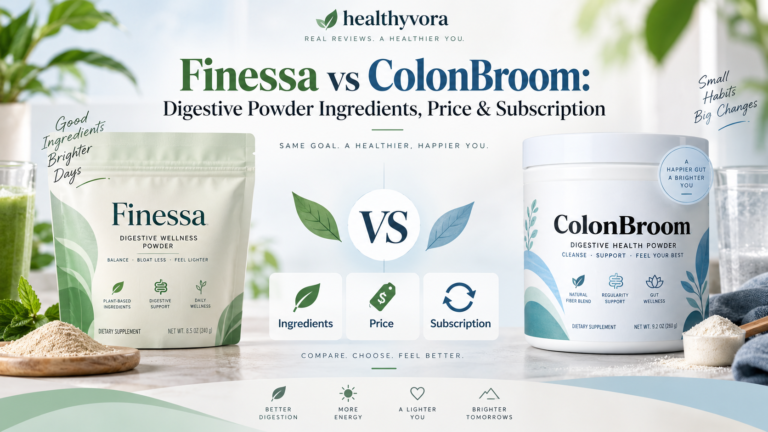
Finessa vs ColonBroom: Digestive Powder Ingredients, Price & Subscription
Finessa and ColonBroom take noticeably different approaches to digestive wellness. Finessa is a broader multi-ingredient powder built around botanicals, probiotics, polyphenols, and digestive-support ingredients, while ColonBroom centers its formula on psyllium husk, a soluble bulk-forming fiber. Their purchasing models differ as well: Finessa currently emphasizes one-time multi-bottle packages, whereas ColonBroom actively promotes recurring subscription plans alongside one-time purchases.
For U.S. shoppers comparing the two, the most useful questions are not simply “Which costs less?” but also what is in each powder, how often it is taken, whether the order renews automatically, and whether the formula suits the user’s digestive goals. In this healthyvora comparison, we separate those points so you can evaluate the products without relying on marketing claims alone.
Visit Official Website
Finessa vs ColonBroom at a Glance
The short answer: ColonBroom is primarily a psyllium-fiber product, while Finessa uses a wider botanical and microbiome-focused formula. ColonBroom offers recurring delivery at discounted promotional prices; Finessa’s current sales materials emphasize one-time payments with no auto-ship subscription.
| Feature | Finessa | ColonBroom |
|---|---|---|
| Product type | Multi-ingredient digestive powder | Psyllium-based fiber powder |
| Core formula approach | Botanicals, probiotics, polyphenols, gut and liver support | Soluble fiber for bowel regularity and digestive support |
| Key named ingredients | Dandelion, silymarin, cascara sagrada, artichoke, turmeric, licorice, probiotics, polyphenols | Psyllium husk powder, citric acid, crystallized lemon, stevia, natural flavors |
| Typical directions shown by seller | One scoop once daily | Up to two servings daily, depending on the current product directions |
| Purchase model | One-time purchase bundles | One-time purchase and subscription |
| U.S. pricing model | Lower per-bottle price on larger bundles | Lower promotional pricing with larger recurring plans |
The practical distinction is simple: compare ColonBroom if you specifically want a psyllium-centered fiber routine; compare Finessa if you are interested in a broader botanical, probiotic, and polyphenol formula.
What Is Finessa?
Finessa is a powdered dietary supplement marketed for digestive wellness, bowel regularity, gut balance, and support of what the company describes as the gut-liver axis. The current Finessa sales page instructs users to mix one scoop with water or another beverage once each morning.
The seller highlights eight main ingredient categories: Taraxacum or dandelion, silymarin from milk thistle, cascara sagrada, Cynara scolymus or artichoke, turmeric, licorice extract, probiotics, and polyphenols. Its strategy is therefore broader than simply increasing daily fiber intake.
What ingredients are highlighted in Finessa?
Finessa combines digestive botanicals with probiotics and plant compounds. Dandelion and artichoke are included in the company’s digestive and liver-support positioning. Milk thistle supplies silymarin, turmeric contributes curcumin-related plant compounds, and the formula also includes licorice extract, probiotics, and polyphenols.
Cascara sagrada deserves separate attention. It has historically been used as a stimulant laxative ingredient. FDA rulemaking determined that cascara sagrada is not generally recognized as safe and effective as an active ingredient in OTC stimulant laxative drug products. That OTC drug classification is not the same thing as saying every dietary supplement containing cascara is prohibited, but its presence is a sensible reason to discuss frequent or long-term use with a healthcare professional.
What Is ColonBroom?
ColonBroom is a flavored fiber powder whose principal ingredient is psyllium husk. Its current U.S. product page also lists citric acid, crystallized lemon, stevia leaf extract, and natural flavors. The brand markets the powder for digestive regularity, bloating support, and appetite-related wellness goals.
How does psyllium work?
Psyllium is a bulk-forming soluble fiber. It absorbs liquid in the intestines, expands, and helps form a bulkier stool that can be easier to pass. This mechanism is much more straightforward than the multi-botanical approach used by Finessa. MedlinePlus identifies psyllium as a bulk-forming laxative used for constipation.
Hydration matters. Psyllium powder should be taken with sufficient liquid, and users should follow the specific product label rather than taking additional powder in an attempt to get a faster result. Fiber supplements may also initially cause gas or bloating in some people.
Finessa vs ColonBroom Ingredients: The Main Difference
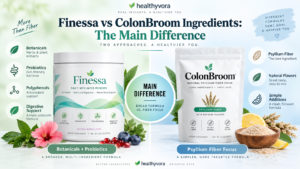
The central formula difference is complexity versus focus. ColonBroom places psyllium fiber at the center of the product. Finessa combines several botanicals and microbiome-related ingredients intended to address digestive wellness through multiple pathways.
This matters because the ingredient you are actually looking for should determine much of the comparison. Someone specifically seeking supplemental soluble fiber may find ColonBroom’s formula easier to understand. A shopper interested in probiotics, polyphenols, milk thistle, turmeric, artichoke, and other botanicals may see more relevance in Finessa’s broader formulation.
More ingredients do not automatically mean greater effectiveness. They also create more variables to evaluate, particularly for people taking medications or managing chronic medical conditions.
Visit Official Website
Finessa vs ColonBroom Price in the United States
Finessa currently starts at $59 per bottle on its main sales page, with the advertised price decreasing to $49 per bottle for three bottles and $39 per bottle for six. The six-bottle package is listed at $234 total with free U.S. shipping, while the single- and three-bottle options on the main page show additional shipping.
Finessa also uses different promotional funnels, and some have displayed lower campaign-specific prices. For that reason, the final checkout amount should always be treated as the authoritative price rather than an old review, advertisement, or search result.
How much does ColonBroom cost?
ColonBroom pricing is more promotion-dependent. One current official U.S. offer displays one-, three-, and six-bottle plans at promotional rates of approximately $39.99, $26.99, and $19.99 per bottle respectively, with the larger offers tied to longer delivery intervals. Another official direct-order page currently displays a three-bottle one-time purchase at $54.99 per bottle and a three-bottle subscription offer at $26.99 per bottle.
ColonBroom’s own help center explicitly notes that prices may vary because of seasonal and personalized discounts. Therefore, comparisons should use the checkout price available on the day of purchase rather than assuming one advertised percentage discount is permanent.
Finessa vs ColonBroom Subscription: What Should U.S. Buyers Know?
Finessa’s current sales funnel states that its packages are one-time payments with no auto-ship subscription. Buyers can purchase larger multi-bottle supplies without agreeing to automatic monthly replenishment.
ColonBroom operates differently. Its official help center says customers can choose one-, three-, or six-month subscriptions. The subscription automatically renews according to the selected interval, and another supply is placed and shipped when the plan renews.
Can you cancel a ColonBroom subscription?
Yes, but shoppers should understand the cancellation terms before choosing the subscription discount. ColonBroom says subscriptions may be canceled at any time. However, if cancellation occurs before the first recurring charge, the customer may have to pay the difference between the discounted subscription price and the corresponding one-time order price. After the first recurring charge has been processed, ColonBroom says cancellation can occur without paying that price difference.
This detail can matter more than the headline discount. If you mainly want to test a product briefly, compare the actual one-time checkout cost with the subscription terms before ordering.
Which Powder Is Easier to Fit Into a Daily Routine?
Finessa’s seller recommends one scoop once each morning, making its advertised routine relatively simple. ColonBroom’s directions vary somewhat between current official landing pages, but its direct plan page instructs new users to begin with one serving daily for the first five days and then increase up to twice daily. It also stresses drinking additional water.
That means shoppers should not judge value only by price per bottle. Check the number of servings, actual serving size, your intended daily frequency, and how quickly a container would be used. This is particularly important when comparing a once-daily product with a fiber product that may be taken more than once per day.
Why This Comparison Matters for U.S. Consumers
Digestive supplements are widely available to American consumers through direct-to-consumer websites, but they are not substitutes for medical diagnosis or treatment. Both Finessa and ColonBroom include disclaimers stating that their supplement claims have not been evaluated by the FDA for diagnosing, treating, curing, or preventing disease. see also.
For consumers in markets from New York and Florida to California and Texas, the buying decision also involves practical U.S.-specific issues such as shipping, promotional pricing, recurring billing, refund conditions, and medication interactions—not merely ingredient marketing.
How to Choose Between Finessa and ColonBroom
- Identify the main goal. Decide whether you primarily want a soluble-fiber supplement or a broader botanical/probiotic digestive formula.
- Read the exact current label. Formulas can change, so use the label on the product being purchased rather than relying exclusively on older reviews.
- Calculate the real cost. Include shipping, servings per container, daily serving frequency, and recurring charges.
- Check subscription terms. Do not choose an autoship discount unless you understand renewal and cancellation conditions.
- Review medications and medical conditions. Fiber and botanical ingredients can require additional caution in some users.
- Start only as directed. More powder does not mean better or faster results.
Safety Considerations Before Using Either Product
With ColonBroom, adequate fluid intake is particularly important because psyllium absorbs water. MedlinePlus recommends taking psyllium powder with at least 8 ounces of liquid and notes that it can interact with certain medicines. People with swallowing problems, intestinal blockage, or certain medical conditions should speak with a healthcare professional before use.
With Finessa, the broader botanical formula creates a different consideration. Cascara sagrada, licorice, turmeric, probiotics, and other ingredients may not be appropriate for every user. Pregnancy, breastfeeding, ongoing gastrointestinal symptoms, or prescription medication use are strong reasons to discuss a new supplement with a clinician or pharmacist first.
Persistent constipation, rectal bleeding, severe abdominal pain, vomiting, unexplained weight loss, or major changes in bowel habits should not be managed solely by experimenting with digestive powders.
Common Mistakes to Avoid When Comparing Digestive Powders
- Choosing solely because one website displays a larger percentage discount.
- Assuming “natural” automatically means risk-free.
- Ignoring automatic subscription renewals.
- Comparing bottle prices without comparing serving frequency.
- Taking psyllium without adequate water.
- Using supplements to self-treat persistent digestive symptoms that deserve medical assessment.
- Assuming an ingredient study proves that the finished commercial product produces the same result.
Why Use healthyvora When Comparing Digestive Supplements?
At healthyvora, a useful supplement comparison should go beyond promotional claims. Ingredients, serving instructions, actual purchase structure, subscription obligations, and safety considerations all affect whether a product makes sense for an individual consumer.
That approach is especially useful with Finessa and ColonBroom because they are not simply two versions of the same fiber powder. Their formulas and purchasing models are materially different. Comparing those differences first can help shoppers make a more informed decision and avoid paying for features they did not actually want.
Finessa vs ColonBroom: Final Comparison
Finessa is the broader formula; ColonBroom is the more psyllium-focused formula. Finessa combines botanical ingredients, probiotics, and polyphenols and is currently promoted primarily through one-time packages. ColonBroom revolves around psyllium husk and offers recurring one-, three-, and six-month subscriptions as well as one-time purchase options.
Price alone should not determine the decision. ColonBroom can display a lower per-bottle promotional price under subscription plans, but recurring billing and cancellation terms matter. Finessa’s larger packages reduce its advertised per-bottle cost without the auto-ship model, although its formula includes more ingredients that users may need to review individually.
Whichever product you consider, confirm the latest Supplement Facts panel, checkout total, shipping cost, and subscription terms immediately before purchase. Supplement prices and promotional funnels change frequently.
Frequently Asked Questions
1. What is the main difference between Finessa and ColonBroom?
Finessa uses a multi-ingredient botanical, probiotic, and polyphenol formula. ColonBroom is primarily centered on psyllium husk soluble fiber.
2. Does Finessa contain psyllium husk?
Psyllium is not among the main ingredients highlighted on Finessa’s current official sales page. Its featured ingredients include dandelion, milk thistle, cascara sagrada, artichoke, turmeric, licorice, probiotics, and polyphenols.
3. What is the main ingredient in ColonBroom?
Psyllium husk powder is the principal digestive-fiber ingredient listed on the current ColonBroom product page.
4. How much does Finessa cost?
The main Finessa sales page currently displays $59 for one bottle, $49 per bottle in a three-bottle package, and $39 per bottle in a six-bottle package. Promotional funnels may differ.
5. How much does ColonBroom cost?
ColonBroom prices vary by promotion and plan. Current official pages show lower per-bottle prices for larger or subscription-based orders, so the checkout price should be verified before purchase.
6. Is Finessa a subscription?
The current Finessa sales funnel states that purchases are one-time payments and do not use an auto-ship subscription.
7. Does ColonBroom automatically renew?
Yes, if you choose the subscription option. ColonBroom says its one-, three-, and six-month subscriptions automatically renew at the chosen interval.
8. Can a ColonBroom subscription be canceled?
Yes. ColonBroom says users can cancel, although canceling before the first recurring payment may require paying the difference between subscription and one-time pricing.
9. Do you need extra water with ColonBroom?
Yes. Psyllium absorbs liquid, so adequate water is important. Always follow the current product label and healthcare guidance.
10. Can Finessa or ColonBroom treat digestive disease?
No digestive supplement should be treated as a substitute for diagnosis or medical treatment. Both brands state that their products are not intended to diagnose, treat, cure, or prevent disease.
Take the Next Step With healthyvora
If you are comparing digestive powders, do not stop at the front-label promise or the biggest discount. Review the ingredients, serving frequency, checkout price, renewal terms, and your personal health considerations together. healthyvora helps make those comparisons clearer so you can approach your next supplement purchase with better information and fewer surprises.
Editorial Verification Note
Pricing, ingredient, usage, and subscription information in this comparison was checked against current Finessa and ColonBroom sales and support materials available in September 2026. Because both companies may change promotions, formulas, shipping policies, or package structures, readers should confirm the final product label and checkout conditions before purchasing. General psyllium safety information was cross-checked with MedlinePlus and Mayo Clinic, while the regulatory context for cascara sagrada was checked against FDA materials.