
DentaBiome vs DentiCore: Ingredients, Dosage, Price & Which Fits Better?
Quick answer: DentaBiome and DentiCore are both once-daily oral health supplements, but they take very different approaches. DentaBiome focuses on postbiotic preparations, xylitol, plant ingredients, and direct mouth contact through a chewable tablet. DentiCore combines minerals such as calcium, iodine, copper, and chromium with a 120 mg proprietary botanical blend. For U.S. shoppers, DentaBiome may fit better if oral microbiome support is the priority, while DentiCore may appeal more to people who prefer a mineral-and-botanical formula and a lower initial purchase cost.
DentaBiome vs DentiCore at a Glance
| Feature | DentaBiome | DentiCore |
|---|---|---|
| Primary approach | Postbiotic and oral microbiome support | Mineral and botanical nutritional support |
| Format | Berry-flavored chewable tablet | Tablet that can be swallowed or chewed |
| Suggested use | 1 tablet daily | 1 tablet daily with water |
| Main named ingredients | L. plantarum complex, L. salivarius, L. rhamnosus, BioFresh Clean Complex, xylitol, purple carrot, cranberry | Calcium, iodine, copper, chromium, chlorella, chlorophyllin, boron citrate, shilajit |
| 30-day equivalent | 1 bottle | 1 bottle |
| Lowest advertised bottle price | $49 in the 6-bottle package | $49 in the 6-bottle package |
| Money-back period | 60 days | 60 days |
| Best fit | People interested in a postbiotic, mouth-contact formula | People interested in minerals plus botanical ingredients |
Pricing reflects advertised U.S. offers reviewed in September 2026 and can change. Always confirm the final checkout price, shipping charge, and refund conditions before ordering.
What Is the Main Difference Between DentaBiome and DentiCore?
The biggest difference is formulation strategy. DentaBiome is positioned primarily as an oral postbiotic supplement. Its chewable format is intended to keep its ingredients in contact with the teeth, tongue, and gums before swallowing.
DentiCore takes a more traditional nutritional-supplement approach. Its Supplement Facts label combines four separately quantified minerals with a proprietary blend containing chlorella, chlorophyllin, boron citrate, and shilajit extract.
That means comparing DentaBiome vs DentiCore is not simply a matter of asking which has “more ingredients.” The better question is which formulation style, ingredient profile, dosing format, and price structure better match your preferences.
DentaBiome Ingredients Explained
The current DentaBiome marketing page names seven major components. However, the public product information reviewed does not show a separate quantity for every named component, so consumers should avoid assuming that ingredient-level research automatically reflects the dose contained in the finished tablet.
1. Dual-Strain L. Plantarum Complex
DentaBiome describes this as a postbiotic preparation associated with Lactiplantibacillus plantarum. The formula is marketed around supporting the oral microbial environment rather than supplying conventional vitamins and minerals.
2. L. Salivarius
Lactobacillus salivarius-related preparations are included as part of DentaBiome’s oral microbiome strategy. Research on specific microorganisms and oral biofilms is interesting, but evidence about an individual ingredient should not be interpreted as proof that a finished supplement will prevent or treat dental disease.
3. L. Rhamnosus
This is another microorganism-associated component used in the postbiotic blend. Again, DentaBiome is presented as a dietary supplement rather than a treatment for cavities, gingivitis, periodontitis, or other diagnosed dental conditions.
4. BioFresh Clean Complex
This proprietary component is described by the manufacturer as an enzyme-focused blend intended to complement the microbiome-oriented formula.
5. Xylitol
Xylitol is particularly relevant to oral care because it is a non-cariogenic sugar alcohol that has been researched in connection with dental plaque and caries prevention. The presence of xylitol may therefore interest users looking for a formula built around the oral environment rather than systemic mineral supplementation.
6. Purple Carrot Powder
Purple carrots provide naturally occurring plant pigments, including anthocyanins. In this formula, the ingredient is positioned primarily as an antioxidant-support component.
7. Cranberry Extract
Cranberry supplies plant polyphenols and is included as another botanical component of the broader oral microbiome formula.
DentiCore Ingredients and Supplement Facts
DentiCore provides more quantitative label information for several nutrients. Its current Supplement Facts panel lists a serving size of one tablet and 30 servings per container.
- Calcium: 20 mg per serving.
- Iodine: 50 mcg per serving.
- Copper: 1.7 mg per serving.
- Chromium: 50 mcg per serving.
- Proprietary Dental Health Blend: 120 mg total.
The 120 mg proprietary blend lists Chlorella vulgaris, sodium copper chlorophyllin, boron citrate complex, and shilajit extract standardized to 5% fulvic acid.
This distinction matters. Consumers can see the quantities of calcium, iodine, copper, and chromium, but the label does not break down how much of each individual botanical is contained within the 120 mg blend.
Ingredient transparency should be judged by both the ingredient list and the actual dose. A long list of recognizable ingredients is less informative when individual quantities are unavailable.
DentaBiome vs DentiCore Dosage: How Do You Take Them?
Both products are designed for once-daily use, but their administration differs slightly.
How to Take DentaBiome
The manufacturer directs users to take one chewable tablet per day. It can be chewed for roughly 30 seconds or allowed to dissolve slowly in the mouth. Water is not required.
The format may be convenient for people who dislike swallowing capsules and for users specifically interested in exposing the oral surfaces to the formula before swallowing it.
How to Take DentiCore
DentiCore’s product label advises adults to take one tablet daily with approximately 6 to 8 ounces of water, unless otherwise directed by a healthcare professional. Manufacturer information also states that the tablet can be chewed briefly or swallowed.
Do not increase either product’s dose simply because you want faster results. Dietary supplements do not necessarily become more effective at higher doses, and excess intake of certain minerals can create avoidable problems.
DentaBiome vs DentiCore Price in the United States
DentiCore has the lower entry price, while the largest bundles are tied at $49 per bottle.
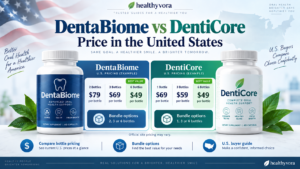
DentaBiome Pricing
- 2 bottles: $158 total, or $79 per bottle.
- 3 bottles: $207 total, or $69 per bottle.
- 6 bottles: $294 total, or $49 per bottle.
The current DentaBiome offer does not display a one-bottle starter package. This means the lowest initial purchase shown is $158 for two bottles.
DentiCore Pricing
- 1 bottle: $69 total.
- 3 bottles: $177 total, or $59 per bottle.
- 6 bottles: $294 total, or $49 per bottle.
For someone who wants the smallest commitment, DentiCore’s single bottle is financially easier to test. At three bottles, DentiCore is also currently $30 less expensive than the comparable DentaBiome package. At six bottles, both advertised packages cost $294.
Both brands currently advertise a 60-day money-back period. Read the return instructions before purchasing because shipping charges, return postage, and the date from which the guarantee period starts can affect the practical value of a refund policy.
Which Formula Has Better Ingredient Transparency?
DentiCore currently has the advantage in quantitative transparency for its four listed minerals. Consumers can see specific amounts for calcium, iodine, copper, and chromium, plus a total quantity for the botanical blend.
DentaBiome clearly names its headline components, but its public marketing information reviewed for this comparison does not display individual quantities for those components.
Neither situation means one product is automatically more effective. It simply means DentiCore makes it somewhat easier to evaluate the intake of certain nutrients against the rest of your diet and supplement routine.
What Does the Research Actually Tell Us?
Some individual ingredients used in these products have scientific literature behind them. Xylitol, for example, has been investigated for its relationship with cariogenic bacteria and dental caries. Minerals and botanical compounds used by DentiCore also have varying levels of nutritional or laboratory research.
However, ingredient research is not the same as a randomized clinical trial of the finished supplement. Marketing mechanisms such as DentaBiome’s discussion of a “FabM acid-lock” or DentiCore’s promotional emphasis on oral tissue “oxygenation” should therefore be treated as manufacturer explanations rather than established proof that the complete products reverse dental disease.
A responsible comparison should distinguish between plausible ingredient-level mechanisms, manufacturer claims, and direct clinical evidence for the branded formula.
Are DentaBiome and DentiCore FDA Approved?
No dietary supplement should be described as FDA approved for safety or effectiveness before sale. In the United States, the FDA does not pre-approve dietary supplements in the same way it approves prescription drugs.
Statements that a supplement is manufactured in an FDA-registered facility are different from saying that the supplement itself has FDA approval. This distinction is especially important for U.S. consumers comparing wellness products online. see also.
Manufacturing standards and facility registration may be relevant quality considerations, but they do not prove that a product treats cavities, gum disease, chronic bad breath, infections, or any other medical or dental condition.
Why This Comparison Matters for U.S. Buyers
The U.S. dietary supplement market gives consumers broad access to products such as DentaBiome and DentiCore, but it also places more responsibility on shoppers to read labels carefully.
Whether you are ordering from New York, California, Texas, Florida, or elsewhere in the United States, focus on factors that can actually be verified: the Supplement Facts panel, current checkout price, return policy, ingredient quantities, manufacturer warnings, and whether the formula duplicates nutrients already present in your multivitamin.
Also remember that a supplement does not replace fluoride toothpaste, interdental cleaning, professional examinations, or necessary dental treatment.
Who May Prefer DentaBiome?
DentaBiome may fit better if you:
- Want a microbiome- and postbiotic-oriented oral supplement.
- Prefer a chewable tablet that stays in contact with the mouth before swallowing.
- Are specifically interested in xylitol and plant-based components.
- Prefer to avoid a formula centered on supplemental copper, chromium, and iodine.
- Do not mind purchasing at least two bottles under the currently displayed package structure.
Its main limitation for comparison shoppers is the lack of visible per-ingredient quantities on the public information reviewed.
Who May Prefer DentiCore?
DentiCore may fit better if you:
- Prefer minerals and botanical ingredients over a postbiotic-focused formula.
- Want a single-bottle option before making a larger purchase.
- Want specific label amounts for calcium, iodine, copper, and chromium.
- Prefer the currently lower-priced three-bottle package.
- Are comfortable with a proprietary 120 mg botanical blend.
Because DentiCore adds several trace minerals, people already using multivitamins or other mineral supplements should compare labels rather than automatically stacking products.
DentaBiome vs DentiCore: Which Fits Better Overall?
There is no universal winner. DentaBiome is the more distinctive choice for someone specifically seeking a postbiotic, xylitol-containing oral microbiome formula. DentiCore is the more practical option for buyers who want mineral-based supplementation, somewhat better dose visibility, and a lower upfront purchase.
At the six-bottle level, price does not separate them because both currently advertise $49 per bottle. At shorter purchase lengths, DentiCore is less expensive.
From an evidence-focused perspective, neither product should be chosen because of promises to cure cavities, reverse gum disease, rebuild damaged teeth, or eliminate the need for dental treatment. Those expectations go beyond what a dietary supplement can responsibly guarantee.
Why Use healthyvora’s Comparison Approach?
At healthyvora, the useful question is not which sales page sounds more persuasive. It is which verifiable characteristics matter to the person making the decision.
This comparison separates ingredient facts from promotional mechanisms, evaluates dosage and package economics, highlights U.S. regulatory context, and identifies missing information rather than filling gaps with assumptions. That approach helps readers make a more informed decision without pretending that one supplement is automatically right for everyone.
5 Steps to Take Before Choosing Either Product
- Read your existing supplement labels. Check whether you already consume copper, chromium, iodine, calcium, or overlapping ingredients.
- Decide which formulation strategy you actually want. Choose between postbiotic/microbiome support and a mineral/botanical approach.
- Compare the total purchase cost. Do not focus only on the lowest advertised “per bottle” number.
- Review the refund policy before checkout. Know the deadline and whether return shipping is your responsibility.
- Ask a qualified professional when appropriate. This is especially important if you are pregnant, nursing, take medication, have a medical condition, or have active dental symptoms.
Common Mistakes to Avoid
- Assuming “FDA-registered facility” means the supplement is FDA approved.
- Choosing solely because a product has more ingredients.
- Ignoring undisclosed quantities inside proprietary blends.
- Doubling the suggested dosage for faster results.
- Buying a six-month supply before understanding the refund conditions.
- Using supplements instead of brushing, interdental cleaning, fluoride care, or dental treatment.
- Interpreting testimonials as guaranteed or typical results.
Final Verdict
DentaBiome and DentiCore target similar oral-wellness shoppers but use substantially different formulas. DentaBiome emphasizes postbiotics, xylitol, and direct oral contact. DentiCore emphasizes calcium and trace minerals alongside chlorella, chlorophyllin, boron, and shilajit.
Choose DentaBiome if the microbiome-focused approach and chewable delivery are your priorities. Choose DentiCore if you prefer the mineral/botanical profile, want a lower-cost starter option, or value seeing exact amounts for several of the nutrients.
Whichever product you consider, keep expectations realistic. Supplements may complement a sound oral-care routine, but they are not substitutes for evidence-based dental hygiene or professional treatment.
Take the Next Step with healthyvora
Before you order, compare the ingredient panel with your current supplements, verify today’s U.S. checkout price, and choose the formula that best matches your actual priorities rather than the strongest marketing claim. For more clear, evidence-aware oral wellness comparisons, make healthyvora your next stop before making a purchase decision.
Frequently Asked Questions
1. Is DentaBiome better than DentiCore?
Neither is universally better. DentaBiome fits a postbiotic and oral-microbiome preference, while DentiCore fits consumers who prefer minerals and botanical ingredients.
2. What are the main DentaBiome ingredients?
DentaBiome names an L. plantarum complex, L. salivarius, L. rhamnosus, BioFresh Clean Complex, xylitol, purple carrot powder, and cranberry extract.
3. What are the main DentiCore ingredients?
DentiCore contains calcium, iodine, copper, chromium, chlorella, sodium copper chlorophyllin, boron citrate complex, and shilajit extract.
4. How do you take DentaBiome?
The manufacturer recommends one chewable tablet daily, chewed or allowed to dissolve slowly in the mouth.
5. How do you take DentiCore?
The label recommends one tablet daily for adults with approximately 6 to 8 ounces of water.
6. Which is cheaper, DentaBiome or DentiCore?
DentiCore currently has the cheaper entry and three-bottle packages. Both advertise $49 per bottle when buying six bottles.
7. Are DentaBiome and DentiCore FDA approved?
No. Dietary supplements are not pre-approved by the FDA for safety and effectiveness before being marketed in the United States.
8. Can either supplement replace brushing and flossing?
No. Oral supplements should complement, not replace, brushing, interdental cleaning, fluoride care, and professional dental visits.
9. Should I ask my doctor or dentist before taking them?
Yes if you take medication, use other supplements, are pregnant or nursing, have a medical condition, or have ongoing dental symptoms.
10. Do DentaBiome and DentiCore offer refunds?
Both currently advertise a 60-day money-back period. Confirm the latest return instructions and shipping conditions before purchasing.