
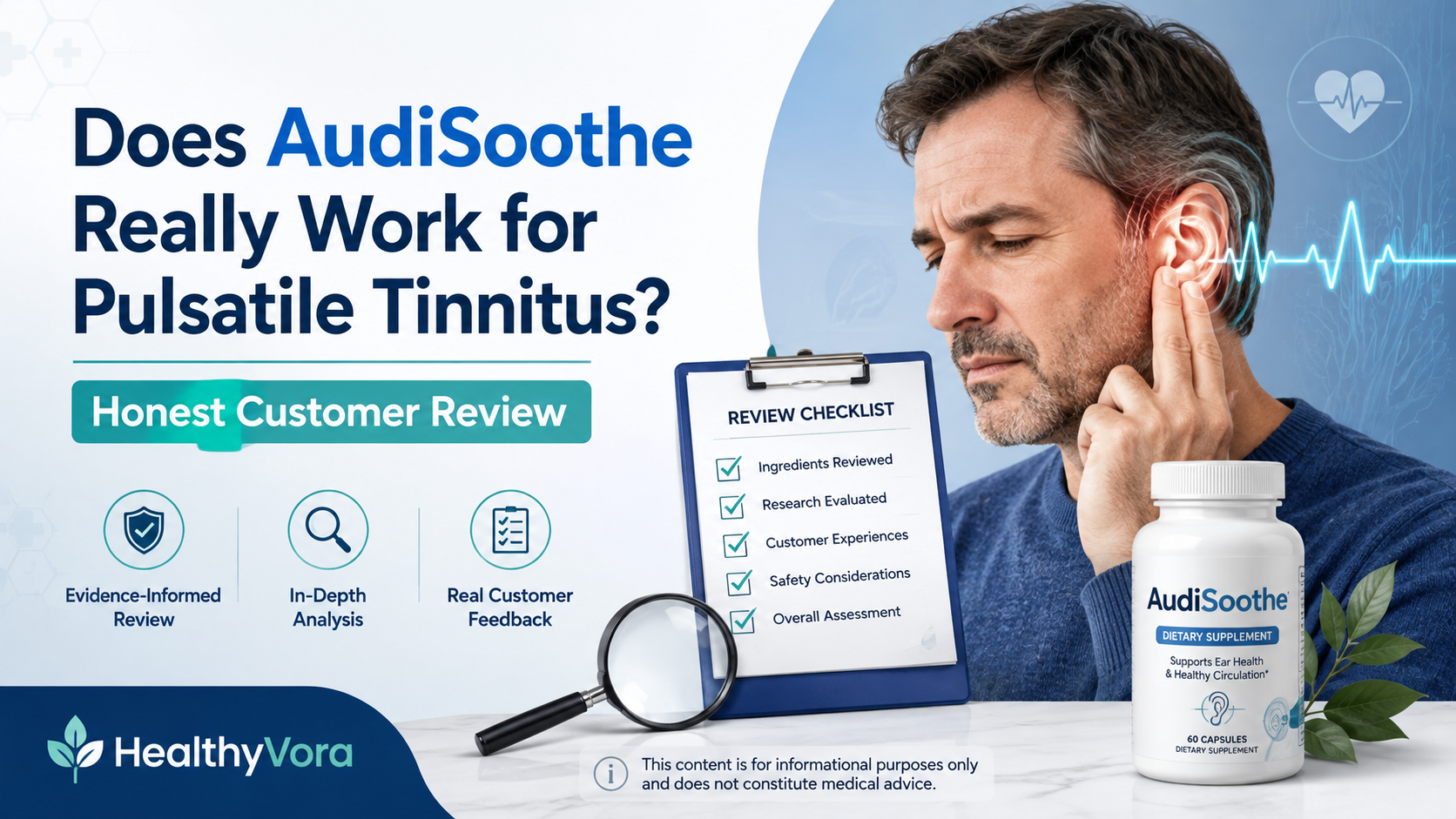
Does AudiSoothe Really Work for Pulsatile Tinnitus? Honest Customer Review
Does AudiSoothe really work for pulsatile tinnitus? Based on currently available medical evidence, there is not enough reliable clinical evidence to say that AudiSoothe can treat or eliminate pulsatile tinnitus. Products marketed under the AudiSoothe/Audifort name contain nutritional and botanical ingredients promoted for hearing support, but pulsatile tinnitus is different from ordinary ringing tinnitus because it can be related to blood flow, blood vessels, blood pressure, or another underlying medical condition.
For that reason, HealthyVora considers AudiSoothe something that should be evaluated as a dietary supplement—not as a replacement for an ENT examination, hearing assessment, or appropriate medical imaging. This review looks at what the product claims, what customers are saying, what the evidence actually supports, and what U.S. consumers should know before spending money.
Quick Answer: Does AudiSoothe Work for Pulsatile Tinnitus?
There is currently no good clinical evidence showing that AudiSoothe specifically treats pulsatile tinnitus. Some users of products promoted as AudiSoothe or Audifort report subjective improvements in ordinary tinnitus, sleep, or how noticeable their ear noise feels. Other users report little or no improvement. These experiences are anecdotal and cannot demonstrate that the supplement treats the underlying cause of pulsatile tinnitus.
If the sound in your ear beats or whooshes in time with your pulse, finding the underlying cause should come before trying to suppress the symptom with a supplement.
The National Institute on Deafness and Other Communication Disorders states that vitamins, herbal extracts, and dietary supplements commonly advertised for tinnitus have not been proven effective as tinnitus cures.
What Is AudiSoothe?
The name AudiSoothe can be confusing. Current online results associated with the AudiSoothe domain point toward a hearing-support product marketed as Audifort. The Audifort website describes a liquid dietary supplement containing more than 20 ingredients intended to support healthy hearing and general auditory wellness.
Ingredients highlighted by current Audifort product materials include maca root, grape seed extract, green tea, Capsicum annuum, Gymnema sylvestre, and GABA. Product marketing associates these ingredients with antioxidant protection, circulation, relaxation, and hearing support.
That distinction matters. Supporting general wellness is not the same thing as demonstrating that a formula can diagnose, treat, or cure tinnitus—especially pulsatile tinnitus.
What Is Pulsatile Tinnitus and Why Is It Different?
Pulsatile tinnitus is a rhythmic sound that usually follows the heartbeat. People often describe it as whooshing, pulsing, thumping, or hearing their heartbeat inside one or both ears.
Unlike many forms of subjective tinnitus associated with hearing loss or noise exposure, pulsatile tinnitus may involve changes in blood flow near the ear. Cleveland Clinic notes that potential causes can include high blood pressure, anemia, vascular abnormalities, atherosclerosis, hyperthyroidism, and idiopathic intracranial hypertension, among others.
This does not mean that everyone with pulsatile tinnitus has a dangerous condition. It means that the symptom deserves proper evaluation rather than automatically being treated as ordinary ringing in the ears.
Symptoms that deserve prompt medical attention
- A new sound synchronized with your heartbeat
- Pulsing or whooshing in only one ear
- Sudden onset of pulsatile tinnitus
- New dizziness or balance problems
- Visual changes
- New neurological symptoms
- Sudden hearing changes
Cleveland Clinic advises people experiencing sudden rhythmic sounds, one-sided pulsatile tinnitus, or pulsatile tinnitus accompanied by balance or vision problems to seek prompt medical attention.
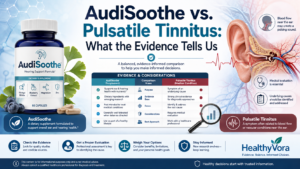
AudiSoothe vs. Pulsatile Tinnitus: What the Evidence Tells Us
| Question | Current Evidence |
|---|---|
| Is AudiSoothe a prescription treatment? | No. It is marketed as a dietary/hearing-support supplement. |
| Has AudiSoothe been proven to cure pulsatile tinnitus? | No reliable clinical evidence currently demonstrates this. |
| Can supplements replace diagnostic evaluation? | No, particularly when tinnitus follows the heartbeat. |
| Do some customers report improvement? | Yes, anecdotal reports exist, but results are mixed and cannot establish effectiveness. |
| Are dietary supplements FDA approved before sale? | No. The FDA generally does not approve dietary supplements for safety and effectiveness before marketing. |
The FDA explains that dietary supplements are regulated differently from drugs and generally are not approved for safety and effectiveness before reaching the marketplace. Consumers should therefore avoid interpreting phrases such as “manufactured in an FDA-registered facility” as meaning that the FDA has approved a product for treating tinnitus.
What Do AudiSoothe and Audifort Customer Reviews Really Say?
Online feedback should be interpreted cautiously. Search results contain promotional reviews, affiliate-style articles, Reddit discussions, and a relatively limited pool of clearly verified independent consumer feedback.
Some online users describe the ringing becoming less intrusive or say they noticed better sleep or less awareness of tinnitus after trying Audifort. At the same time, other publicly posted comments report no meaningful improvement or dissatisfaction with the purchasing or refund experience. These statements are individual experiences rather than controlled evidence.
Why customer testimonials cannot prove that AudiSoothe works
Tinnitus naturally fluctuates. Stress, sleep quality, blood pressure, background noise, attention, medication use, and other factors can influence how noticeable symptoms become.
If someone starts a supplement during a bad week and feels better several weeks later, it is impossible from the testimonial alone to know whether the improvement came from the supplement, natural variation, lifestyle changes, expectation effects, or treatment of another contributing factor.
This is why HealthyVora does not present individual customer testimonials as clinical proof.
Can AudiSoothe Ingredients Help Hearing Health?
Some ingredients promoted in the Audifort formula have legitimate nutritional or biological properties. For example, grape seed and green tea contain antioxidant compounds, while GABA is involved in inhibitory nervous-system signaling. However, evidence for an individual ingredient does not automatically demonstrate that a finished combination supplement treats tinnitus.
This distinction is especially important for pulsatile tinnitus. Improving general nutritional status is fundamentally different from correcting a blood-vessel abnormality, intracranial pressure problem, uncontrolled hypertension, or another potential medical cause.
The American Academy of Otolaryngology–Head and Neck Surgery guideline recommends against routinely recommending ginkgo biloba, zinc, or other dietary supplements as treatments for persistent bothersome tinnitus because evidence of meaningful benefit is inadequate.
Is AudiSoothe FDA Approved?
No dietary supplement should be described as FDA approved in the same way an FDA-approved medication is.
Manufacturers may operate facilities registered with the FDA and follow applicable manufacturing requirements, but facility registration does not establish that the FDA has independently proven a supplement effective for tinnitus.
FDA guidance makes clear that supplements are generally marketed without FDA preapproval for effectiveness.
U.S. consumers should treat claims such as “FDA registered,” “GMP manufactured,” and “FDA approved” as separate concepts rather than interchangeable endorsements.
Could AudiSoothe Be Worth Trying After Medical Evaluation?
For someone who has already been medically evaluated and wants to discuss a hearing-support supplement with a healthcare professional, the decision becomes more personal.
However, realistic expectations are essential. AudiSoothe should not be purchased with the assumption that it will eliminate the vascular or structural cause of pulsatile tinnitus.
A cautious decision process would be:
- Confirm that the sound actually follows your pulse.
- Discuss the symptom with a primary-care clinician or ENT specialist.
- Complete hearing testing if recommended.
- Complete medical or imaging evaluation if your clinician considers it necessary.
- Review the supplement’s current ingredient label.
- Check ingredients against medications and medical conditions.
- Only then decide whether nutritional supplementation makes sense for you.
NIDCD notes that clinicians may request MRI, CT, ultrasound, or other testing when tinnitus pulsates in order to investigate possible structural or medical causes.
Why Pulsatile Tinnitus Evaluation Matters in the United States
People searching for tinnitus relief in the United States have access to several appropriate starting points, including primary-care physicians, audiologists, ENT specialists, neurotologists, and—when indicated—vascular or neurological specialists. see also.
The American College of Radiology specifically treats pulsatile tinnitus differently from ordinary nonpulsatile tinnitus when determining whether imaging may be appropriate. Depending on examination findings, imaging options can include MRI/MRA or CT/CTA studies selected by the treating clinician.
The important point is not to request a particular scan yourself. It is to communicate clearly that the noise follows your heartbeat so your healthcare professional can choose the appropriate evaluation.
What Treatments Have Better Evidence for Tinnitus Management?
Treatment depends heavily on the type and cause of tinnitus. When an identifiable medical condition causes pulsatile tinnitus, treating that condition may reduce or eliminate the sound.
For persistent nonpulsatile tinnitus, commonly recommended management approaches may include:
- Hearing evaluation and hearing aids when hearing loss is present
- Sound therapy or background noise
- Cognitive behavioral therapy
- Tinnitus counseling and education
- Sleep and stress management
- Treatment of an identifiable medical, dental, or ear-related cause
NIDCD identifies sound therapy, hearing aids in appropriate patients, and behavioral approaches such as cognitive behavioral therapy among established tinnitus-management options.
Common Mistakes to Avoid Before Buying AudiSoothe
1. Assuming every type of tinnitus has the same cause
Heartbeat-synchronized tinnitus should not automatically be treated as ordinary ringing tinnitus.
2. Believing “natural” automatically means risk-free
Botanical ingredients and supplements can interact with medications or affect people with certain medical conditions. The FDA specifically advises discussing supplements with a healthcare professional because interactions and adverse effects can occur.
3. Treating testimonials as clinical evidence
A positive review can describe one person’s experience, but it cannot prove causation or predict your result.
4. Delaying medical evaluation
This is the biggest concern for someone with genuine pulsatile tinnitus. A supplement should never delay investigation of a new heartbeat-like ear sound.
5. Buying from an unclear website
Several similarly named domains and promotional pages appear in search results. Consumers should verify the current product name, seller, ingredients, payment processor, return policy, contact details, and checkout domain before providing payment information.
Why HealthyVora Takes a Cautious Approach to AudiSoothe Reviews
HealthyVora’s goal is to help readers distinguish between product marketing, customer experiences, and established medical evidence.
That distinction is particularly important with tinnitus products. A useful review should not promise silence, imply a guaranteed cure, or turn anecdotal testimonials into medical claims.
For AudiSoothe, the balanced conclusion is straightforward: the formula may interest consumers looking for general nutritional or hearing-support supplementation, but current evidence does not justify presenting it as a proven treatment for pulsatile tinnitus.
Final Verdict: Does AudiSoothe Really Work for Pulsatile Tinnitus?
AudiSoothe cannot currently be considered a proven treatment for pulsatile tinnitus. There are online reports of people experiencing changes in tinnitus after using products promoted under the AudiSoothe/Audifort name, but customer feedback is mixed and does not establish clinical effectiveness.
More importantly, pulsatile tinnitus deserves a different approach from ordinary ear ringing. Because the sound may be connected to blood flow or another identifiable health condition, the safest first step is professional evaluation.
If your physician has evaluated the underlying cause and you still want to consider a supplement, review the current ingredient label, medication interactions, seller information, and refund terms before purchasing. Keep expectations realistic and judge the product as a dietary supplement rather than a medical cure.
HealthyVora recommends making evidence, diagnosis, and safety your first filters when comparing tinnitus products. If you are considering AudiSoothe, use this review as a decision checklist and discuss the formula with a qualified U.S. healthcare professional before adding it to your routine.
Frequently Asked Questions About AudiSoothe and Pulsatile Tinnitus
1. Does AudiSoothe really work for pulsatile tinnitus?
There is currently no reliable clinical evidence proving that AudiSoothe treats pulsatile tinnitus or its underlying causes.
2. Can AudiSoothe stop the heartbeat sound in my ear?
It cannot be reliably expected to do so. Heartbeat-synchronized tinnitus should first be medically evaluated to determine why it is occurring.
3. Is AudiSoothe the same as Audifort?
Current online information indicates that AudiSoothe-related pages have been associated with the product marketed as Audifort, so consumers should carefully verify the exact product and seller before ordering.
4. What do AudiSoothe customer reviews say?
Public feedback is mixed. Some users describe subjective improvement, while others report little benefit or dissatisfaction. Anecdotal reviews cannot prove effectiveness.
5. Is AudiSoothe FDA approved?
No dietary supplement should be interpreted as FDA approved for treating tinnitus simply because it is produced in an FDA-registered facility. Supplements generally do not undergo FDA premarket approval for effectiveness.
6. What causes pulsatile tinnitus?
Possible causes include changes in blood flow, hypertension, anemia, vascular abnormalities, thyroid conditions, intracranial pressure disorders, and other conditions.
7. Should I see an ENT for pulsatile tinnitus?
Yes. A clinician can determine whether evaluation by an ENT, audiologist, or another specialist is appropriate and whether diagnostic imaging is necessary.
8. Are tinnitus supplements proven to work?
NIDCD states that commonly advertised vitamins, herbs, and supplements have not been proven effective as tinnitus cures.
9. Can supplements interact with medications?
Yes. Dietary supplements can interact with prescription or over-the-counter medications, so the FDA recommends discussing them with a healthcare professional.
10. What should I do before buying AudiSoothe?
First investigate pulsatile tinnitus medically. Then verify the product label, ingredients, seller, refund conditions, and potential medication interactions before deciding whether to buy.