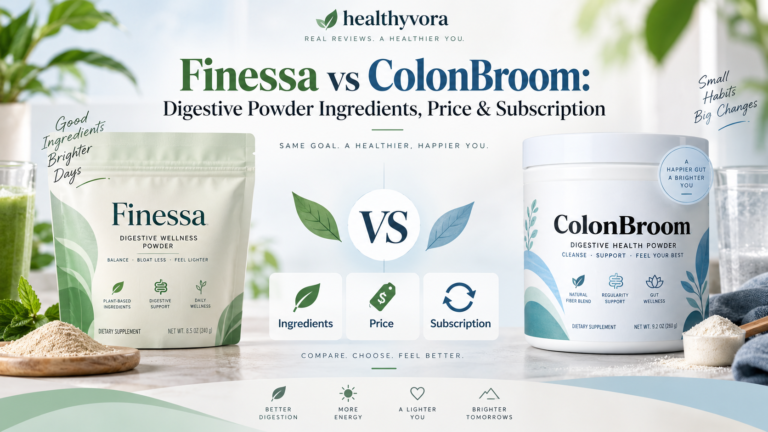

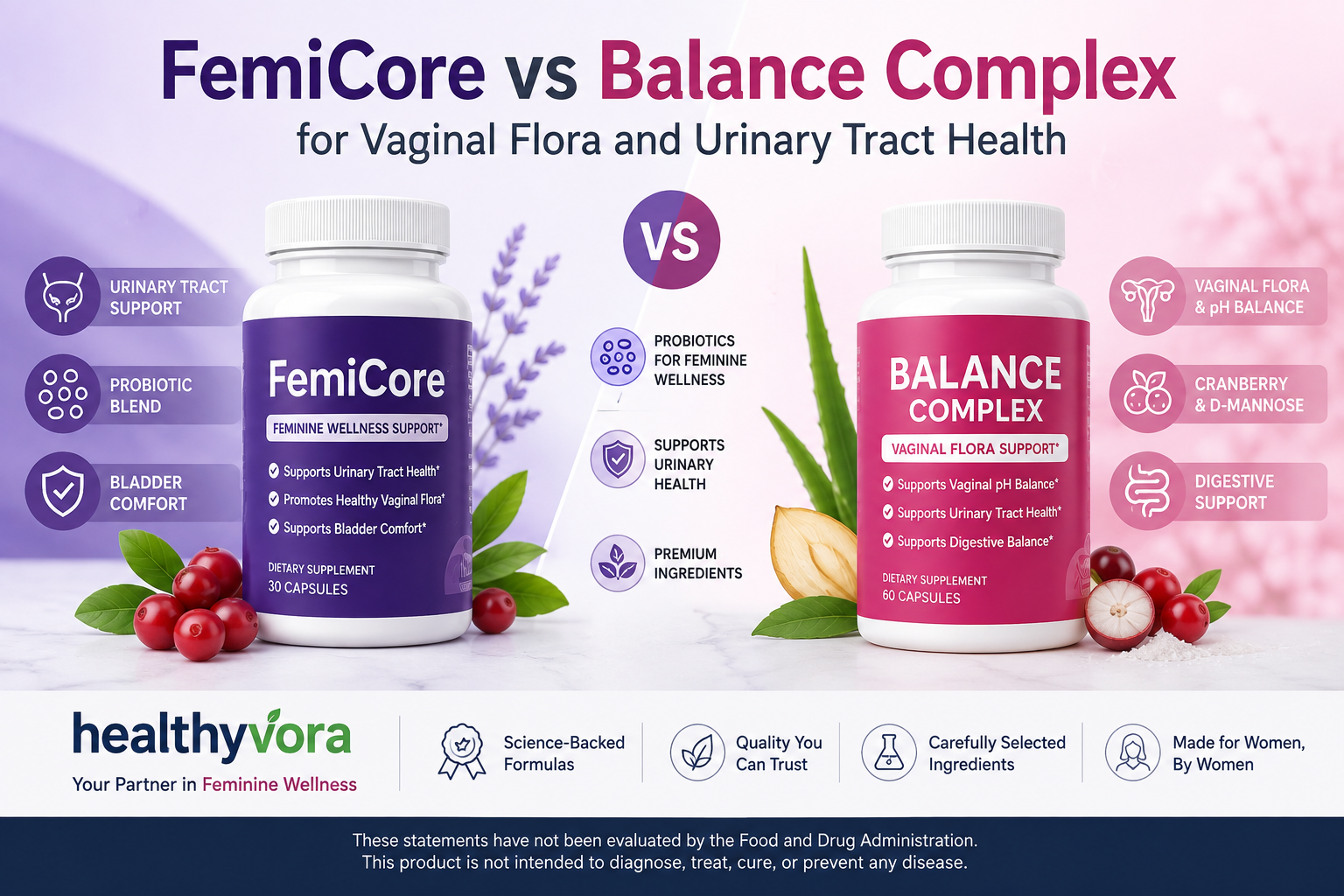
FemiCore vs Balance Complex for Vaginal Flora and Urinary Tract Health
FemiCore and Balance Complex take different approaches to women’s vaginal and urinary wellness. FemiCore is positioned primarily around the urinary microbiome, bladder comfort, and targeted Lactobacillus support, while Balance Complex combines vaginal probiotics with cranberry, D-mannose, botanicals, prebiotic support, and other ingredients in a broader feminine-wellness formula.
For women comparing FemiCore vs Balance Complex for vaginal flora and urinary tract health, the right choice depends less on which bottle has the longer ingredient list and more on what you actually want to support. At healthyvora, we recommend comparing probiotic strains, urinary-support ingredients, formula transparency, personal health needs, and evidence rather than relying on dramatic supplement claims.
ORDER TODAY
FemiCore vs Balance Complex: Quick Comparison
In short: FemiCore has a more targeted urinary-microbiome and bladder-support profile, while Balance Complex offers a broader vaginal-flora, urinary, and digestive-support formula.
| Feature | FemiCore | Balance Complex |
|---|---|---|
| Primary positioning | Urinary microbiome and bladder wellness | Vaginal flora, pH, urinary and gut support |
| Probiotic approach | Five Lactobacillus strains | Four Lactobacillus strains plus Bacillus coagulans |
| L. crispatus | Yes | Not listed in the current published formula |
| L. rhamnosus | Not listed in the formula reviewed | Yes |
| L. reuteri | Not listed in the formula reviewed | Yes |
| Cranberry | Yes | Yes |
| D-mannose | Not listed in the formula reviewed | Yes |
| Botanical support | Yes | Yes, with a larger supporting blend |
| Best suited to compare for | Targeted urinary/bladder and microbiome support | Broader vaginal flora plus urinary wellness support |
Formulas and labels can change. U.S. shoppers should always verify the current Supplement Facts panel before purchasing rather than relying solely on an older review or product comparison.
What Is FemiCore?
FemiCore is a women’s dietary supplement centered on bladder, urinary, and feminine microbiome support. Its published formula combines probiotic Lactobacillus species with several botanical ingredients.
The formula currently promoted by the brand includes Lactobacillus crispatus, Lactobacillus gasseri, Lactobacillus plantarum, Lactobacillus casei, and Lactobacillus acidophilus. Its botanical side includes cranberry extract, bearberry (uva ursi), berberine, and Mimosa pudica.
The standout difference is L. crispatus. Lactobacillus-dominant vaginal microbial communities are an important part of vaginal microbiome research, and L. crispatus is a particularly relevant species when discussing healthy vaginal ecology.
That does not mean simply consuming an oral product containing L. crispatus guarantees vaginal colonization or prevents infection. Species names, strain identity, viable dose, delivery method, and clinical evidence for the finished product all matter.
Who might be interested in FemiCore?
FemiCore may appeal most to women whose priority is a formula specifically positioned around the urinary microbiome and bladder wellness while still incorporating probiotics relevant to feminine flora.
What Is Balance Complex?
Balance Complex is a multi-ingredient feminine probiotic designed to support healthy vaginal flora, vaginal pH, urinary wellness, and digestive balance. Its formula takes a broader approach than a probiotic-only product.
The current formula lists Lactobacillus acidophilus, Lactobacillus rhamnosus, Lactobacillus reuteri, Lactobacillus plantarum, and Bacillus coagulans.
It also incorporates cranberry extract and D-mannose alongside ingredients such as caprylic acid, oregano, aloe vera, arabinogalactan, reishi, black walnut, anise, wormwood, and digestive enzymes.
This makes Balance Complex conceptually different from FemiCore. Rather than concentrating mainly on the urinary microbiome and bladder, it attempts to address several interconnected areas of feminine wellness through probiotics, urinary-support ingredients, botanicals, and gut-oriented components.
Who might be interested in Balance Complex?
Women looking for one broader formula covering vaginal flora plus urinary and digestive wellness may find Balance Complex more aligned with their goals, provided the ingredients are appropriate for them.
Which Is Better for Vaginal Flora?
There is no responsible basis for saying that either FemiCore or Balance Complex is universally better for vaginal flora. Their probiotic profiles differ, and the presence of more strains does not automatically mean better clinical results.
FemiCore’s notable feature is L. crispatus together with L. gasseri, L. plantarum, L. casei, and L. acidophilus. Balance Complex instead combines L. acidophilus, L. rhamnosus, L. reuteri, L. plantarum, and B. coagulans.
This distinction matters because probiotic evidence can be strain-specific. Consumers should not assume that research involving one Lactobacillus strain proves that every product containing the same species will produce the same outcome.
A better probiotic comparison asks “Which exact organisms, strains, viable doses, and supporting ingredients am I getting?” rather than simply “Which product has more probiotics?”
Women experiencing strong vaginal odor, abnormal discharge, itching, burning, pain, or recurrent symptoms should also avoid using supplements as a substitute for diagnosis. Similar symptoms can have different causes and therefore require different treatment.
Which Is Better for Urinary Tract Health?
Both formulas contain urinary-health components, but they approach the goal differently. FemiCore emphasizes probiotics and botanicals, whereas Balance Complex includes probiotics alongside cranberry and D-mannose.
Cranberry is an important point of overlap
Both products include cranberry. Cranberry products have been studied extensively for recurrent UTI prevention, particularly because proanthocyanidins (PACs) may interfere with bacterial adhesion to urinary tract tissue.
A major Cochrane systematic review found evidence that cranberry products can reduce the risk of symptomatic, culture-verified UTIs in women with recurrent UTIs. Importantly, cranberry is considered a preventive option rather than a treatment for an infection that is already present.
D-mannose gives Balance Complex a different profile
Balance Complex also contains D-mannose, an ingredient frequently marketed for urinary wellness. However, shoppers should be careful with claims surrounding it.
A large randomized clinical trial published in JAMA Internal Medicine in 2024 found that daily D-mannose did not significantly reduce medically attended recurrent UTIs compared with placebo in women recruited through primary care.
Therefore, the presence of D-mannose can distinguish a formula, but it should not automatically be interpreted as proof that the product will prevent recurrent UTIs.
FemiCore vs Balance Complex Ingredients: What Matters Most?
Instead of judging either supplement by ingredient count alone, evaluate the formula in layers.
- Check the probiotic organisms and strains. Look beyond generic statements such as “probiotic blend.”
- Review viable probiotic quantities. A large number printed on marketing material is less useful if viability through shelf life is unclear.
- Examine cranberry standardization. Cranberry products can vary substantially in their PAC content.
- Consider every botanical. A larger formula creates more potential for interactions and contraindications, not just more potential benefits.
- Check serving size and daily practicality. A supplement that fits your routine is easier to take consistently.
- Look for quality information. Manufacturing standards, testing, ingredient sourcing, and label transparency deserve attention.
Why Vaginal Flora and Urinary Health Are Connected
Vaginal and urinary health are biologically related because nearby microbial ecosystems can influence urogenital health. Beneficial Lactobacillus species are particularly important in discussions about the vaginal microbiome.
A Lactobacillus-dominant vaginal environment commonly produces lactic acid and helps maintain the acidic conditions associated with healthy vaginal flora. Changes in this ecosystem can occur for many reasons, including antibiotics, hormonal changes, sexual activity, menopause, illness, and individual microbiome differences.
This is why modern feminine-health supplements increasingly combine concepts such as the vaginal microbiome, urinary microbiome, gut-vagina axis, cranberry compounds, and targeted probiotics.
However, microbiome science is more complex than “adding good bacteria.” Whether an orally consumed organism survives digestion, reaches an ecologically relevant site, persists there, and produces a meaningful clinical effect depends on the specific product and organism.
Why This Comparison Matters for Women in the United States
Women shopping online in the United States can find a rapidly growing number of products marketed for vaginal pH, bladder comfort, feminine probiotics, urinary wellness, and microbiome support. The marketing language can make these products appear more medically established than they actually are.
Under the U.S. regulatory framework, dietary supplements are not approved by the FDA in the same way drugs are approved before marketing. Supplement structure/function claims must meet applicable requirements, and products making such claims carry the required disclaimer explaining that the statements have not been evaluated by the FDA and that the product is not intended to diagnose, treat, cure, or prevent disease.
Whether you are shopping from New York, California, Texas, Florida, or elsewhere in the U.S., that distinction matters. “Supports urinary health” is fundamentally different from “treats a UTI.”
Can FemiCore or Balance Complex Treat a UTI?
No dietary supplement should be relied upon to treat an active urinary tract infection. A UTI is a medical condition, and supplements containing probiotics, cranberry, D-mannose, or herbs should not delay appropriate evaluation and treatment.
Seek medical care if you develop symptoms such as painful or burning urination, persistent urinary urgency or frequency, blood in the urine, worsening pelvic discomfort, fever, chills, back or flank pain, or symptoms that persist or rapidly worsen.
Pregnancy, recurrent infections, kidney problems, and complicated urinary conditions are additional reasons to involve a healthcare professional rather than self-treating with supplements.
Can These Supplements Treat BV or Yeast Infections?
Probiotic supplements should not be treated as replacements for established medical treatment for bacterial vaginosis or a yeast infection.
The CDC’s bacterial vaginosis treatment guidance notes that studies have examined intravaginal Lactobacillus and other probiotic formulations, but available evidence does not support these products as an adjunctive or replacement therapy for women with BV.
This distinction is important when reading supplement advertising. Supporting a healthy microbiome is a wellness claim; treating a diagnosed infection is a medical claim.
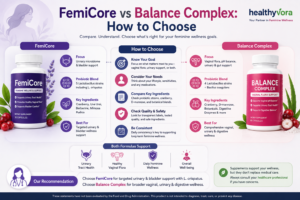
FemiCore vs Balance Complex: How to Choose
Choose according to your primary wellness goal and the formula details rather than brand claims alone.
FemiCore may be worth considering if:
- Your main interest is urinary microbiome and bladder wellness support.
- You specifically want a formula containing L. crispatus.
- You prefer a more targeted probiotic-plus-botanical concept.
- You do not specifically need D-mannose in the same product.
Balance Complex may be worth considering if:
- Your primary interest includes vaginal flora and pH support.
- You want L. rhamnosus and L. reuteri in the probiotic profile.
- You want cranberry and D-mannose in one formula.
- You prefer a broader formula combining vaginal, urinary, and gut-oriented ingredients.
These are formula-based distinctions, not guarantees of better outcomes.
ORDER TODAY
What to Check Before Buying Either Supplement
Before choosing FemiCore, Balance Complex, or another women’s probiotic in the United States, review the current label carefully.
- Confirm the complete Supplement Facts panel.
- Check probiotic species, strains, and potency information.
- Look for transparent cranberry extract and PAC information.
- Review allergens and inactive ingredients.
- Check storage requirements and expiration information.
- Consider independent quality or purity testing where documented.
- Check whether any botanical ingredients interact with your medications.
- Ask a healthcare professional before use during pregnancy or breastfeeding.
People taking prescription medications or managing chronic medical conditions should be especially cautious with complex herbal formulas because “natural” does not mean interaction-free.
Common Mistakes When Comparing Vaginal and Urinary Supplements
Assuming more CFUs automatically means a better probiotic
CFU count is only one variable. Strain selection, viability, formulation, storage, and clinical evidence also matter.
Treating every Lactobacillus as interchangeable
Probiotic effects can be strain-specific. Evidence for one organism or strain cannot automatically be transferred to another.
Using supplements to self-treat persistent symptoms
Burning, discharge, odor, itching, urgency, and pelvic discomfort can have multiple causes. Correct diagnosis comes before supplementation.
Believing every D-mannose claim
Recent randomized evidence has challenged earlier enthusiasm around D-mannose for recurrent UTI prevention. Marketing should be interpreted in light of current research.
Ignoring botanical ingredients
Probiotics may dominate the product name, but herbal components can be equally important when assessing tolerability, pregnancy considerations, and medication interactions.
Why Use healthyvora When Comparing Feminine Health Products?
healthyvora helps consumers evaluate feminine wellness products by focusing on meaningful formula differences rather than simply repeating marketing claims.
For comparisons such as FemiCore vs Balance Complex, that means looking at the probiotic profile, vaginal microbiome relevance, urinary-support ingredients, formulation complexity, evidence limitations, and practical considerations that can affect the buying decision. see also.
This evidence-aware approach is particularly useful in the U.S. supplement market, where consumers often need to distinguish between legitimate structure/function support and claims that sound like promises to treat disease.
FemiCore vs Balance Complex: Final Verdict
FemiCore is the more targeted option conceptually for women prioritizing urinary microbiome and bladder-oriented support, particularly those interested in a formula containing L. crispatus. Balance Complex is the broader option for women looking for vaginal-flora support combined with urinary and gut-oriented ingredients, including L. rhamnosus, L. reuteri, cranberry, and D-mannose.
Neither formula can responsibly be declared universally superior. The best choice depends on your goal, health history, medications, tolerance for complex botanical formulas, and the exact current product label.
Most importantly, supplements belong in the category of supportive wellness—not diagnosis or treatment. Symptoms suggesting a UTI, BV, yeast infection, or another urogenital condition deserve appropriate medical evaluation.
For a clearer side-by-side look at feminine probiotics and urinary wellness formulas available to U.S. consumers, explore healthyvora’s product comparisons and ingredient guides before making your next choice.
Frequently Asked Questions
1. Is FemiCore better than Balance Complex?
Neither is universally better. FemiCore is more focused on urinary microbiome and bladder support, while Balance Complex offers a broader vaginal, urinary, and gut-oriented formula.
2. Which is better for vaginal flora, FemiCore or Balance Complex?
Both contain probiotics relevant to feminine microbiome support. FemiCore includes L. crispatus, while Balance Complex includes L. rhamnosus and L. reuteri. The better choice depends on the exact strain-level formula and your needs.
3. Does FemiCore contain Lactobacillus crispatus?
Yes. The FemiCore formula reviewed for this comparison lists L. crispatus among its five Lactobacillus species.
4. Does Balance Complex contain D-mannose?
Yes. Balance Complex currently lists D-mannose as part of its broader feminine-health formula.
5. Which product contains cranberry?
Both FemiCore and Balance Complex contain cranberry-derived ingredients intended for urinary wellness support.
6. Can either supplement cure a UTI?
No. Dietary supplements should not be used to cure or treat an active UTI. Seek appropriate medical care when UTI symptoms occur.
7. Can probiotics treat bacterial vaginosis?
Probiotic supplements should not replace recommended medical treatment for BV. The CDC does not currently support probiotic products as replacement or adjunctive BV therapy based on available evidence.
8. Is cranberry useful for urinary tract health?
Evidence suggests cranberry products may reduce recurrent symptomatic UTIs in some women, but cranberry does not treat an active UTI and formulations vary considerably.
9. Is D-mannose proven to prevent recurrent UTIs?
Evidence is mixed. A large 2024 randomized trial found that daily D-mannose did not significantly prevent medically attended recurrent UTIs compared with placebo.
10. Should I ask my doctor before taking a vaginal or urinary supplement?
It is especially advisable if you are pregnant, breastfeeding, taking medications, have recurrent urinary or vaginal symptoms, or have an underlying medical condition.
Medical and Regulatory Note
This article is educational and does not provide medical advice, diagnosis, or treatment. Dietary supplements are not substitutes for professional evaluation of urinary or vaginal symptoms.
These statements have not been evaluated by the Food and Drug Administration. This product is not intended to diagnose, treat, cure, or prevent any disease.