
Pineal Guardian vs Pineal XT Third Eye Decalcification Ingredients Test
Pineal Guardian and Pineal XT take noticeably different approaches to pineal gland supplements, but neither can currently be described as scientifically proven to decalcify the pineal gland or “activate the third eye.” Pineal Guardian’s current product information emphasizes botanical, mushroom, algae, and cognitive-support ingredients, while Pineal XT combines iodine with herbs, mushrooms, algae, and antioxidant ingredients. For U.S. consumers, the most important comparison is therefore not which product makes the strongest claims, but which provides the clearest label, appropriate dosages, credible quality testing, and an ingredient profile suitable for the individual.
This HealthyVora comparison performs an ingredient and label-transparency test rather than claiming to be an independent laboratory analysis. We compare the formulas currently presented online, examine their proposed roles, identify safety considerations, and separate legitimate pineal-gland science from marketing language surrounding “third eye activation” and “decalcification.”
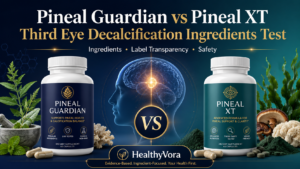
Pineal Guardian vs Pineal XT: Quick Answer
Pineal Guardian appears more focused on general cognitive and antioxidant support, while Pineal XT has a more explicitly pineal-targeted formula that includes iodine. However, current product pages create transparency questions that consumers should resolve by checking the physical Supplement Facts label before purchasing.
| Comparison Point | Pineal Guardian | Pineal XT |
|---|---|---|
| Formula style | Botanicals, algae, mushrooms, cognitive-support ingredients | Iodine, botanicals, mushroom, algae, antioxidant ingredients |
| Ingredients currently listed online | Nine named ingredients on the reviewed page | Seven named ingredients visible on the reviewed page, although its FAQ refers to nine |
| Shared ingredient | Chlorella | Chlorella |
| Notable safety consideration | Ginkgo can interact with anticoagulants and some medications | Iodine intake requires particular attention in people with thyroid conditions |
| Human evidence for pineal decalcification | Not established | Not established |
| Best next step | Verify current Supplement Facts and exact doses | Verify current Supplement Facts, iodine dose, and exact formula |
What Is Pineal Gland Decalcification?
Pineal gland calcification is a real biological phenomenon, but “pineal decalcification” through dietary supplements is not an established medical treatment. The pineal gland is a small neuroendocrine structure involved in melatonin production and circadian timing. Calcium-containing deposits can develop within it, and research has investigated relationships among calcification, aging, melatonin production, and neurological health.
The crucial distinction is that evidence showing pineal calcification exists does not automatically prove that a commercial supplement can reverse it. Current medical literature has not established an oral supplement protocol that reliably removes existing pineal calcium deposits in humans. Some published discussions about reversing calcification remain theoretical or experimental rather than validated clinical treatments.
For this reason, HealthyVora treats “decalcification” as a claim that requires evidence—not as an assumed benefit of chlorella, iodine, turmeric, herbs, or any branded supplement.
Is the “third eye” the same thing as the pineal gland?
No. The pineal gland is a physical endocrine structure in the brain. The “third eye” is primarily a spiritual, philosophical, or metaphysical concept. Although the terms are frequently connected in wellness marketing, third-eye activation is not a recognized clinical outcome that can be measured in the same way as melatonin levels, sleep timing, blood biomarkers, or medical imaging.
Pineal Guardian Ingredients Test
The current Pineal Guardian page reviewed for this comparison lists nine ingredients: Pine Bark Extract, Tamarind, Chlorella, Ginkgo Biloba, Spirulina, Lion’s Mane, Bacopa Monnieri, Moringa, and Neem.
Pine Bark Extract
Pine bark extracts contain antioxidant compounds and are commonly marketed for circulation and oxidative-stress support. That makes the ingredient relevant to general wellness discussions, but it should not be interpreted as evidence of direct pineal-gland decalcification.
Tamarind
Tamarind is a fruit containing polyphenols and other naturally occurring compounds. Pineal-health marketing sometimes connects tamarind with detoxification, yet consumers should distinguish broad nutritional properties from clinical evidence demonstrating removal of calcium deposits from the pineal gland.
Chlorella and Spirulina
Chlorella and spirulina are nutrient-rich microalgae frequently used in wellness supplements. Chlorella has also been investigated in limited human research involving environmental or heavy-metal exposure, but such studies do not demonstrate that chlorella specifically decalcifies the human pineal gland.
Ginkgo Biloba
Ginkgo is widely marketed for memory and brain health. However, evidence for improving cognitive performance in healthy adults remains uncertain. U.S. consumers taking anticoagulants should be especially cautious because the National Center for Complementary and Integrative Health notes that ginkgo may increase bleeding risk and can interact with medications.
Lion’s Mane and Bacopa Monnieri
These ingredients place Pineal Guardian closer to the broader nootropic and cognitive-support category. Lion’s Mane mushroom is widely researched for neurological applications, while Bacopa has a history of traditional use related to cognition. Neither ingredient, however, should be presented as clinically proven to remove pineal calcification.
Moringa and Neem
Moringa and neem contribute additional plant compounds to the formula. Their inclusion may fit an antioxidant or traditional-herbal positioning, but the relevance of these botanicals to actual pineal mineral deposits remains unproven. see also.
Pineal XT Ingredients Test
The Pineal XT page reviewed by HealthyVora currently displays Iodine, “Alma Extract,” Chaga Mushroom, Schisandra Powder, Turmeric, Chlorella Powder, and Burdock Powder. Another Pineal XT promotional page uses the spelling “Amla Extract.” Importantly, the main site’s FAQ says the supplement contains nine ingredients even though seven named ingredients are visible in its ingredient section. That discrepancy makes checking the physical Supplement Facts panel particularly important.
Iodine
Iodine distinguishes Pineal XT from the reviewed Pineal Guardian formula. It is an essential nutrient required for normal thyroid hormone production, but more is not necessarily better. The NIH Office of Dietary Supplements lists an adult tolerable upper intake level of 1,100 micrograms per day from all sources for people not receiving iodine medically. Excessive iodine intake can disrupt thyroid function.
Anyone with thyroid disease, anyone using thyroid medication, or anyone already taking iodine-containing supplements should therefore verify the actual iodine dose before adding Pineal XT.
Amla/“Alma” Extract
Amla, also known as Indian gooseberry, contains antioxidant compounds and vitamin C. Because different promotional pages use different spellings, buyers should rely on the bottle label to establish the actual ingredient identity rather than assuming two sales pages necessarily represent the same production batch.
Chaga Mushroom
Chaga is a mushroom commonly marketed as an antioxidant ingredient. Its presence may complement a general wellness formula, but there is no established human clinical evidence showing that consuming chaga reverses pineal calcification.
Schisandra
Schisandra is commonly categorized as an adaptogenic botanical and is used in traditional herbal practices. Its role is more plausibly related to general wellness positioning than to a proven mechanism for physically removing calcium from the pineal gland.
Turmeric
Turmeric and its constituent curcumin have been extensively studied, particularly in inflammation-related research. However, the NCCIH notes that evidence is still insufficient to reach definitive conclusions for many promoted health uses. Highly bioavailable curcumin preparations have also been linked to reports of liver injury in some individuals.
Chlorella and Burdock
Chlorella appears in both Pineal XT and Pineal Guardian, making it the clearest overlap between the formulas reviewed here. Burdock is a traditional botanical commonly associated with general wellness and “detox” marketing. Neither ingredient currently provides direct clinical proof of pineal decalcification.
Which Formula Looks Better for Third Eye Decalcification?
Neither Pineal Guardian nor Pineal XT can currently win a science-based “decalcification” comparison because reliable human evidence demonstrating that either finished product removes pineal calcification has not been established.
A more useful comparison asks what each formula is actually designed around.
- Pineal Guardian leans toward cognitive support through ingredients such as Ginkgo biloba, Lion’s Mane, Bacopa, pine bark, and nutrient-rich algae.
- Pineal XT leans toward the pineal-detox marketing category through iodine, chlorella, turmeric, schisandra, chaga, and burdock.
- Both products contain ingredients with broader nutritional or wellness research, but ingredient-level research cannot automatically be transferred to claims about the finished supplement.
- Neither formula should be described as clinically proven to activate psychic abilities, open a third eye, or reverse calcium deposits.
If your main priority is cognitive-oriented ingredients, Pineal Guardian’s listed formula is arguably more directly aligned with that category. If you specifically want iodine-containing supplementation, Pineal XT is the formula that currently lists it—but that also creates additional thyroid-related considerations.
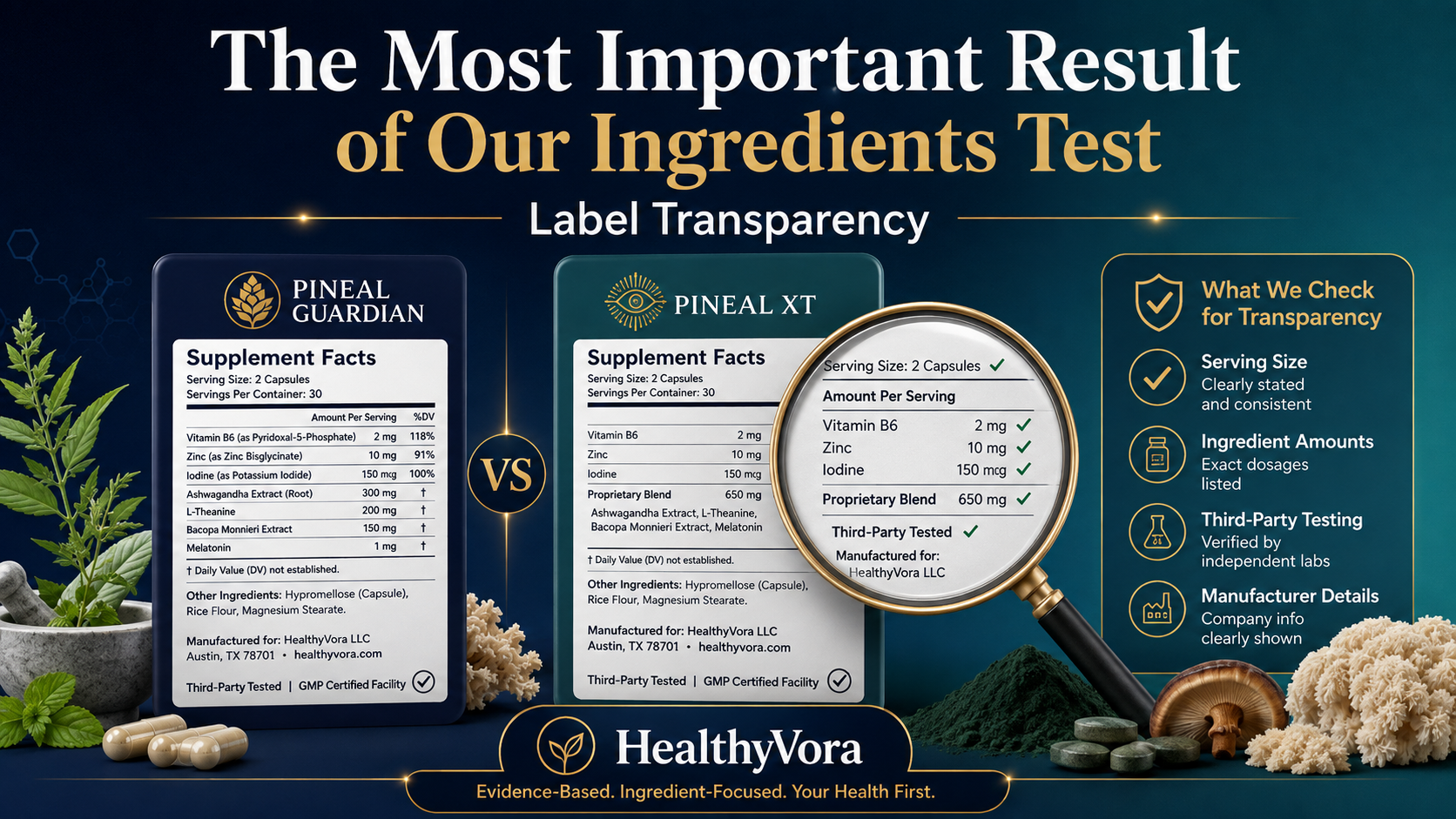
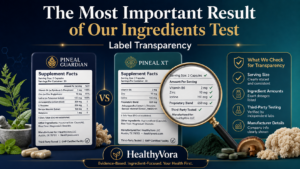
The Most Important Result of Our Ingredients Test: Label Transparency
Ingredient names alone are not enough to judge a dietary supplement. Exact amounts, extract standardization, serving size, manufacturing controls, contaminants, and independent testing can matter as much as the ingredient list.
Before choosing either supplement, use this five-step label test:
- Read the physical Supplement Facts panel. Do not depend exclusively on an affiliate review or promotional page.
- Confirm the exact dose of every ingredient. An impressive ingredient can be difficult to evaluate when the quantity is undisclosed.
- Look for standardized extracts where relevant. Two supplements containing the same herb can deliver substantially different preparations.
- Ask for current third-party testing or a Certificate of Analysis. Look for information tied to a specific lot rather than a generic “tested for purity” statement.
- Check interactions with medications and existing supplements. This is particularly important with ingredients such as iodine and Ginkgo biloba.
 Visit Official Website
Why This Comparison Matters for Supplement Buyers in the United States
U.S. consumers should understand an important regulatory distinction: dietary supplements are not approved by the FDA in the same way prescription drugs are approved before marketing. Companies are responsible for meeting applicable safety and labeling requirements, and structure/function claims must be truthful, non-misleading, and appropriately substantiated. FDA guidance also distinguishes legitimate structure/function statements from claims that would imply treatment, cure, prevention, or diagnosis of disease.
This is especially important in highly promotional categories such as “third eye supplements,” where scientific terminology can become mixed with spiritual concepts. Whether you are shopping from New York, California, Texas, Florida, or elsewhere in the United States, phrases such as “natural,” “detox,” “pineal activation,” or “tested for purity” should never replace examination of the actual label and evidence.
Why Use HealthyVora When Comparing Pineal Supplements?
HealthyVora’s approach is designed around a simple principle: evaluate what can actually be verified before evaluating what is promised. In a supplement category filled with dramatic language, this means separating four different questions that are often incorrectly combined:
- Does an ingredient have general nutritional or biological activity?
- Has that ingredient been studied in humans?
- Was the specific claimed outcome—such as pineal decalcification—actually measured?
- Has the finished commercial formula been independently demonstrated to produce that outcome?
This framework helps readers compare Pineal Guardian, Pineal XT, and similar products without automatically accepting marketing claims or dismissing every botanical ingredient simply because stronger research is still needed.
Safety Tips Before Choosing Pineal Guardian or Pineal XT
Dietary supplements can still produce side effects and medication interactions even when their ingredients are described as natural.
- Discuss supplementation with a healthcare professional if you use prescription medication.
- Check with a clinician before using iodine supplements if you have a thyroid disorder.
- Use extra caution with Ginkgo biloba if you take anticoagulant or antiplatelet medication.
- Avoid stacking multiple supplements containing the same ingredients without calculating the combined dose.
- Do not stop prescribed calcium, thyroid, sleep, or neurological treatment in an attempt to “decalcify” the pineal gland.
- Pregnant or breastfeeding consumers should seek professional guidance before using multi-herbal formulas.
Common Mistakes When Comparing Third Eye Supplements
1. Assuming detoxification means decalcification
A substance having antioxidant, chelating, or detox-related research does not establish that it physically removes calcium deposits from the pineal gland.
2. Looking only at the number of ingredients
Nine ingredients are not automatically better than seven. Dose, identity, standardization, purity, and formulation quality matter more than ingredient count.
3. Treating spiritual claims as medical endpoints
People are free to explore spiritual practices, but “third eye activation” should not be presented as a medically verified consequence of taking a supplement.
4. Ignoring dosage information
An ingredient list without quantities gives consumers less information for evaluating effectiveness, interactions, and safety.
5. Assuming “FDA compliant” means “FDA approved”
Dietary supplement regulation in the United States does not mean every supplement or advertised benefit has received FDA premarket approval. FDA explicitly notes that structure/function claims on dietary supplements are generally not approved by the agency before products are sold.
Pineal Guardian vs Pineal XT: Final Verdict
The ingredient test produces no scientifically defensible winner for pineal gland decalcification. Pineal Guardian currently presents a broader cognitive-support formula featuring Ginkgo, Lion’s Mane, Bacopa, pine bark, algae, and other botanicals. Pineal XT presents a different combination built around iodine, chlorella, turmeric, chaga, schisandra, burdock, and amla/“alma.”
Pineal Guardian may make more sense to someone primarily comparing botanical cognitive-support ingredients. Pineal XT may appeal to consumers specifically searching for an iodine-containing pineal formula, although iodine makes verifying the dose and individual thyroid suitability especially important.
For the narrower question—which one is proven to decalcify the pineal gland or activate the third eye?—the answer is neither. Current evidence does not establish that either finished supplement reliably reverses human pineal calcification.
The strongest buying decision is therefore based on transparent Supplement Facts, appropriate dosages, medication compatibility, quality documentation, realistic expectations, and professional guidance when needed.
HealthyVora CTA: Before choosing Pineal Guardian, Pineal XT, or another pineal-support supplement, use HealthyVora’s evidence-first comparisons to examine the ingredients, safety considerations, label transparency, and strength of the claims. A careful comparison is a more useful next step than relying on the boldest “third eye” promise.
Frequently Asked Questions
1. Is Pineal Guardian better than Pineal XT?
Neither is universally better. Pineal Guardian currently has a more cognitive-oriented botanical profile, while Pineal XT includes iodine and several ingredients commonly marketed for detox and pineal support.
2. Can Pineal Guardian decalcify the pineal gland?
There is currently no reliable human clinical evidence proving that Pineal Guardian reverses pineal gland calcification.
3. Does Pineal XT really decalcify the pineal gland?
No scientifically established human evidence currently demonstrates that the finished Pineal XT formula removes pineal calcium deposits.
4. What ingredients are in Pineal Guardian?
The reviewed page lists pine bark extract, tamarind, chlorella, Ginkgo biloba, spirulina, Lion’s Mane, Bacopa monnieri, moringa, and neem.
5. What ingredients are in Pineal XT?
The current page displays iodine, Alma/Amla extract, chaga mushroom, schisandra, turmeric, chlorella powder, and burdock powder. Buyers should verify the current bottle label.
6. What ingredient do Pineal Guardian and Pineal XT share?
Chlorella is the most obvious shared ingredient in the formulas currently presented online.
7. Is pineal gland calcification real?
Yes. Pineal calcification is documented medically and can be observed on imaging, although its clinical significance varies and continues to be researched.
8. Is “third eye activation” scientifically proven?
No. Third-eye activation is a spiritual or metaphysical concept rather than an established medical endpoint.
9. Is iodine safe in a pineal supplement?
Iodine is an essential nutrient, but excessive intake can affect thyroid function. Consumers should check the dose and consider their total iodine intake.
10. What should I check before buying a pineal gland supplement?
Check the Supplement Facts, exact dosages, ingredient standardization, manufacturer information, third-party testing, medication interactions, and whether advertised benefits are supported by human evidence.