
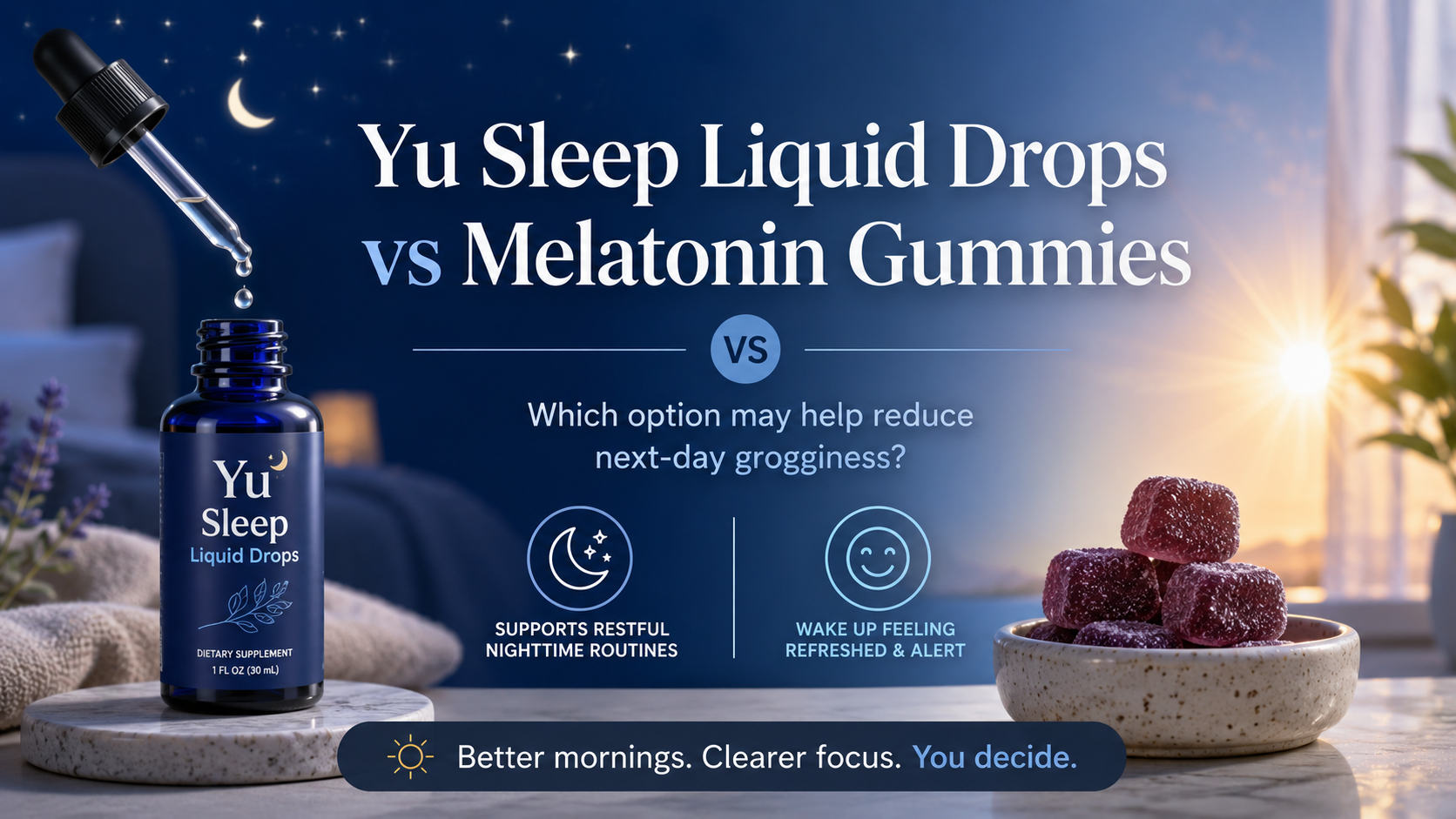
yu sleep liquid drops vs melatonin gummies no next day hangover
If you are comparing Yu Sleep liquid drops with melatonin gummies because you want better sleep without feeling foggy the next morning, the most important difference is not simply liquid versus gummy. Melatonin dose, timing, other ingredients, your individual sensitivity, and how many hours you can sleep all influence next-day alertness. Yu Sleep currently lists 0.9 mg of melatonin per two-dropper serving, while melatonin gummies sold in the United States can contain a wide range of doses. For readers comparing sleep products through healthyvora, the practical goal should be finding the lowest appropriate, clearly labeled option that supports sleep without unnecessarily increasing morning drowsiness.
ORDER NOW
Yu Sleep Drops vs Melatonin Gummies: Quick Answer
Yu Sleep may appeal to adults trying to limit melatonin exposure because its current formula lists 0.9 mg of melatonin per serving. However, neither Yu Sleep nor any melatonin gummy can guarantee “no next-day hangover.” Morning grogginess is possible with melatonin and depends on dose, timing, individual response, other ingredients, medications, and sleep duration.
According to Yu Sleep’s August 2026 product disclosure, a two-dropper, 2 mL serving contains 0.9 mg of melatonin plus vitamins B2 and B6 and a proprietary blend containing red tart cherry, magnesium glycinate, apigenin, lemon balm, 5-HTP, L-theanine, and GABA. The individual amounts of the seven proprietary-blend ingredients are not separately disclosed.
The National Center for Complementary and Integrative Health notes that sleepiness is a possible side effect of melatonin and that information about long-term supplementation remains limited. Mayo Clinic also identifies persistent sedation into the next morning as a possible issue, especially when the dose is too high for the individual.
What Is Yu Sleep Liquid?
Yu Sleep is a liquid dietary supplement designed for nighttime use. Its current directions specify two full droppers, approximately 2 mL, about 30 minutes before bedtime. That serving provides 0.9 mg of melatonin.
The current formula also combines several nutrients, botanical ingredients, and amino-acid-related compounds. These include magnesium glycinate, L-theanine, GABA, lemon balm, apigenin, tart cherry concentrate, and 5-HTP.
This combination distinguishes Yu Sleep from a basic melatonin gummy containing only melatonin plus flavoring and gummy ingredients. It also means consumers should evaluate the entire formula rather than looking only at the melatonin number.
Does the liquid format automatically make Yu Sleep better?
No. A liquid format can be convenient for people who dislike swallowing pills and may make serving measurement easier, but being liquid does not by itself prove that a sleep supplement produces better sleep or less morning grogginess than a gummy.
The more useful comparison is the complete ingredient profile, dose, product quality, timing, and your personal response.
What Are Melatonin Gummies?
Melatonin gummies are chewable dietary supplements containing melatonin, a hormone naturally involved in regulating circadian rhythm and the sleep-wake cycle. Your brain normally produces melatonin in response to darkness. Supplemental melatonin can provide an additional sleep-timing signal.
Gummies are popular because they are simple to take and usually have a pleasant flavor. The downside is that melatonin concentration varies substantially among products, so comparing one gummy brand with another requires reading the Supplement Facts panel rather than assuming all gummies provide similar doses.
A 2023 JAMA analysis of 25 melatonin gummy products available in the United States found substantial differences between labeled and measured melatonin quantities. Among products containing melatonin, measured amounts ranged from 74% to 347% of the labeled quantity. The researchers emphasized that the study was relatively small and evaluated gummies specifically, so its results should not be generalized to every supplement on the U.S. market.
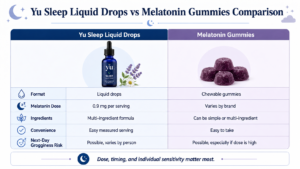
Yu Sleep Liquid Drops vs Melatonin Gummies Comparison
| Feature | Yu Sleep Liquid Drops | Melatonin Gummies |
|---|---|---|
| Melatonin amount | Current label lists 0.9 mg per 2 mL serving | Varies significantly by product |
| Format | Measured liquid drops | Chewable gummy |
| Formula | Melatonin plus vitamins, botanicals, magnesium and amino-acid-related ingredients | Can be melatonin-only or multi-ingredient |
| Morning grogginess | Possible; cannot be ruled out | Possible, particularly if melatonin exposure is excessive for the user |
| Dose flexibility | Liquid format offers measured serving administration; follow label directions | Usually based on whole or specified portions of gummies |
| Ingredient transparency | Melatonin amount disclosed; several ingredients are contained within a 637 mg proprietary blend | Depends on brand and label |
| Best suited for | Adults interested in a relatively low labeled melatonin amount within a multi-ingredient formula | Consumers who prioritize simplicity, taste, or a specific clearly labeled gummy formula |
ORDER NOW
Why Can Melatonin Cause a Next-Day Hangover?
A “melatonin hangover” generally refers to morning sleepiness, sluggishness, reduced alertness, or a foggy feeling after using melatonin the previous night. Melatonin is not an intoxicating substance, so the term “hangover” is informal rather than a medical diagnosis.
Several factors can increase the likelihood of morning drowsiness.
- Taking more melatonin than you personally need: Higher exposure does not automatically produce better sleep.
- Taking it too late: Using a sleep supplement close to your required wake-up time can leave insufficient time for its effects to wear off.
- Getting too little sleep: No supplement compensates for consistently inadequate sleep opportunity.
- Combining nighttime products: Stacking melatonin, antihistamines, prescription sleep medicines, alcohol, or multiple calming supplements may increase impairment.
- Individual sensitivity: People metabolize and respond to melatonin differently.
Mayo Clinic lists daytime drowsiness among the potential side effects of melatonin and advises avoiding driving or machinery for several hours after taking it.
Does Yu Sleep Have Less Risk of Morning Grogginess?
Yu Sleep’s 0.9 mg labeled melatonin dose may be attractive to someone who has previously felt excessively sleepy after taking a higher-dose melatonin product. However, a lower labeled dose should not be converted into a guarantee of zero morning grogginess.
That distinction matters. Marketing language may describe a product as providing sleep “without grogginess,” but individual response cannot be predicted with certainty. Yu Sleep’s own updated disclosure acknowledges that next-morning alertness can vary by individual.
The strongest comparison therefore is not “Yu Sleep never causes grogginess while gummies do.” A more accurate conclusion is that Yu Sleep provides a clearly disclosed 0.9 mg melatonin amount, while gummy doses vary considerably between products. For someone sensitive to melatonin, total dose can be an important factor when discussing options with a healthcare professional.
Why This Comparison Matters for U.S. Consumers
Sleep supplements are widely available across the United States through online retailers, pharmacies, supermarkets, and wellness stores. That convenience can make different products appear more standardized than they really are.
Under U.S. law, dietary supplements are not FDA-approved for safety and effectiveness before reaching the market in the same way prescription drugs are. Manufacturers are responsible for product safety, labeling, and compliance, while the FDA performs regulatory oversight and post-market enforcement.
This also means that phrases such as “made in an FDA-registered facility” should not be interpreted as “FDA-approved supplement.” Facility registration and product approval are different concepts. The FDA specifically states that dietary supplements are not FDA-approved before marketing.
Whether you live in New York, California, Texas, Florida, or elsewhere in the United States, reading the current Supplement Facts label is more useful than relying on front-label claims alone.
How to Choose Between Yu Sleep and Melatonin Gummies
Choose based on your actual sleep goal rather than the format that sounds most advanced.
- Check the melatonin amount per serving. Compare milligrams rather than simply comparing “one dropper” with “one gummy.”
- Review every active ingredient. Multi-ingredient products may overlap with supplements or medications you already use.
- Consider previous reactions. If a certain melatonin dose previously caused morning fatigue, discuss a lower-dose strategy with a qualified healthcare professional.
- Check serving directions. More is not automatically better. Follow the current product label.
- Allow adequate sleep time. Taking any nighttime supplement when you have only a few hours before waking can undermine next-day alertness.
- Evaluate product transparency. Look for clear Supplement Facts, manufacturer information, serving size, warnings, and quality information.
Who May Prefer Yu Sleep Liquid Drops?
Yu Sleep may be worth comparing if you prefer a liquid product, want a labeled melatonin amount below 1 mg per current serving, or are specifically interested in a multi-ingredient nighttime formula.
It may also be more convenient for adults who dislike chewable gummies or tablets.
However, Yu Sleep contains several ingredients in addition to melatonin. That makes medication and supplement interactions an important consideration. Its current safety guidance recommends professional advice for people using prescription medications, managing medical conditions, or using other nighttime products.
Who May Prefer a Melatonin Gummy?
A gummy may make more sense if you want a simple, easy-to-take product and can find one with a dose and ingredient profile appropriate for your needs.
Not every gummy is a high-dose supplement, and it would be inaccurate to treat all gummies as one category. Compare the amount per serving, third-party quality information when available, other active ingredients, sugar or sweeteners, and manufacturer instructions. see also.
The main lesson is simple: dosage and formulation matter more than whether the product happens to be chewy or liquid.
Common Mistakes to Avoid When Trying to Prevent Morning Grogginess
- Taking multiple melatonin products on the same night without professional guidance.
- Assuming a larger dose will automatically produce deeper sleep.
- Taking melatonin immediately before an early alarm.
- Ignoring prescription-drug or supplement interactions.
- Using alcohol together with products intended to promote sleep.
- Assuming “natural” means completely risk-free.
- Believing an FDA-registered manufacturing facility means the supplement itself is FDA approved.
- Driving or performing safety-sensitive tasks while drowsy.
Why Choose healthyvora for Sleep Supplement Comparisons?
Healthyvora approaches sleep-supplement comparisons around the factors that actually help consumers make informed decisions: dose, ingredient transparency, intended use, potential side effects, regulatory context, and realistic expectations.
Instead of treating marketing phrases such as “fast acting,” “natural,” or “no grogginess” as guarantees, healthyvora encourages readers to compare the Supplement Facts panel with credible health guidance and their own individual needs.
That approach is particularly valuable when comparing products such as Yu Sleep and melatonin gummies, because the right question is not simply which format sounds better. It is which formulation is appropriate for your situation and can be used responsibly.
Tips Before Making Your Decision
If next-day alertness is your priority, focus first on minimizing unnecessary melatonin exposure and getting enough sleep opportunity. Take sleep products only as directed, and avoid combining formulas without understanding their ingredients.
People who are pregnant or breastfeeding, have a medical condition, take prescription medications, have epilepsy, use blood-thinning medications, or are considering long-term melatonin use should speak with a qualified healthcare professional before starting a supplement. NCCIH specifically advises discussing melatonin with a healthcare provider when medications or relevant medical conditions are involved.
Also remember that persistent difficulty falling asleep, repeated nighttime waking, loud snoring, breathing interruptions, or significant daytime sleepiness can have causes that deserve medical evaluation rather than simply adding another supplement.
Yu Sleep vs Melatonin Gummies: Final Verdict
For consumers searching for Yu Sleep liquid drops vs melatonin gummies with no next-day hangover, Yu Sleep has one meaningful differentiator: its current serving lists 0.9 mg of melatonin, combined with several additional nighttime-support ingredients. Some melatonin gummies contain considerably more melatonin, although doses vary by brand.
That does not mean Yu Sleep is guaranteed to produce a clearer morning. Melatonin itself can cause next-day drowsiness, and the effect depends on the person, dose, timing, sleep duration, medications, and other ingredients.
If you have experienced morning fog from gummies, comparing lower-dose options can be reasonable. Just evaluate the complete formula rather than focusing exclusively on whether the supplement comes as a drop or gummy.
Bottom line: When your goal is better sleep without next-day grogginess, dose, timing, label quality, and individual response matter more than liquid versus gummy format alone.
Take the Next Step with healthyvora
Before choosing another nighttime supplement based on advertising alone, use healthyvora’s evidence-first approach to compare the melatonin dose, complete ingredient list, safety considerations, and morning-alertness tradeoffs. A careful label comparison is the logical next step toward finding a sleep-support option that fits your routine without making claims your body may not follow.
Frequently Asked Questions
1. Does Yu Sleep contain melatonin?
Yes. Yu Sleep’s current 2026 disclosure lists 0.9 mg of melatonin in a two-dropper, 2 mL serving.
2. Can Yu Sleep cause next-day grogginess?
Yes, it is possible. Although the labeled melatonin amount is relatively low, individual sensitivity varies and no melatonin-containing supplement can guarantee zero morning drowsiness.
3. Are Yu Sleep drops better than melatonin gummies?
Not universally. Yu Sleep may suit people seeking a liquid, multi-ingredient formula with 0.9 mg of melatonin, while a well-labeled gummy may be preferable for someone wanting simplicity or a different dose.
4. Can melatonin gummies make you tired the next morning?
Yes. Morning sleepiness is a recognized potential side effect of melatonin, particularly when the amount or timing is unsuitable for the individual.
5. Is liquid melatonin automatically faster or more effective than gummies?
No. Product format alone does not prove better clinical effectiveness or less morning grogginess.
6. Is Yu Sleep FDA approved?
No dietary supplement should be described as FDA approved simply because it is manufactured in an FDA-registered facility. The FDA does not pre-approve dietary supplements for safety and effectiveness before marketing.
7. Can I take Yu Sleep together with melatonin gummies?
Avoid stacking sleep supplements unless a healthcare professional has reviewed the combination. Doing so can increase total melatonin and duplicate other calming ingredients.
8. When should Yu Sleep be taken?
The current Yu Sleep disclosure instructs users to take its two-dropper serving approximately 30 minutes before bedtime. Always follow the label on your specific bottle.
9. What is the best way to reduce a melatonin hangover?
Use only an appropriate dose, take it at the correct time, leave enough time for sleep, avoid unnecessary supplement stacking, and discuss recurring side effects with a healthcare professional.
10. Who should speak with a doctor before using melatonin?
People taking medications, managing medical conditions, or who are pregnant or breastfeeding should seek professional advice before using melatonin or multi-ingredient sleep supplements.