
Arctic Blast vs Voltaren Gel: Active Ingredients, Cost, Evidence & Safety
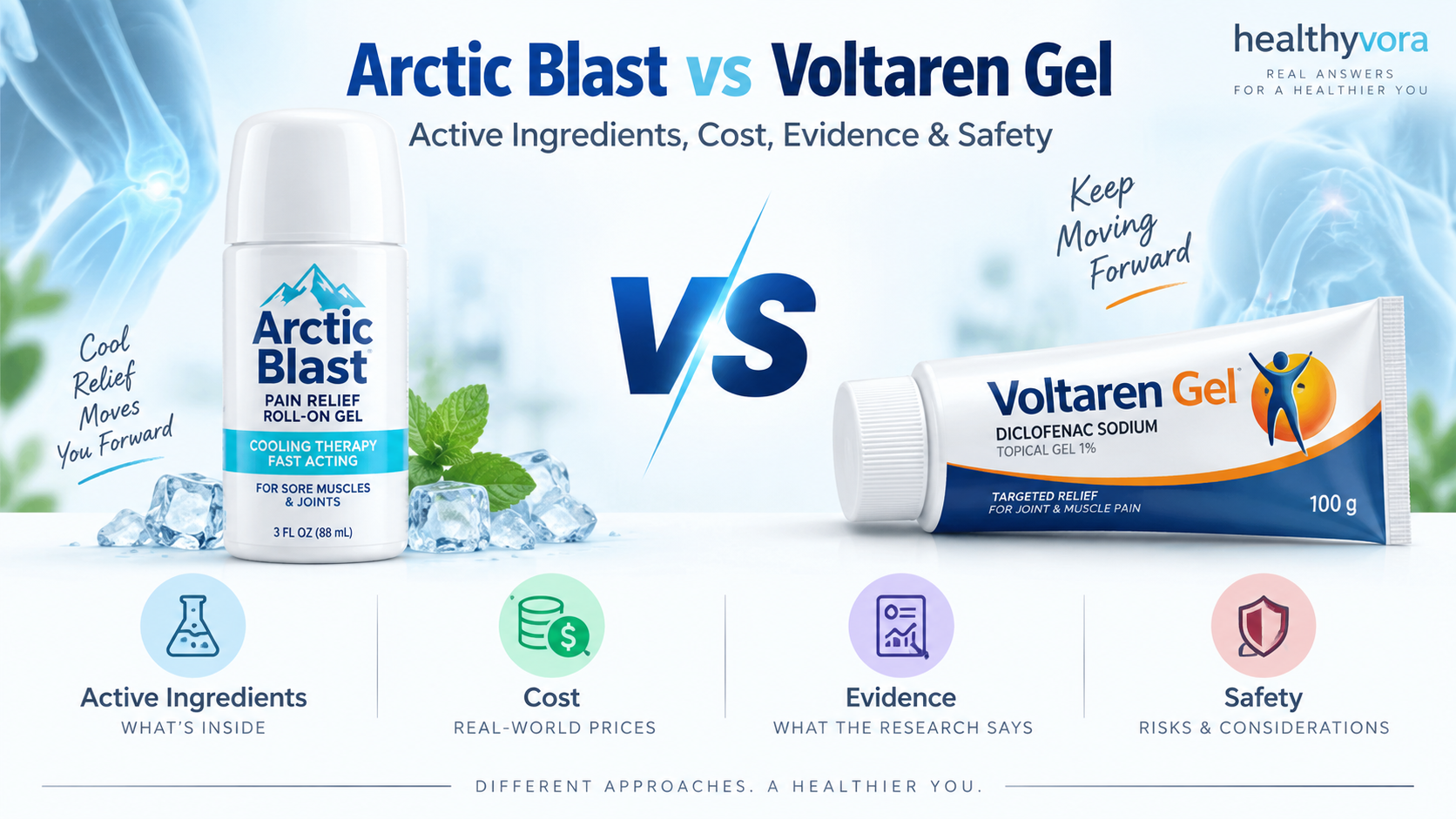
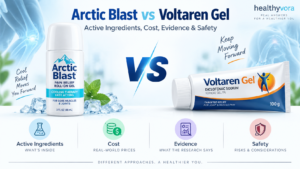
Arctic Blast and Voltaren Gel are not interchangeable pain relievers. Arctic Blast is a topical analgesic containing menthol 10% and camphor 3%, intended for temporary relief of minor muscle and joint aches, including strains, sprains, bruises, simple backache, and arthritis discomfort. Voltaren Arthritis Pain Gel contains diclofenac sodium 1%, a topical nonsteroidal anti-inflammatory drug (NSAID) specifically labeled for arthritis pain in the hands, wrists, elbows, feet, ankles, and knees.
Visit Official Website
Arctic Blast vs Voltaren Gel: Quick Answer
Choose based on the type of pain, not simply which product feels stronger. Voltaren Gel is the more evidence-supported option for osteoarthritis pain in FDA-labeled joints. Arctic Blast may be more appropriate when you want temporary cooling relief for minor muscle aches, strains, sprains, bruises, or simple backache. Neither product is right for every type of pain.
| Feature | Arctic Blast | Voltaren Arthritis Pain Gel |
|---|---|---|
| Active ingredients | Menthol 10% + camphor 3% | Diclofenac sodium 1% |
| Drug type | Topical counterirritant analgesic | Topical NSAID |
| Main labeled uses | Minor muscle/joint pain, arthritis, sprains, strains, bruises, simple backache | Arthritis pain in hand, wrist, elbow, foot, ankle, or knee |
| Immediate sensation | Cooling/counterirritant effect | Not designed for immediate relief |
| Clinical evidence for osteoarthritis | Limited for the finished product and counterirritant combination | Substantially stronger evidence for topical diclofenac |
| Typical U.S. price observed | About $49 per bottle on a current sales page | About $14–$26 depending on tube size and retailer |
| Key safety distinction | Flammable; avoid damaged skin and excessive application | NSAID warnings involving cardiovascular, gastrointestinal, liver, kidney, allergy, and pregnancy risks |
What Are the Active Ingredients in Arctic Blast?
The current U.S. Drug Facts listing identifies menthol 10% and synthetic camphor 3% as Arctic Blast’s active ingredients. Both are topical analgesic counterirritants. Menthol activates cold-sensitive sensory pathways and produces the familiar cooling feeling, while camphor can create cooling, warming, or tingling sensations that temporarily alter the perception of pain.
DailyMed lists several additional substances as inactive ingredients, including DMSO (dimethyl sulfoxide), arnica, aloe vera, calendula, emu oil, St. John’s wort, methyl salicylate, propylene glycol, and alcohol. This distinction matters because some Arctic Blast marketing materials emphasize ingredients such as DMSO, but the current Drug Facts record does not identify DMSO as one of the product’s active drug ingredients.
What does Arctic Blast treat?
The label states that Arctic Blast temporarily relieves minor muscle and joint aches associated with arthritis, strains, sprains, bruises, and simple backache. Adults should apply it no more than three to four times per day.
What Is the Active Ingredient in Voltaren Gel?
Voltaren Arthritis Pain Gel contains diclofenac sodium 1%, equivalent to 0.93% diclofenac. Diclofenac is an NSAID, meaning it works differently from menthol and camphor. Instead of primarily creating a competing skin sensation, diclofenac reduces inflammatory processes involved in osteoarthritis pain.
The OTC Voltaren label is much narrower than Arctic Blast’s. It is intended for temporary relief of arthritis pain in the hands, wrists, elbows, feet, ankles, and knees. The label specifically states that it is not for strains, sprains, bruises, or sports injuries and is not intended for areas such as the back, hip, or shoulder.
How quickly does Voltaren work?
Voltaren is not an instant-relief gel. Its U.S. label says it may take up to seven days to work for arthritis pain. It is normally applied four times daily and can be used for up to 21 days unless a doctor directs otherwise.
Which Has Better Evidence: Arctic Blast or Voltaren?
Voltaren has the stronger evidence base for osteoarthritis. Systematic reviews have found topical diclofenac to provide greater pain relief than topical placebo for some people with osteoarthritis. A Cochrane review covering thousands of participants concluded that diclofenac and ketoprofen were the topical NSAIDs with the strongest longer-term evidence.
The American College of Rheumatology and Arthritis Foundation strongly recommend topical NSAIDs for knee osteoarthritis and conditionally recommend them for hand osteoarthritis. The guideline also favors local treatments with lower systemic exposure before oral NSAIDs when appropriate.
Menthol-based analgesics can temporarily decrease pain sensitivity, but the overall evidence is less extensive and less consistent than the evidence for topical diclofenac in osteoarthritis. Research reviews also note that camphor has comparatively limited high-quality clinical evidence.
DMSO deserves separate attention because it is frequently highlighted in discussions of Arctic Blast. The National Center for Complementary and Integrative Health states that only limited research has evaluated DMSO for osteoarthritis and that firm conclusions about its effectiveness cannot currently be made.
No head-to-head clinical trial directly comparing the finished Arctic Blast product with Voltaren Gel was identified in the sources reviewed. Therefore, claims that one product has been clinically proven superior to the other would go beyond the available evidence.
Arctic Blast vs Voltaren Gel Cost in the United States
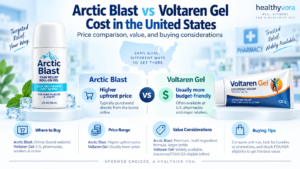
Voltaren is generally less expensive to try based on current advertised U.S. prices, although prices vary significantly by size, retailer, coupons, and promotions.
DailyMed lists Arctic Blast in a 30 mL dropper bottle. A current Arctic Blast sales page reviewed in September 2026 advertised the product at approximately $49 per bottle. Because direct-to-consumer promotions can change frequently, shoppers should verify the final checkout price and shipping charges before purchasing.
Voltaren is widely available through U.S. pharmacy chains. Recent Walgreens listings showed approximately $13.99 for a 1.76 oz tube, $23.99 for 3.53 oz, and around $25.99 for a 5.29 oz tube during a sale. CVS also listed smaller Voltaren packages around the mid-teens. Local prices in New York, California, Texas, Florida, or other states may differ, and pharmacy promotions can change without notice.
Price per bottle is not the same as cost per treatment course. Arctic Blast and Voltaren use different quantities, dosing instructions, and treatment schedules, so comparing sticker price alone can be misleading.
Visit Official Website
Is Arctic Blast Safer Than Voltaren?
Arctic Blast has a simpler systemic warning profile, but that does not mean it is risk-free. Voltaren requires more precautions because diclofenac is an NSAID and some of the drug can enter systemic circulation.
Arctic Blast safety warnings
The Arctic Blast Drug Facts label says the product is for external use only and is flammable. Users should keep it away from flames, sparks, and heated surfaces, avoid the eyes, avoid wounds or damaged skin, and avoid tight bandaging. Pregnant or breastfeeding individuals should ask a healthcare professional before use. Treatment should be stopped and medical advice sought if symptoms worsen, last more than seven days, or disappear and return within a few days.
Voltaren Gel safety warnings
Voltaren carries the warnings associated with diclofenac and NSAIDs. Its current U.S. Drug Facts label includes warnings concerning serious allergic reactions, stomach bleeding, liver damage, heart attack, heart failure, and stroke. People with cardiovascular disease, kidney disease, liver disease, asthma, prior gastrointestinal bleeding, or other significant medical conditions should review the label carefully and discuss use with a healthcare professional when appropriate.
People taking anticoagulants, steroids, aspirin, ibuprofen, naproxen, other NSAIDs, or other medicines should also check with a doctor or pharmacist because combining therapies may increase risk. The current label advises people under age 18 to ask a doctor because safety and effectiveness have not been established for that group. see also.
During pregnancy, diclofenac deserves particular caution. The current Voltaren label advises consulting a healthcare professional and says it is especially important not to use diclofenac at 20 weeks of pregnancy or later unless specifically directed by a doctor.
Is Arctic Blast FDA Approved Like Voltaren?
No—the regulatory pathways are different. Arctic Blast is listed as an OTC Monograph Drug under Monograph M017. FDA explains that products meeting an applicable OTC monograph may be marketed without an individually approved New Drug Application. The agency also notes that an OTC monograph listing should not be interpreted as FDA having individually reviewed and approved the finished product’s labeling and effectiveness.
Voltaren Arthritis Pain, by contrast, came through the drug-application pathway for its transition from prescription to OTC use. This difference does not automatically make every monograph product ineffective or unsafe; it simply means consumers should not treat the phrase “FDA listed” or an NDC number as equivalent to individual FDA approval.
Who Should Consider Arctic Blast vs Voltaren?
Arctic Blast may make more sense when the problem is a temporary minor muscle ache, strain, sprain, bruise, simple backache, or mild joint discomfort and you prefer a noticeable cooling counterirritant sensation.
Voltaren may make more sense when you have arthritis pain affecting a knee, hand, wrist, elbow, foot, or ankle and want a topical anti-inflammatory treatment with stronger osteoarthritis evidence.
- For a sore back after everyday activity, Arctic Blast fits its labeled uses better than OTC Voltaren.
- For diagnosed knee osteoarthritis, Voltaren has stronger clinical and guideline support.
- For a fresh sports sprain, OTC Voltaren’s U.S. label specifically says it has not been shown to work for strains, sprains, bruises, or sports injuries.
- For people with significant NSAID-related medical risks, Voltaren warrants additional professional guidance.
- For unexplained, severe, recurrent, or progressively worsening pain, choosing another topical product should not replace medical evaluation.
How to Use Topical Pain Relievers More Safely
- Identify the cause of the pain. Arthritis, muscle soreness, nerve pain, injuries, and inflammatory conditions do not necessarily respond to the same treatments.
- Read the current Drug Facts label. Packaging and warnings may change.
- Use only the recommended amount. Applying more does not guarantee better pain relief.
- Use intact skin only. Avoid cuts, infections, wounds, or significant rashes unless a healthcare professional specifically advises otherwise.
- Avoid combining topical products on the same area. Layering several pain creams can increase irritation and complicate dosing.
- Reassess persistent pain. Pain lasting beyond the product’s recommended treatment period deserves medical attention rather than indefinite self-treatment.
Common Mistakes to Avoid
- Assuming a strong cooling sensation means inflammation is being treated.
- Using Voltaren for every type of backache, muscle strain, or sports injury despite its narrower OTC indication.
- Calling DMSO an Arctic Blast active ingredient when the current Drug Facts record classifies it as inactive.
- Assuming “natural” ingredients cannot produce irritation or other adverse effects.
- Using Voltaren together with other NSAIDs without considering cumulative risk.
- Applying either product to damaged skin or near the eyes.
- Choosing a pain reliever entirely on testimonials rather than diagnosis, labeling, evidence, and personal risk factors.
Why Use healthyvora When Comparing Pain-Relief Products?
Topical pain products can look similar online even when their ingredients, regulatory status, evidence, indications, and warnings are fundamentally different. The healthyvora approach in this comparison starts with current Drug Facts information, then evaluates clinical evidence and real-world U.S. pricing separately from promotional claims.
That distinction is especially important for products such as Arctic Blast and Voltaren. One primarily uses counterirritant analgesics for temporary relief across several minor aches and injuries; the other contains a clinically studied NSAID for a narrower arthritis indication. Understanding that difference can prevent consumers from paying for—or using—a product that does not match the problem they are trying to treat.
Arctic Blast vs Voltaren Gel: Final Verdict
For osteoarthritis pain in the knee, hand, wrist, elbow, foot, or ankle, Voltaren Gel has the stronger clinical evidence and guideline support. Diclofenac sodium 1% acts as a topical anti-inflammatory medicine rather than simply producing a cooling or warming sensation.
For temporary relief of minor muscle aches, sprains, strains, bruises, or simple backache, Arctic Blast has broader labeled uses than OTC Voltaren. Its menthol and camphor formula provides counterirritant relief, although the evidence for the finished Arctic Blast formula is less robust than the osteoarthritis evidence supporting topical diclofenac.
Cost also favors Voltaren at many U.S. pharmacies based on current advertised prices, while Arctic Blast is generally sold at a higher direct-to-consumer bottle price. Safety is more nuanced: Arctic Blast has fewer systemic drug warnings, while Voltaren requires greater caution in people with NSAID-related cardiovascular, gastrointestinal, kidney, liver, medication, or pregnancy risks.
Ultimately, the best topical pain reliever is the one that matches the cause and location of your pain, your medical history, and the labeled indication.
Frequently Asked Questions
1. Is Arctic Blast better than Voltaren Gel?
Not universally. Voltaren has stronger evidence for osteoarthritis, while Arctic Blast is labeled for a broader range of temporary minor muscle and joint aches, including strains, sprains, bruises, and simple backache.
2. What are the active ingredients in Arctic Blast?
Arctic Blast contains menthol 10% and camphor 3% as its active topical analgesic ingredients. DMSO, arnica, aloe, and methyl salicylate are listed as inactive ingredients in the current Drug Facts record.
3. What is the active ingredient in Voltaren Gel?
Voltaren Arthritis Pain Gel contains diclofenac sodium 1%, a topical nonsteroidal anti-inflammatory drug used for arthritis pain.
4. Does Arctic Blast reduce inflammation?
Its primary active ingredients are counterirritant analgesics. They can temporarily change pain perception, but Arctic Blast should not be considered equivalent to a topical NSAID with established osteoarthritis anti-inflammatory evidence.
5. Is Voltaren good for back pain?
OTC Voltaren Arthritis Pain Gel is not labeled for back pain in the United States. Its treatment areas are the hand, wrist, elbow, foot, ankle, and knee.
6. Can Arctic Blast be used for back pain?
Yes, its U.S. Drug Facts label includes temporary relief of minor aches associated with simple backache. Persistent or severe back pain should be medically evaluated.
7. How long does Voltaren take to work?
Voltaren may take up to seven days to provide arthritis pain relief, according to its current U.S. label. It is not intended as immediate pain relief.
8. How often can Arctic Blast be applied?
The current label directs adults to apply Arctic Blast to the affected area no more than three to four times daily.
9. Can I use Arctic Blast and Voltaren together?
Do not automatically layer topical pain products on the same area. Voltaren’s instructions say not to apply another product to the same treatment area. Ask a pharmacist or healthcare professional before combining topical medicines.
10. Which product is cheaper in the United States?
Voltaren usually has a lower initial purchase price based on current pharmacy listings. Arctic Blast has been advertised around $49 per bottle, while Voltaren tubes are commonly listed from roughly the mid-teens into the $20s depending on size and retailer. Prices can change.
Make Your Next Pain-Relief Decision With Better Information
If you are comparing topical products, start with the active ingredient, labeled use, evidence, safety warnings, and total cost—not the strongest marketing promise. Explore healthyvora for clear, evidence-conscious comparisons that help you ask better questions and choose products more appropriately for your needs.
Medical note: This article is for informational purposes and does not replace personalized medical advice. Seek professional care for severe, unexplained, persistent, recurrent, or worsening pain, or before using a topical medication when you have significant medical conditions, take interacting medicines, or are pregnant or breastfeeding.