
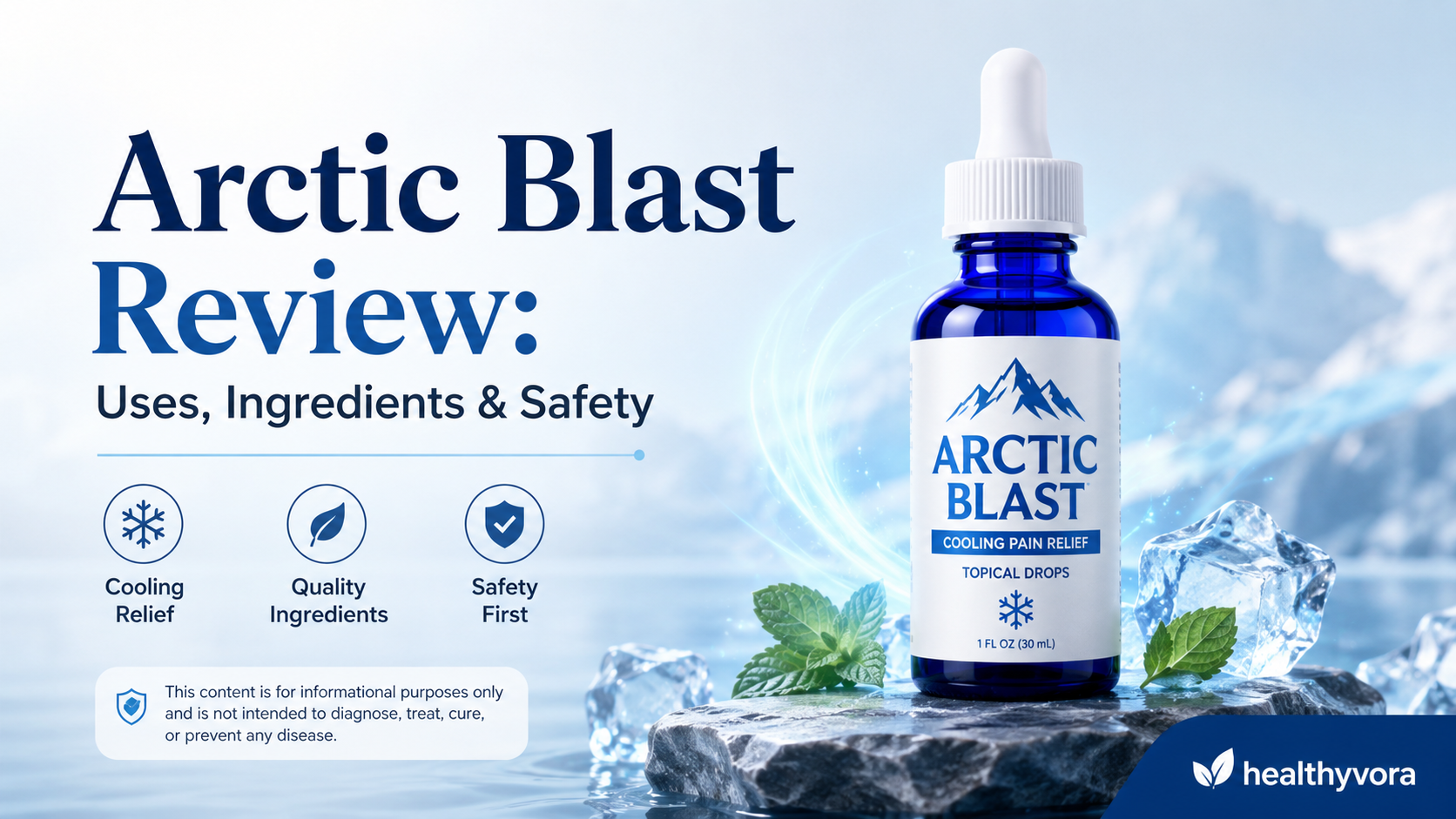
Arctic Blast Review: Uses, Ingredients & Safety
Arctic Blast is a topical analgesic liquid marketed in the United States for the temporary relief of minor muscle and joint aches. According to its current U.S. drug label, the formula contains 10% menthol and 3% synthetic camphor as its active ingredients and is intended for adults experiencing minor discomfort associated with arthritis, sprains, strains, bruises, and simple backache. Rather than being swallowed like an oral pain reliever, Arctic Blast is applied directly to the affected area of the skin.
For consumers researching Arctic Blast before purchasing or using it, the most important questions involve what is actually in the formula, what its official label says it can do, how it should be applied, and which safety precautions should be followed. This HealthyVora guide examines those points without relying on exaggerated promises or unsupported health claims.
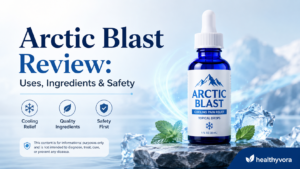
What Is Arctic Blast?
Arctic Blast is an over-the-counter topical pain-relieving liquid designed to provide temporary relief from minor muscle and joint aches. It is applied directly to the skin rather than taken orally.
The U.S. DailyMed listing identifies Arctic Blast Pain Relieving Drops as a human OTC drug with menthol and synthetic camphor as the active ingredients. The product is supplied as a topical liquid and is labeled for adult use.
The distinction between a topical analgesic and a dietary supplement is important. Arctic Blast is sometimes described online using terms such as “supplement,” but the U.S. drug label identifies it as a topical analgesic. Consumers comparing products should therefore evaluate it according to its Drug Facts label rather than treating it as a vitamin, capsule, or nutritional supplement.
What Is Arctic Blast Used For?
The official label states that Arctic Blast is intended for the temporary relief of minor aches and pains of the muscles and joints associated with several common conditions.
- Minor arthritis-related aches
- Sprains
- Strains
- Bruises
- Simple backache
The word temporary matters. A topical analgesic may help make everyday discomfort more manageable, but it does not automatically address the underlying reason a joint, muscle, or back is hurting.
Persistent or severe pain may require medical evaluation, particularly when discomfort follows a significant injury, occurs with swelling or weakness, repeatedly returns, or interferes with normal movement.
How Does Arctic Blast Work?
Arctic Blast primarily relies on menthol and camphor, ingredients commonly found in topical analgesic products. These substances produce noticeable sensations on the skin that can temporarily change how discomfort is perceived in the treated area.
Menthol
Menthol is listed at a concentration of 10% in Arctic Blast. It produces the characteristic cooling sensation many people associate with topical muscle and joint products.
This cooling effect can provide localized comfort without requiring an oral medication. Users should remember that a strong cooling sensation does not necessarily mean an injury is healing faster; the product is intended for temporary symptom relief.
Camphor
Synthetic camphor is listed at 3% as the second active ingredient. Camphor is also used in external analgesic products and contributes to the sensory effect experienced after topical application.
Because both ingredients are applied to the skin, following the labeled application instructions is more important than assuming that using additional product will produce better results.
Arctic Blast Ingredients Explained
The current Drug Facts information separates Arctic Blast ingredients into active and inactive ingredients. That difference is particularly useful when evaluating claims found on promotional websites.
| Ingredient | Label Status | Role in the Formula |
|---|---|---|
| Menthol 10% | Active ingredient | Topical analgesic and cooling sensation |
| Camphor 3% | Active ingredient | Topical analgesic |
| DMSO | Inactive ingredient | Part of the topical formulation |
| Aloe vera | Inactive ingredient | Commonly included in topical skin formulations |
| Arnica montana extract | Inactive ingredient | Botanical component of the formula |
| Calendula extract | Inactive ingredient | Botanical component |
| Methyl salicylate | Inactive ingredient | Included in the topical formulation |
Other listed ingredients include water, emu oil, glycerin, St. John’s wort, isopropyl alcohol, olive oil derivatives, phenoxyethanol, polysorbate 20, propylene glycol, and SD alcohol 40B.
What About DMSO?
DMSO, or dimethyl sulfoxide, receives significant attention in marketing discussions about Arctic Blast. However, consumers should understand its regulatory position within this particular formula: the current DailyMed label lists DMSO among the inactive ingredients, while menthol and camphor are the labeled active ingredients.
This is a useful example of why consumers should read the Drug Facts panel instead of determining a product’s active ingredients from advertisements alone.
How to Use Arctic Blast Correctly
The U.S. label instructs adults to apply Arctic Blast to the affected area no more than three to four times daily.
- Identify the area of minor muscle or joint discomfort.
- Check that the skin is intact and not wounded or damaged.
- Apply the product to the affected area according to the bottle directions.
- Avoid contact with the eyes.
- Do not tightly bandage the treated area.
- Wash your hands when appropriate after application.
- Do not exceed the labeled frequency of three to four applications per day.
More frequent application should not be assumed to produce stronger or faster results. OTC topical medications should be used according to their labeled directions.
Arctic Blast Safety Warnings
Arctic Blast is intended for external use only. The current label contains several precautions that U.S. consumers should understand before applying it.
- Do not apply it to wounds or damaged skin.
- Avoid contact with the eyes.
- Do not bandage the treated area tightly.
- Keep the product away from fire, flames, sparks, and heated surfaces because it is labeled flammable.
- Keep it out of reach of children.
- Seek medical help or contact a Poison Control Center if the product is swallowed.
The label also advises users to stop using the product and ask a doctor if the condition worsens, symptoms persist for more than seven days, or symptoms disappear and then return within a few days.
Anyone who is pregnant or breastfeeding is instructed to ask a health professional before use.
Topical pain relief can be useful for minor, temporary discomfort, but persistent pain should not be repeatedly masked without considering its underlying cause.
Is Arctic Blast FDA Approved?
It is more accurate to describe Arctic Blast as an OTC monograph drug rather than simply saying that the individual product is “FDA approved.”
The DailyMed record lists Arctic Blast under the OTC Monograph Drug marketing category and references OTC Monograph M017. In the United States, OTC monograph products can be marketed without an individually approved New Drug Application when they meet the applicable regulatory requirements.
FDA guidance specifically explains that products conforming to an OTC monograph may reach the market without FDA pre-approval of each individual product.
This distinction is important because some health-product websites use expressions such as “FDA approved” or “made in an FDA-approved facility” in ways that may lead consumers to believe FDA has independently reviewed and approved every claim made about the finished product. Those are not equivalent concepts.
Arctic Blast for Joint and Muscle Discomfort
Arctic Blast may be relevant to adults looking for localized, temporary relief from minor joint or muscle aches because it can be placed directly on the affected area.
For example, someone experiencing temporary muscle soreness after ordinary physical activity may prefer a topical product because it targets a specific area rather than requiring an oral medication. Similarly, a person experiencing minor arthritis-associated aches may consider a topical analgesic as one option for short-term symptom management.
However, joint discomfort has many possible causes. Pain accompanied by significant swelling, instability, redness, fever, numbness, loss of strength, or a major injury deserves appropriate medical attention rather than self-treatment alone.
Why Arctic Blast Matters to U.S. Consumers
American shoppers have a large selection of topical creams, gels, patches, sprays, and liquids for everyday muscle and joint discomfort. That variety makes label literacy particularly important.
Instead of selecting a product solely because of dramatic testimonials or phrases such as “instant recovery,” consumers should compare active ingredients, directions, warnings, application format, and the type of discomfort listed on the Drug Facts panel.
Whether someone lives in New York, California, Texas, Florida, or elsewhere in the United States, the same principle applies: an OTC pain-relief product should be judged primarily by its labeled use and safety information.
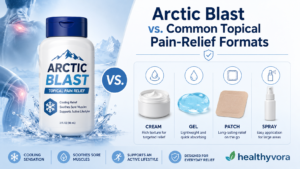
Arctic Blast vs. Common Topical Pain-Relief Formats
| Format | Main Characteristic | Potential Consideration |
|---|---|---|
| Arctic Blast liquid | Targeted liquid application with menthol and camphor | Requires careful topical application |
| Pain-relief cream | Spreadable consistency | May leave more residue depending on formula |
| Gel | Often fast-drying | Ingredients vary significantly |
| Patch | Stays over one localized area | Less practical on some body areas |
| Spray | Useful for areas difficult to reach | Requires care around the face and eyes |
No delivery format is automatically the right choice for everyone. The preferred option depends on the location of discomfort, ingredient tolerance, convenience, skin condition, and labeled indications.
What to Check Before Buying Arctic Blast
A careful purchase decision involves more than finding the lowest advertised price. Before ordering Arctic Blast online in the United States, consider the following checks.
- Read the current Drug Facts label. Confirm active ingredients, indications, warnings, and directions.
- Check the seller. Make sure you understand who is fulfilling the order and which return terms apply.
- Review the bottle size. Price comparisons are more useful when package quantities are comparable.
- Check recurring billing terms. Determine whether the purchase is one-time or connected to a subscription.
- Ignore unsupported guarantees. Individual responses to topical analgesics can vary.
- Consider your medical circumstances. Ask a healthcare professional when symptoms or health conditions make self-treatment uncertain.
Common Arctic Blast Buying and Usage Mistakes
Assuming It Treats the Cause of Pain
Arctic Blast is labeled for temporary symptom relief. Feeling better after application does not necessarily indicate that the underlying injury or condition has resolved.
Using More Than Directed
Topical products still contain active drug ingredients. Applying excessive amounts or using them more frequently than the label directs is not a sensible way to improve performance.
Applying It to Damaged Skin
The Drug Facts warning specifically states that it should not be applied to wounds or damaged skin.
Believing Every Online Health Claim
Affiliate pages and advertisements may make claims that go beyond the official product label. Consumers should distinguish between promotional language and verified Drug Facts information.
Ignoring Persistent Pain
The product label advises consulting a doctor if symptoms worsen or persist for more than seven days. Recurrent pain can sometimes indicate a problem that requires evaluation.
Who May Want to Consider Arctic Blast?
Arctic Blast may appeal to adults who want a topical option for temporary minor muscle or joint discomfort and prefer a liquid application rather than tablets, creams, or patches.
It may be particularly convenient when discomfort is concentrated in a small, accessible area. However, suitability depends on the individual, the cause of the discomfort, skin condition, medical history, and any advice provided by a healthcare professional. see also.
People should not use a topical analgesic as a substitute for emergency or professional care when symptoms suggest a significant injury or medical condition.
Why Read HealthyVora Before Choosing Arctic Blast?
Health-product searches often produce a mixture of official labeling, advertisements, affiliate reviews, personal testimonials, and product claims. That can make seemingly simple purchasing decisions surprisingly confusing.
This HealthyVora guide takes a consumer-first approach by separating the product’s official active ingredients and labeled indications from broader promotional claims. That distinction helps readers decide whether Arctic Blast matches the type of temporary discomfort they want to address and whether they should discuss their symptoms with a healthcare professional instead.
When evaluating any topical pain-relief product, HealthyVora recommends focusing on the Drug Facts label, appropriate use, safety warnings, and realistic expectations rather than relying exclusively on testimonials.
Tips Before Making Your Decision
- Confirm that your symptoms fall within the product’s labeled uses.
- Read the complete ingredient list if you have sensitive skin or known ingredient sensitivities.
- Follow the stated maximum daily application frequency.
- Avoid applying the liquid near the eyes or on broken skin.
- Keep the bottle away from heat and flames.
- Do not use temporary pain relief to delay assessment of persistent or unexplained symptoms.
- Compare the actual Drug Facts label with claims made on the seller’s website.
Final Verdict on Arctic Blast
Arctic Blast is best understood as a topical OTC analgesic for temporary relief of minor muscle and joint aches. Its current U.S. label identifies menthol 10% and synthetic camphor 3% as the active ingredients, while DMSO, aloe vera, arnica, calendula, methyl salicylate, and several other substances appear among the inactive ingredients.
The product may be a practical option for adults who prefer targeted topical pain relief, but expectations should remain realistic. Arctic Blast is not a universal solution for every type of pain, and its labeled purpose is temporary relief rather than diagnosis or treatment of an underlying medical problem.
The safest purchasing approach is straightforward: check the official label, understand the active ingredients, follow the directions, pay attention to warnings, and seek professional advice when symptoms persist or the cause of pain is unclear.
If you are comparing Arctic Blast with other topical pain-relief options in the United States, use HealthyVora as a starting point for clear, evidence-aware product research. Review the facts first, compare your options carefully, and contact HealthyVora when you need help navigating health-product information before making your next decision.
Frequently Asked Questions About Arctic Blast
1. What is Arctic Blast?
Arctic Blast is a topical OTC analgesic liquid designed for temporary relief of minor muscle and joint aches.
2. What are the active ingredients in Arctic Blast?
The current U.S. label lists menthol 10% and synthetic camphor 3% as its active ingredients.
3. Does Arctic Blast contain DMSO?
Yes. Dimethyl sulfoxide, or DMSO, appears on the current label as an inactive ingredient rather than an active ingredient.
4. Can Arctic Blast be used for back pain?
The label includes temporary relief of minor aches associated with simple backache among its indications.
5. Can Arctic Blast be used for arthritis pain?
The label includes temporary relief of minor muscle and joint aches associated with arthritis.
6. How often can adults use Arctic Blast?
The Drug Facts directions state that adults should apply it to the affected area no more than three to four times daily.
7. Can Arctic Blast be applied to broken skin?
No. The product warning says not to apply it to wounds or damaged skin.
8. Is Arctic Blast safe during pregnancy?
The label advises people who are pregnant or breastfeeding to ask a health professional before using the product.
9. Is Arctic Blast FDA approved?
Arctic Blast is listed as an OTC monograph drug. OTC monograph products can be marketed without an individually approved drug application when applicable regulatory requirements are met.
10. When should I stop using Arctic Blast and see a doctor?
The label says to stop use and ask a doctor if symptoms worsen, persist for more than seven days, or disappear and then return within a few days.