
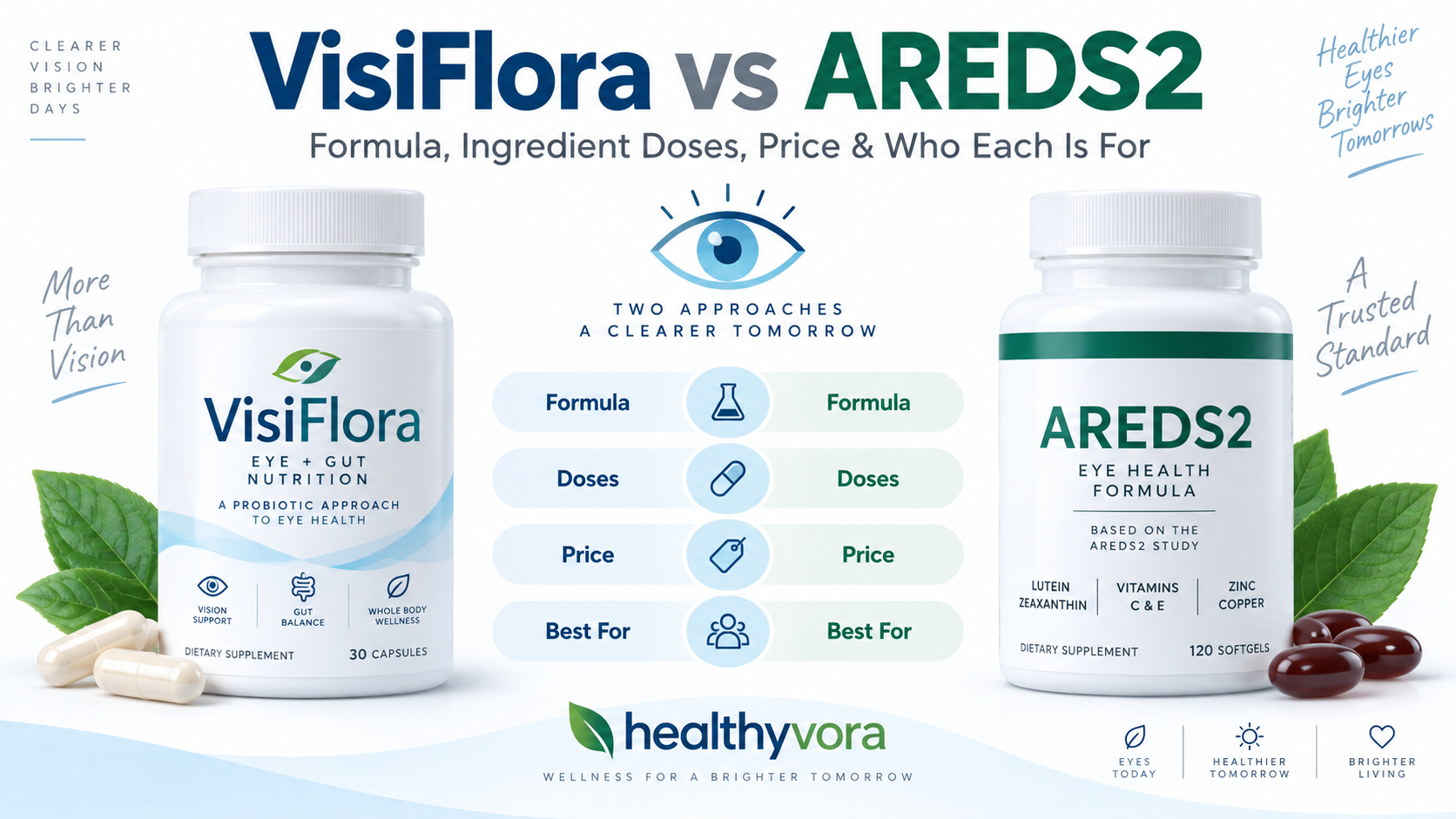
VisiFlora vs AREDS2: Formula, Ingredient Doses, Price & Who Each Is For
VisiFlora and AREDS2 are not interchangeable eye supplements. VisiFlora is a broad multi-ingredient dietary supplement containing vitamins, minerals, carotenoids, antioxidants, and botanical extracts. AREDS2, by contrast, is a specific nutrient formula studied by the National Eye Institute for people at elevated risk of progression from intermediate to advanced age-related macular degeneration (AMD). Its clinically studied daily amounts are clearly defined.
For U.S. consumers comparing VisiFlora vs AREDS2, the most important question is therefore not which bottle contains more ingredients. It is whether you need broad nutritional eye support or a formula that matches the nutrient doses studied specifically for AMD. Healthyvora breaks down those differences below using ingredient amounts, current U.S. pricing, clinical evidence, and practical buying considerations.
Visit Official Website
VisiFlora vs AREDS2 at a Glance
AREDS2 has the stronger evidence for a specific medical population: people with intermediate AMD or certain patients with advanced AMD in one eye. VisiFlora is better described as a general eye-nutrition supplement with a wider variety of ingredients but without the same AREDS2 nutrient doses or AREDS2 clinical evidence.
| Comparison | VisiFlora | AREDS2 Formula |
|---|---|---|
| Primary positioning | Broad nutritional and antioxidant eye support | Reducing risk of progression to advanced AMD in appropriate patients |
| Vitamin C | 90 mg | 500 mg |
| Vitamin E | 15 mg | 400 IU |
| Zinc | 11 mg | 80 mg |
| Copper | 0.9 mg | 2 mg |
| Lutein | Included; individual dose not disclosed | 10 mg |
| Zeaxanthin | Included; individual dose not disclosed | 2 mg |
| Beta-carotene | Vitamin A as beta-carotene, 450 mcg RAE | None |
| Additional botanicals/antioxidants | Yes | No |
| Clinical AREDS2 formula | No | Yes |
| Typical use | General nutritional eye-support routine | AMD-specific supplementation when appropriate |
The VisiFlora label reviewed in September 2026 lists seven individually quantified vitamins and minerals plus 14 ingredients sharing a 351 mg proprietary blend. The individually disclosed amounts include vitamin A 450 mcg RAE, vitamin C 90 mg, vitamin E 15 mg, zinc 11 mg, selenium 20 mcg, copper 0.9 mg, and chromium 15 mcg. Lutein and zeaxanthin are present inside the proprietary blend, but their individual amounts are not disclosed.
By comparison, the National Eye Institute lists the AREDS2 daily formula as vitamin C 500 mg, vitamin E 400 IU, zinc 80 mg, copper 2 mg, lutein 10 mg, and zeaxanthin 2 mg. It contains no beta-carotene.
What Is VisiFlora?
VisiFlora is a once-daily dietary supplement marketed for broad vision and eye-wellness support. Its formula combines conventional nutrients such as vitamins C and E, zinc, copper, lutein, and zeaxanthin with additional carotenoids, antioxidants, and plant-derived ingredients.
The current label lists a 351 mg proprietary blend containing taurine, ginkgo biloba, eyebright, grape seed extract, Coleus forskohlii, alpha-lipoic acid, rutin, quercetin, bilberry extract, saffron extract, lycopene, lutein, zeaxanthin, and astaxanthin.
Where VisiFlora differs from a standard eye vitamin
VisiFlora takes a broad-formula approach. Instead of concentrating only on the six AREDS2 nutrients, it combines macular carotenoids with several botanicals and antioxidant compounds.
- Lutein and zeaxanthin are included for macular nutrition.
- Astaxanthin and lycopene add additional carotenoid compounds.
- Bilberry, saffron, ginkgo, and grape seed extract add botanical components.
- Alpha-lipoic acid, quercetin, rutin, selenium, and vitamins C and E contribute to its antioxidant-focused formulation.
- One capsule per day provides the stated serving.
The limitation is dose transparency. Although the product lists many ingredients, 14 of them share one 351 mg blend. A consumer cannot determine from the Supplement Facts panel how many milligrams of lutein, zeaxanthin, saffron, astaxanthin, bilberry, or ginkgo are present individually. That matters when comparing a supplement against research based on specific ingredient doses.
What Is the AREDS2 Formula?
AREDS2 is a research-based combination of six nutrients, not a single brand. The formula came from the National Eye Institute’s Age-Related Eye Disease Studies and is sold by multiple supplement manufacturers in the United States.
The standardized AREDS2 formula provides:
- Vitamin C: 500 mg
- Vitamin E: 400 IU
- Zinc: 80 mg
- Copper: 2 mg
- Lutein: 10 mg
- Zeaxanthin: 2 mg
The NEI reports that AREDS/AREDS2 supplementation lowered the risk of progression from intermediate to advanced AMD by approximately 25% in the populations studied. The studies did not show that AREDS2 prevents AMD from developing in people without the relevant stage of disease, and the formulas did not prevent cataracts.
Key distinction: AREDS2 is designed around a specific clinical evidence base. A supplement containing lutein, zeaxanthin, zinc, or vitamin C does not automatically qualify as an AREDS2-equivalent formula.
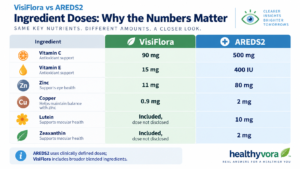
VisiFlora vs AREDS2 Ingredient Doses: Why the Numbers Matter
The biggest difference between VisiFlora and AREDS2 is dosage, not ingredient count.
Vitamin C: 90 mg vs 500 mg
VisiFlora provides 90 mg of vitamin C per serving, while the AREDS2 research formula uses 500 mg daily. VisiFlora therefore contains vitamin C, but it does not match the AREDS2 amount.
Vitamin E: 15 mg vs 400 IU
VisiFlora lists 15 mg of vitamin E. AREDS2 uses 400 IU. These units should not be casually converted without considering the specific vitamin E form, but the label amounts clearly show that the products are formulated for different purposes.
Zinc: 11 mg vs 80 mg
VisiFlora provides 11 mg of zinc, compared with 80 mg in the classic AREDS2 formula. The AREDS2 trial also investigated a lower 25 mg zinc variation and did not identify a significant difference between the zinc levels, but the formula commonly cited by the NEI still lists 80 mg.
Copper: 0.9 mg vs 2 mg
AREDS2 includes 2 mg of copper because high supplemental zinc can contribute to copper deficiency. VisiFlora contains 0.9 mg copper alongside its lower zinc dose.
Lutein and zeaxanthin: disclosed vs undisclosed doses
AREDS2 supplies exactly 10 mg of lutein and 2 mg of zeaxanthin daily. VisiFlora contains both carotenoids, but they are part of its 351 mg proprietary blend and are not individually quantified on the reviewed label.
This is one of the most important facts for anyone searching “VisiFlora vs AREDS2 for macular degeneration.” You cannot assume that the presence of lutein and zeaxanthin means VisiFlora supplies the clinically studied AREDS2 amounts.
Visit Official Website
Who Is AREDS2 Actually For?
AREDS2 is generally intended for people with intermediate AMD or certain people with late AMD in one eye, based on an eye doctor’s diagnosis.
The AREDS2 study enrolled adults with intermediate AMD in both eyes or intermediate AMD in one eye and advanced AMD in the other. Earlier AREDS research did not demonstrate the same benefit for people without AMD or with early-stage AMD.
That means buying AREDS2 simply because you are over 50, use screens frequently, or want “strong eye vitamins” is not the evidence-based way to use the formula. An ophthalmologist or retina specialist can determine your AMD stage and whether AREDS2 supplementation makes sense.
Who May Prefer VisiFlora?
VisiFlora may appeal more to adults who want a broad-spectrum eye-nutrition supplement rather than an AMD-specific clinical formula.
It may be considered by consumers who value:
- A once-daily capsule.
- A combination of vitamins, carotenoids, and botanical extracts.
- Ingredients beyond the traditional AREDS2 nutrient set.
- A general nutritional approach to eye wellness rather than a formula intended to reproduce AREDS2 doses.
However, anyone whose ophthalmologist specifically recommends AREDS2 because of AMD should not substitute VisiFlora merely because several ingredient names overlap. The formulas are quantitatively different.
VisiFlora vs AREDS2 Price in the United States
AREDS2 products are generally less expensive per month than VisiFlora based on current U.S. retail examples, although prices vary by brand, retailer, promotions, and package size.
As checked on September 15, 2026, VisiFlora’s sales page advertised a two-bottle package at $79 per bottle, three bottles at $59 each, and six bottles at $49 each. Each bottle represents approximately a 30-day supply at one capsule per day. Promotional prices can change.
AREDS2 has no single universal price because it is a formula rather than a brand. For a real U.S. retail comparison, Walmart listed a 120-count bottle of PreserVision AREDS 2 at $34.47. At the standard two-softgel daily serving, 120 softgels represent approximately 60 days, or roughly $17.24 per 30 days before tax or other discounts.
Walgreens, meanwhile, listed a 60-count PreserVision AREDS2 product at $23.99, illustrating why shoppers should compare equivalent serving sizes rather than bottle prices alone.
Is VisiFlora Better Than AREDS2 for Macular Degeneration?
No evidence currently establishes VisiFlora as superior to AREDS2 for slowing progression of AMD. AREDS2 has large National Eye Institute clinical trials behind its use in specific AMD populations. VisiFlora uses a broader combination of nutrients and botanicals but does not reproduce the AREDS2 formula and should not be represented as clinically equivalent.
This does not make VisiFlora inherently “bad.” It means the products answer different questions. One is a broad nutritional supplement. The other is a defined clinical nutrient formula used for a specific eye-disease risk group.
What Current and Former Smokers Should Know
AREDS2 was specifically reformulated without beta-carotene. In AREDS2 research, former smokers receiving the older beta-carotene-containing formulation experienced a higher incidence of lung cancer. The NEI therefore advises current and former smokers to use the beta-carotene-free AREDS2 formula rather than the older AREDS formula.
VisiFlora’s reviewed label lists vitamin A as beta-carotene at 450 mcg RAE. This is not the same dose as the 15 mg beta-carotene used in the original AREDS formula, so the AREDS risk data should not simply be transferred to VisiFlora. Still, current or former smokers should tell their eye doctor or pharmacist about any beta-carotene-containing supplement they are considering.
Safety and Medication Considerations
Both products should be treated as active dietary supplements, not as harmless additions simply because they are available without a prescription.
VisiFlora contains ginkgo biloba. The National Center for Complementary and Integrative Health notes that ginkgo may increase bleeding risk in people using anticoagulants such as warfarin and may interact with other medicines.
AREDS2 contains relatively high doses of several nutrients, particularly zinc and vitamins C and E. The NEI advises discussing AREDS2 with a doctor because high-dose supplements may interact with medications or affect how the body handles other nutrients.
U.S. consumers should also understand that dietary supplements are not FDA-approved for safety and effectiveness before being marketed in the same way as prescription drugs. The FDA recommends discussing supplements with a healthcare professional and carefully reviewing Supplement Facts labels. see also.
How to Choose Between VisiFlora and AREDS2
The safest way to choose is to begin with the reason you are taking an eye supplement.
- Know whether you have AMD. If you have been diagnosed, ask what stage you have.
- Ask whether your ophthalmologist specifically recommends AREDS2. If yes, choose a product that matches the researched nutrient amounts rather than simply containing similar ingredients.
- Read the Supplement Facts panel. Compare doses, not front-label marketing claims.
- Review your medications. This is especially important with herbal ingredients such as ginkgo or when taking anticoagulants.
- Compare cost per daily serving. Bottle price alone can be misleading because serving sizes differ.
- Recheck the label when reordering. Supplement formulas and promotional packages can change.
Common Mistakes to Avoid
- Assuming more ingredients means better AMD protection. Clinical evidence depends on formula, dose, and patient population.
- Calling every lutein-and-zeaxanthin supplement “AREDS2.” A true AREDS2 comparison requires checking all six nutrients and their doses.
- Taking AREDS2 without knowing your AMD stage. The evidence does not show the same benefit for everyone.
- Ignoring undisclosed proprietary-blend doses. Ingredient presence alone does not reveal how much you are receiving.
- Overlooking smoking history. Beta-carotene deserves particular attention in current and former smokers.
- Assuming “FDA-registered facility” means an FDA-approved supplement. The FDA does not preapprove dietary supplements for effectiveness.
Why Use Healthyvora When Comparing Eye Supplements?
Healthyvora’s approach is to separate marketing language from the details that actually affect a supplement decision: ingredient amounts, transparency, clinical relevance, price per serving, intended user, and safety considerations.
In a comparison such as VisiFlora vs AREDS2, that distinction is critical. A 20-plus-ingredient supplement and a six-nutrient clinical formula cannot be judged fairly by ingredient count alone. Looking at dose and evidence produces a more useful answer for U.S. consumers.
Final Verdict: VisiFlora or AREDS2?
Choose based on your goal, not on which label looks more impressive.
For someone with intermediate AMD or another AREDS2-appropriate diagnosis, an eye doctor may recommend an AREDS2 formula because its exact nutrient combination has been studied for reducing progression to advanced AMD. VisiFlora does not match those doses and should not automatically replace it.
For an adult seeking general eye-nutrition support and interested in a wider combination of antioxidants, carotenoids, and botanicals, VisiFlora offers a different type of formula. Its main drawback in a scientific comparison is that the individual amounts of lutein, zeaxanthin, and the other proprietary-blend ingredients are not disclosed.
The practical takeaway is simple: AREDS2 is the evidence-based choice for the specific AMD population studied; VisiFlora is a broader nutritional supplement for consumers whose goal is general eye-wellness support.
Frequently Asked Questions About VisiFlora vs AREDS2
1. Is VisiFlora the same as AREDS2?
No. VisiFlora contains some overlapping nutrients, but its doses differ substantially and its lutein and zeaxanthin amounts are not individually disclosed.
2. Does VisiFlora contain lutein and zeaxanthin?
Yes. Both are listed in VisiFlora’s proprietary blend, but the current reviewed label does not state their individual doses.
3. What are the AREDS2 lutein and zeaxanthin doses?
The NEI AREDS2 formula contains 10 mg lutein and 2 mg zeaxanthin per daily dose.
4. Is VisiFlora an AREDS2 replacement?
No. It should not be considered an AREDS2-equivalent formula because the ingredient amounts do not match the studied AREDS2 formulation.
5. Who should take AREDS2?
AREDS2 is primarily supported for people with intermediate AMD or certain patients with advanced AMD in one eye. An eye-care professional should determine whether it is appropriate.
6. Does AREDS2 prevent macular degeneration?
No. The NEI states that AREDS/AREDS2 supplements do not prevent AMD from developing. Their demonstrated role is reducing progression risk in selected higher-risk patients.
7. How much does VisiFlora cost?
As checked in September 2026, advertised multi-bottle packages ranged from approximately $49 to $79 per bottle, depending on quantity. Prices can change.
8. How much do AREDS2 supplements cost?
Prices vary by brand and retailer. Current U.S. PreserVision examples range from roughly $18 to $24 for approximately a 30-day supply, depending on package and retailer.
9. Can smokers take AREDS2?
Current and former smokers should use the newer beta-carotene-free AREDS2 formula rather than the original beta-carotene-containing AREDS formula.
10. Can I take VisiFlora and AREDS2 together?
Do not combine them automatically. Doing so could duplicate vitamins and minerals and add botanical ingredients. Ask an ophthalmologist, physician, or pharmacist to review the combined doses first.
Take the Next Step With Healthyvora
If you are comparing eye supplements, start with your diagnosis, the Supplement Facts panel, and the actual daily doses—not the number of ingredients printed on the front of the bottle. Use Healthyvora’s evidence-focused comparisons to narrow your options, then review the final choice with your eye-care professional, especially if you have AMD, take prescription medication, or have a history of smoking.