

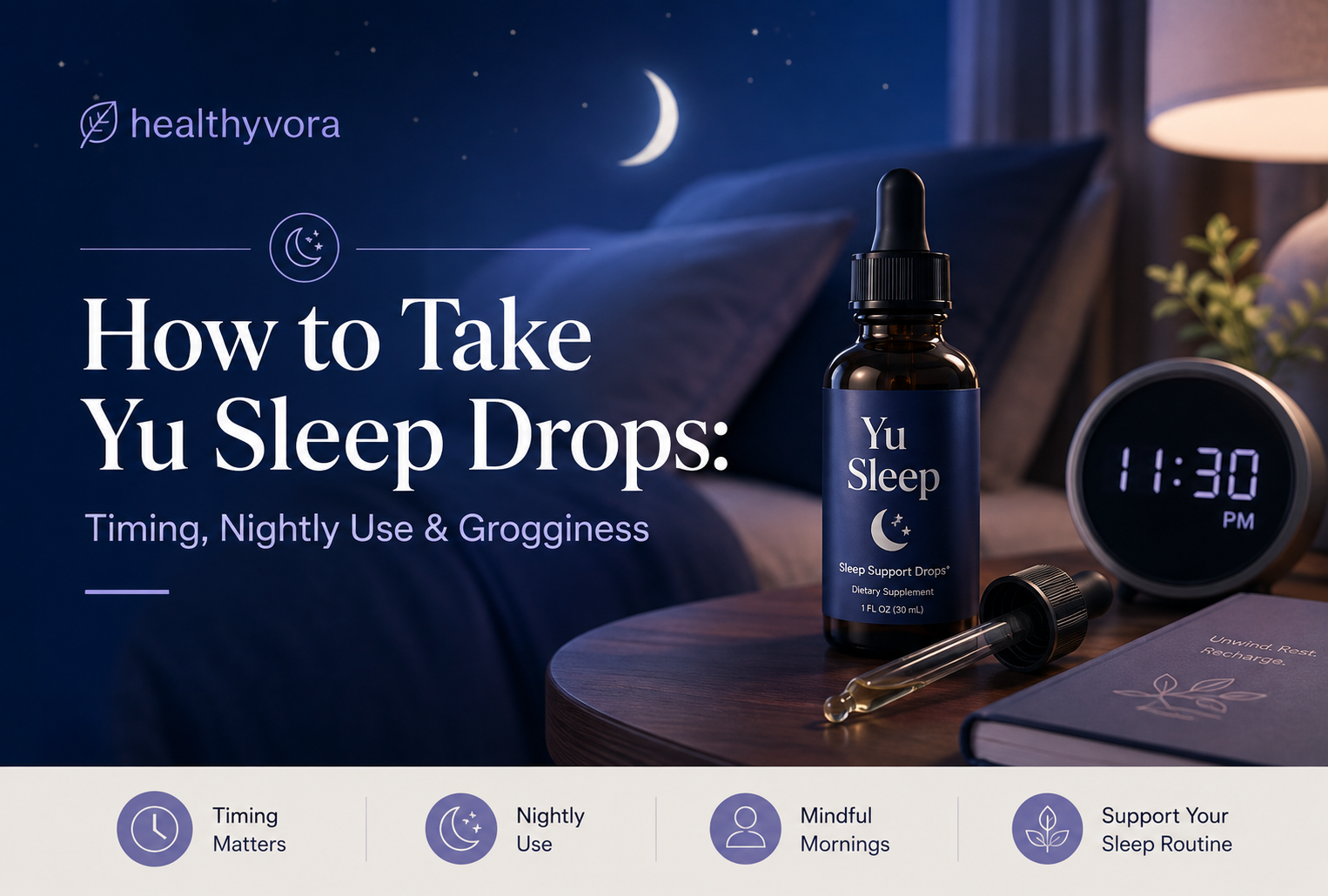
How to Take Yu Sleep Drops: Timing, Nightly Use & Grogginess
How should you take Yu Sleep Drops? Start with the directions printed on the Supplement Facts panel or bottle you actually purchased. Current Yu Sleep materials are not completely consistent: one recent product description identifies a 2 mL serving, equal to two droppers, while another Yu Sleep sales page tells users to take one full dropper about 15–30 minutes before bedtime. Because formulations and directions can change, your bottle’s current label should take priority over older reviews, advertisements, or social-media instructions.
Yu Sleep is a liquid dietary supplement marketed in the United States for nighttime sleep support. Current listings describe a formula containing melatonin along with ingredients such as tart cherry, GABA, 5-HTP, magnesium glycinate, and other sleep-related nutrients. At healthyvora, the safest way to approach a product like this is to separate the serving directions on the label from marketing promises and then consider timing, medication interactions, sleep schedule, and next-morning alertness before making it part of a routine.
ORDER NOW
Quick Answer: How to Take Yu Sleep Drops
For most adults using the current liquid version, Yu Sleep is intended for use shortly before the planned sleep period. However, the exact amount must come from your bottle rather than from a generic online dosing rule.
- Read the current Supplement Facts and Directions panels.
- Confirm the serving size in milliliters rather than judging the amount only by how full the dropper looks.
- Shake the bottle if the product label instructs you to do so.
- Measure only the labeled serving.
- Take it at the recommended pre-bedtime interval.
- Do not take an additional serving during the night unless the current label specifically directs you to do so.
- Allow yourself enough time for a full sleep period before driving, working, or performing safety-sensitive tasks the next morning.
A current Yu Sleep sales page recommends taking the liquid approximately 15–30 minutes before the desired bedtime and describes sublingual use. Another current description identifies two droppers, or 2 mL, as one serving. This discrepancy is exactly why the physical bottle should be your dosing reference.
Yu Sleep Timing at a Glance
| Question | Practical Approach |
|---|---|
| When should I take it? | Follow your bottle; current online directions commonly place use shortly before bedtime. |
| How much should I take? | Use the serving listed on your current bottle. Do not assume all Yu Sleep versions use the same dropper amount. |
| Can I take more if I am still awake? | Do not automatically redose during the night. More is not necessarily better and can increase unwanted effects. |
| Can I use it every night? | Regular use deserves periodic review, particularly because long-term melatonin safety data remain limited. |
| What if I feel groggy? | Avoid driving while drowsy and review the serving, timing, other sedating products, alcohol use, and total sleep opportunity. |
How Long Before Bed Should You Take Yu Sleep?
Yu Sleep is generally positioned as a pre-bedtime supplement rather than something to take after waking in the middle of the night. One current product page recommends approximately 15–30 minutes before the intended bedtime. Melatonin timing matters because melatonin acts partly as a biological timing signal rather than simply functioning like a conventional sedative.
Try to attach the supplement to a consistent bedtime routine. For example, finish your normal nighttime preparations, reduce stimulating activities, dim bright lights, and then use the product according to the label. Consistency makes it easier to judge whether the supplement is actually helping or whether changes in caffeine, stress, bedtime, or screen use are influencing the result.
What Is in Yu Sleep?
Current Yu Sleep product information describes a liquid formula built around a relatively low amount of supplemental melatonin plus several other ingredients commonly found in nighttime supplements. One current product listing reports approximately 0.9 mg of melatonin per serving, together with tart cherry extract, GABA, 5-HTP and magnesium glycinate. Additional current materials also list ingredients such as L-theanine and B vitamins.
Melatonin
Melatonin is a hormone involved in signaling biological night and regulating the sleep-wake cycle. Short-term supplemental use appears reasonably safe for many adults, but daytime sleepiness, headache, dizziness and nausea can occur. Long-term safety is less certain.
5-HTP
5-HTP is involved in serotonin production and deserves particular attention when medications are involved. Memorial Sloan Kettering advises caution with antidepressants and other substances that affect serotonin because combining serotonergic products may increase the risk of excessive serotonin effects.
GABA, L-Theanine, Magnesium and Tart Cherry
These ingredients are commonly included in relaxation or sleep-support formulas, but the presence of recognizable ingredients does not prove that the finished Yu Sleep formula will work the same way for every person. Individual response can vary, and claims made for individual ingredients should not automatically be treated as clinical proof for the complete product.
Can You Take Yu Sleep Drops Every Night?
A product may be marketed for nightly use without long-term nightly use being equally well studied. This distinction matters with Yu Sleep because its formula contains melatonin. The NCCIH states that short-term melatonin use appears safe for most people, while information about long-term supplemental use remains limited.
If you use Yu Sleep occasionally, the decision is different from taking it every night for months. People planning regular long-term use should consider reviewing the routine with a physician or pharmacist, especially when they take prescription medication, have ongoing medical conditions, are older adults, or continue to have significant sleep problems despite using a supplement.
Persistent insomnia also deserves evaluation rather than simply escalating a supplement. NCCIH notes that clinical guidelines have not found sufficient evidence to recommend melatonin as a treatment for chronic insomnia and that cognitive behavioral therapy for insomnia, commonly known as CBT-I, is an established first-line approach.
Does Yu Sleep Cause Next-Day Grogginess?
It can be possible to feel sleepy or groggy the next day even when a product is advertised as “non-groggy.” Yu Sleep marketing emphasizes waking refreshed and promotes its relatively low melatonin amount, but melatonin itself is associated with daytime sleepiness in some users. A marketing statement therefore cannot guarantee that every person will wake without residual drowsiness.
Why You May Feel Groggy
- You may be particularly sensitive to melatonin or another ingredient.
- You may have taken more than the labeled serving.
- The supplement may have been taken too close to a required wake time.
- You may not have allowed enough time for normal sleep.
- You may have combined it with alcohol or another sedating product.
- Another medication or health condition may be contributing to daytime sleepiness.
What to Do if You Wake Up Groggy
Do not drive, operate machinery, or perform other safety-sensitive tasks while you still feel drowsy. Review the exact dose you took and compare it with the bottle’s directions. Do not assume that increasing the dose will improve sleep; higher melatonin exposure does not necessarily produce better results and may increase unwanted effects such as morning drowsiness.
If grogginess repeatedly occurs despite following the label, stop and discuss the product with a healthcare professional rather than continually changing the dose on your own.
Should You Take Another Dose After Waking During the Night?
Do not automatically take a second serving at 2 or 3 a.m. If the product label gives one pre-bedtime serving, adding another serving can increase your total intake and leave less time before morning activities.
Middle-of-the-night waking can have many causes, including stress, an inconsistent sleep schedule, environmental disturbances, alcohol, caffeine timing, pain, medication effects, sleep apnea, or another sleep disorder. Repeated nighttime waking is therefore not necessarily a sign that you need more Yu Sleep.
Who Should Be Especially Careful With Yu Sleep?
Anyone taking medication should review the ingredient list rather than thinking of Yu Sleep as “just melatonin.” The formula contains multiple active compounds. NCCIH specifically advises people who use medications to discuss melatonin with a healthcare professional and identifies particular concerns involving blood thinners and epilepsy medications.
Because Yu Sleep also contains 5-HTP, people using SSRIs, MAO inhibitors, tricyclic antidepressants, linezolid or other serotonin-affecting medicines should not combine these products casually. 5-HTP can interact with substances that influence serotonin, so professional medication review is appropriate.
Pregnant or breastfeeding individuals should also speak with a healthcare professional because reliable safety information for melatonin during pregnancy and breastfeeding is limited.
Yu Sleep and Dietary Supplement Regulation in the United States
U.S. shoppers should understand what supplement terminology means. Dietary supplements are regulated differently from prescription and over-the-counter drugs. The FDA does not approve dietary supplements for safety and effectiveness before they reach the market. Manufacturers and distributors are responsible for meeting applicable safety, manufacturing, and labeling requirements, while the FDA performs regulatory oversight and can take action against unsafe or misbranded products.
Therefore, language such as “made in an FDA-registered facility” should not be interpreted as “FDA-approved Yu Sleep.” FDA explicitly explains that dietary supplements themselves are not FDA-approved before marketing.

ORDER NOW
Why Use healthyvora When Researching Yu Sleep?
Sleep-supplement decisions become confusing when advertisements, marketplace listings and different product pages give slightly different directions. The healthyvora approach is to make the decision easier by focusing first on the current label, actual serving size, ingredients, interaction concerns and evidence behind the claims.
For Yu Sleep in particular, that distinction is useful because online dosing instructions currently vary. A responsible review should flag that inconsistency instead of choosing whichever dosage makes the product sound easiest to use.
Practical Tips Before Adding Yu Sleep to Your Night Routine
- Photograph the Supplement Facts panel when you open the bottle so you can reference the exact formulation later.
- Measure the serving rather than estimating by eye.
- Use the supplement before a normal sleep period, not before driving or late-night work.
- Avoid combining several sleep supplements simply because each one is sold over the counter.
- Check every ingredient against your medication list.
- Keep your bedtime and wake time reasonably consistent while evaluating whether the product helps.
- Stop and seek professional advice if you develop persistent or concerning symptoms.
Common Mistakes to Avoid
Using an Online Review as the Dosing Label
Yu Sleep information has changed across different pages. Your current bottle is the better dosing reference.
Taking Extra Drops Because Sleep Has Not Started Yet
Sleep supplements do not necessarily work immediately, and doubling a serving can increase side effects without guaranteeing better sleep.
Assuming “Natural” Means Interaction-Free
Melatonin and 5-HTP have biologic activity and can interact with medicines. “Natural” is not the same as risk-free. NCCIH specifically recommends reading labels and discussing supplement use with healthcare providers when medication or health conditions are involved.
Ignoring Morning Drowsiness
Repeated morning grogginess is useful feedback. Do not simply compensate with more caffeine while continuing the same routine indefinitely. Review the supplement and your sleep pattern instead.
Using Yu Sleep as a Substitute for Evaluating Chronic Insomnia
A supplement should not delay assessment of persistent insomnia, loud snoring with breathing pauses, unexplained excessive daytime sleepiness, or other ongoing sleep problems.
Final Takeaway: The Safest Way to Take Yu Sleep Drops
The most important rule for how to take Yu Sleep Drops is simple: follow the current label on your own bottle. Online Yu Sleep materials currently differ on the exact dropper amount, although a recent product description reports a 2 mL/two-dropper serving and another page recommends one full dropper roughly 15–30 minutes before bedtime. see also.
Do not exceed the labeled serving or automatically redose during the night. Pay attention to next-day alertness, medication interactions and how frequently you are relying on the supplement. Although Yu Sleep marketing promotes a low-melatonin formula designed to avoid morning grogginess, melatonin can still cause sleepiness in some users, and long-term nightly safety remains less certain than short-term use.
If you are deciding whether Yu Sleep fits your routine, use healthyvora as a starting point for comparing the latest label, ingredient profile, potential interactions and realistic expectations. For ongoing sleep problems or regular medication use, reviewing the supplement with your doctor or pharmacist is the logical next step.
Frequently Asked Questions
1. How do you take Yu Sleep Drops?
Follow the serving and administration directions printed on your current bottle. Online Yu Sleep instructions vary, so the physical label should be your primary reference.
2. How long before bed should you take Yu Sleep?
One current Yu Sleep page recommends roughly 15–30 minutes before your intended bedtime, but follow the timing printed on your bottle.
3. How many droppers of Yu Sleep should I take?
A current description lists 2 mL, or two droppers, per serving, while another page lists one full dropper. Confirm the serving on your own bottle before use.
4. Can I take Yu Sleep every night?
It is marketed for nighttime use, but long-term melatonin safety data remain limited. Regular long-term use is worth discussing with a healthcare professional.
5. Can Yu Sleep make you groggy the next morning?
Yes, it is possible. Although the product is promoted as avoiding grogginess, melatonin can cause daytime sleepiness in some people.
6. Should I take more Yu Sleep if I wake up at night?
Do not automatically take another serving unless your current product directions specifically instruct you to do so.
7. How much melatonin is in Yu Sleep?
Current product information reports approximately 0.9 mg of melatonin per serving. Always verify the Supplement Facts panel because formulations can change.
8. Can Yu Sleep interact with antidepressants?
Potentially. Yu Sleep contains 5-HTP, which can interact with medications that affect serotonin. Ask a doctor or pharmacist before combining them.
9. Is Yu Sleep FDA approved?
No dietary supplement should be described as FDA-approved for safety and effectiveness before marketing. FDA regulates supplements differently from drugs.
10. What should I do if Yu Sleep makes me very sleepy the next day?
Avoid driving or other hazardous activities until fully alert. Review the dose and timing, and contact a healthcare professional if the problem repeatedly occurs.