
Nitric Boost Dosage and Timing: Workouts, Food & Blood Pressure
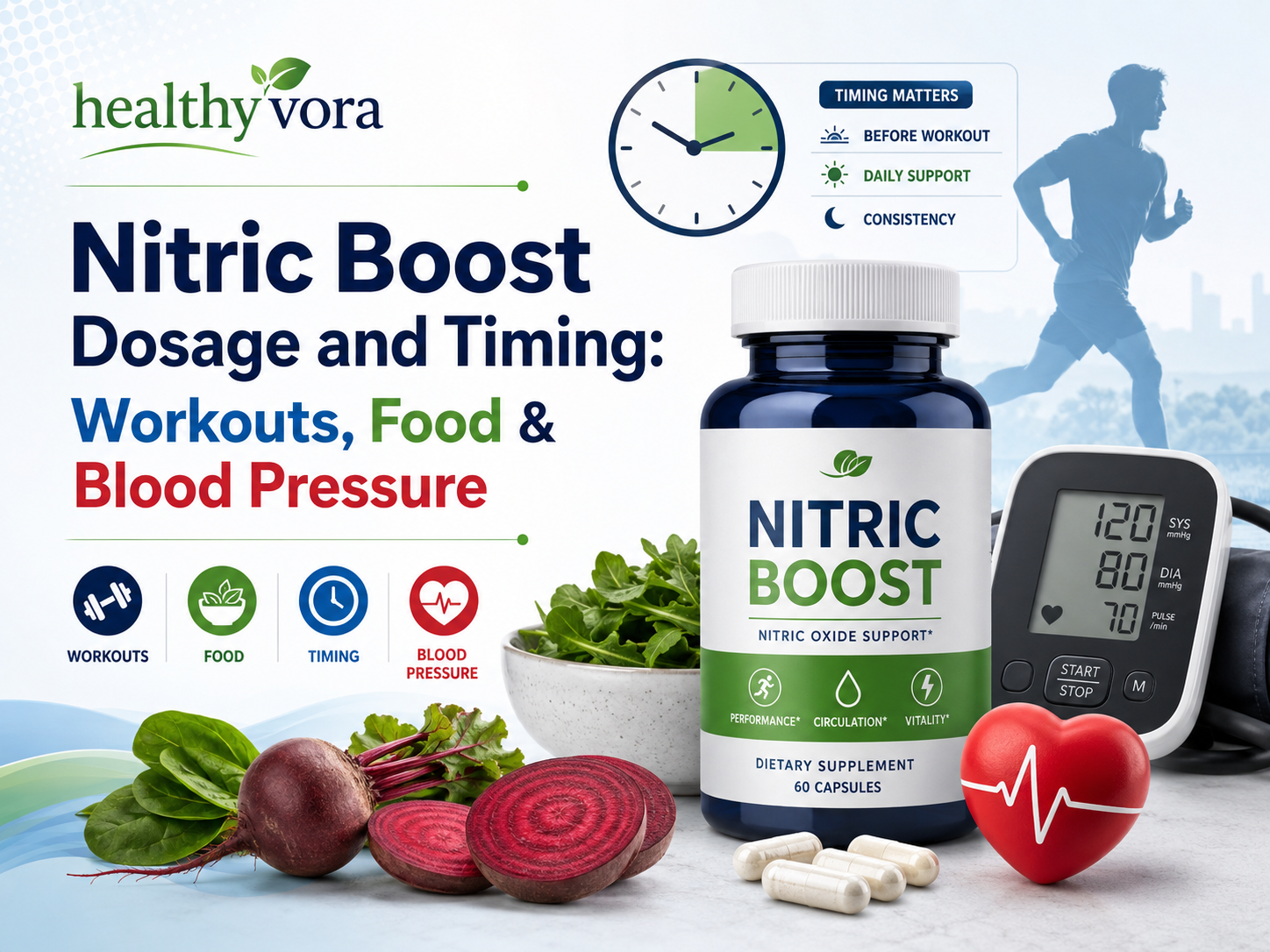
The published Nitric Boost directions are simple: take one scoop once daily, mixed with a glass of water, a smoothie, or tea. Do not add a second scoop for a harder workout or replace a missed serving. The product’s public directions do not require food and do not establish a clinically validated pre-workout window. Because the formula is designed to support nitric oxide and circulation, anyone using blood pressure drugs, prescription nitrates, blood thinners, or erectile dysfunction medication should ask a physician or pharmacist before taking it. HealthyVora explains the safest practical routine below without turning ingredient research into an unsupported product claim.
Nitric Boost Dosage and Timing at a Glance
| Question | Practical answer | Important caution |
|---|---|---|
| Daily dosage | One scoop once per day | Use the scoop supplied with the current container; do not double the serving |
| How to mix it | Mix thoroughly into a glass of water, smoothie, or tea | Do not combine it with another nitric oxide or “pump” product without professional review |
| Workout timing | No product-specific timing window has been clinically established | A 1–3 hour pre-workout trial is an ingredient-based estimate, not an official guarantee |
| With food | Food is not required in the published directions | Take it with a light meal if it causes nausea, flushing, or stomach discomfort |
| Blood pressure | It may affect vascular tone or lower pressure in some users | It must not replace prescribed blood pressure care |
What Is Nitric Boost and Why Does Timing Matter?
Nitric Boost is a powdered dietary supplement marketed for nitric oxide production, circulation, stamina, and male vitality. Public product materials identify ingredients such as beetroot powder, L-arginine, L-citrulline DL-malate, niacin, ginkgo biloba, dong quai, horny goat weed, and D-aspartic acid. The body can use dietary nitrate from beetroot and arginine-related pathways to produce nitric oxide, a signaling molecule involved in blood-vessel relaxation.
That mechanism makes timing sound more precise than the evidence allows. Ingredient amounts and standardization influence how a formula may act, so an ingredient list cannot establish an optimal minute-by-minute schedule. The NIH Office of Dietary Supplements describes evidence for arginine and citrulline as limited or conflicting, while beetroot research is more encouraging for some endurance activities but not universally positive.
How Much Nitric Boost Should You Take?
Take one scoop per day unless the current physical label or your clinician gives different instructions. The official Nitric Boost product page describes one daily scoop mixed into a glass of water, smoothie, or tea. “One scoop” means the included measuring scoop filled according to the label—not a kitchen spoon and not a heaping estimate.
- Read the Supplement Facts and directions on the container you received.
- Confirm the serving size and inspect the safety seal before use.
- Measure one serving with the supplied scoop.
- Mix it completely into your chosen nonalcoholic drink.
- Use it once that day and record any unusual symptom.
Do not “top up” before training. If you miss a day, resume the normal single serving the next day rather than doubling it. More powder does not reliably mean better performance and may increase headache, flushing, dizziness, or digestive discomfort.
What Is the Best Time to Take Nitric Boost for Workouts?
There is no proven best time for the complete Nitric Boost formula. Consistency and tolerance matter more than chasing an exact pre-workout minute. The product directions support daily use but do not establish that taking it immediately before exercise improves strength, endurance, or muscle pump.
A Practical Workout-Day Approach
After a clinician clears the product and you have tolerated it on a non-training day, you may test the single daily scoop about 1–3 hours before an ordinary workout. This range is extrapolated from individual-ingredient studies, not a proven Nitric Boost protocol. NIH notes that many beetroot-juice studies used the beverage about 2.5–3 hours before exercise, while one citrulline study used it one hour before testing. Beetroot powder has not been established as equivalent to the studied juice or concentrate.
Do not use your first serving before a race, maximum-effort session, or hot-weather event. If you feel lightheaded, unusually weak, nauseated, or unsteady, stop the workout and do not take another serving.
Morning, Evening, and Rest-Day Timing
Morning use can make adherence easier. Evening use is possible if the label permits it, but niacin-related warmth, digestive symptoms, or headache could disturb sleep. On rest days, take the same single serving at a consistent time and reassess use if you notice no meaningful benefit.
Should You Take Nitric Boost With Food?
The published directions do not require an empty stomach. Water is the simplest choice. A smoothie or tea is also listed as an option, but the drink’s other ingredients still count. A highly caffeinated tea or stimulant-heavy smoothie can make it difficult to know which ingredient caused palpitations, flushing, anxiety, or nausea.
If you have a sensitive stomach, use a light meal or snack and adequate water. A large meal immediately before exercise may make training uncomfortable. Do not mix the powder into alcohol, which can worsen dehydration, dizziness, and poor exercise judgment.
You do not need to “boost” the serving with extra beetroot, arginine, citrulline, niacin, or a second pre-workout. Stacking overlapping ingredients makes the total dose harder to calculate and may increase adverse effects without improving performance.
Can Nitric Boost Lower Blood Pressure?
Nitric Boost could lower blood pressure in some people, but it is not a blood pressure treatment. NIH reports that higher supplemental arginine intakes can slightly reduce blood pressure and cause gastrointestinal symptoms, while beetroot-derived nitrate may influence vascular function. Any Nitric Boost effect remains unpredictable because a published product-specific trial has not established its blood-pressure response.
Who Should Be Especially Careful?
Ask a physician or pharmacist before use if you have low blood pressure, hypertension, fainting episodes, heart disease, an irregular heartbeat, kidney or liver disease, a bleeding disorder, or a planned procedure.
How to Monitor Your Response Safely
- Know your usual blood-pressure range rather than reacting to one reading.
- If your clinician recommends monitoring, measure under the same resting conditions.
- Record the serving time, workout, symptoms, and reading.
- Stop and contact your clinician if readings are unexpectedly low for you or symptoms recur.
Seek urgent medical help for fainting, chest pain, severe shortness of breath, confusion, one-sided weakness, or signs of a serious allergic reaction. Do not stop a prescribed hypertension medicine because a supplement appears to change your readings.
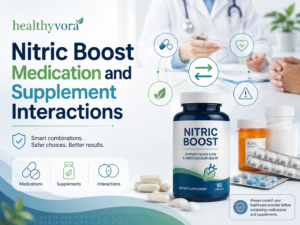
Nitric Boost Medication and Supplement Interactions
A complete medication review is more useful than asking whether one ingredient is “natural.” The FDA warns that supplements and medicines can interact, sometimes seriously. Bring the current Nitric Boost label—not only a website ingredient list—to your pharmacist.
- Prescription nitrates: Nitroglycerin and isosorbide are not the same as dietary nitrate in beetroot. However, both relate to vascular signaling, so anyone prescribed a nitrate should not add Nitric Boost without explicit medical approval.
- Blood pressure drugs: ACE inhibitors, ARBs, calcium-channel blockers, beta-blockers, diuretics, and alpha-blockers can affect blood pressure through different pathways. Adding a circulation supplement may increase dizziness or hypotension in a susceptible person.
- ED medicines: Sildenafil, tadalafil, and vardenafil affect blood-vessel relaxation. The combination with Nitric Boost has not been established as safe or effective. Do not combine them unless the prescriber who knows your cardiovascular history approves it.
- Anticoagulants and antiplatelet drugs: Ginkgo may increase bleeding risk with anticoagulants such as warfarin, according to NCCIH. Dong quai may also interact with warfarin. Aspirin, clopidogrel, and other blood-thinning regimens warrant professional review.
- Other performance products: Avoid stacking nitric oxide boosters, pump powders, male-enhancement products, high-dose niacin, or formulas containing overlapping amino acids and botanicals.
Why This Guidance Matters for U.S. Consumers
In the United States, the FDA does not approve dietary supplements before they are marketed. Facility registration or good manufacturing practices do not mean the finished product was FDA-approved for safety or effectiveness.
Verify the sealed container, current Supplement Facts, seller, lot information, and adverse-event contact. The FDA warns broadly that some sexual-enhancement products have contained hidden drugs. This does not prove Nitric Boost is adulterated, but it supports avoiding unknown resellers and “instant cure” claims.
Who Should Avoid Nitric Boost Until Medically Cleared?
- Anyone under 18, pregnant, or breastfeeding.
- People taking nitrates, blood thinners, blood pressure drugs, or ED medication.
- Anyone with cardiovascular, kidney, liver, or bleeding conditions.
- People preparing for an invasive procedure or allergic to a listed ingredient.
A professional should compare the actual label with your diagnoses, medicines, and other supplements.
Common Nitric Boost Dosage Mistakes to Avoid
- Taking two scoops for faster results: This increases exposure without proving greater benefit.
- Using the first dose before intense training: You do not yet know whether it will cause dizziness or stomach upset.
- Assuming beetroot-powder timing equals beetroot-juice research: Nitrate content and absorption may differ.
- Ignoring a proprietary blend: A serving direction does not reveal every ingredient’s individual amount.
- Combining it with ED drugs or pre-workouts: Your prescriber and pharmacist need the full list.
- Using it instead of medical care: Persistent fatigue, chest symptoms, erectile dysfunction, or abnormal pressure deserves assessment.
Why Use HealthyVora’s Label-First Approach?
HealthyVora separates verified directions from marketing claims and ingredient-level research. That distinction matters here: one scoop daily is a published product direction, while a precise pre-workout window and a guaranteed blood-pressure effect are not established. This approach helps readers discuss the product clearly with a U.S. physician or pharmacist and make a decision based on their own health profile.
Tips Before Adding Nitric Boost to Your Routine
- Photograph the current front label, Supplement Facts, other ingredients, warnings, and lot number.
- Give your pharmacist a complete list of prescriptions, OTC drugs, and supplements.
- Choose a calm first-use day without alcohol, extreme heat, or maximal training.
- Use one scoop consistently and track tolerance against a specific goal.
Final Answer on Nitric Boost Dosage and Timing
The safest general answer is one scoop once daily, mixed thoroughly into water or another label-approved beverage. Food is optional, but a light meal may improve tolerance. For workouts, no exact product-specific window is proven; a cautious 1–3 hour trial may be reasonable only after medical clearance and a successful tolerance test. Nitric Boost should never be used to self-treat blood pressure or combined casually with nitrates, ED drugs, blood thinners, blood pressure medicine, or overlapping performance supplements. see also.
HealthyVora CTA: Before ordering or starting Nitric Boost, review the current label with your pharmacist or clinician. If it fits your health plan, follow the one-scoop limit, keep your routine simple, and judge the product by both tolerability and realistic results—not by promises of an instant transformation.
Frequently Asked Questions
1. How much Nitric Boost should I take each day?
The published direction is one scoop once daily. Use the supplied scoop and follow the current container label.
2. What is the best time to take Nitric Boost?
No clinically proven best time exists for the complete formula. Choose a consistent time that you tolerate well.
3. Can I take Nitric Boost before a workout?
After medical clearance and a non-training tolerance test, you may try the single serving 1–3 hours before exercise. This is not a proven product-specific window.
4. Should I take Nitric Boost with food?
Food is not required by the published directions. A light meal may help if you experience nausea, flushing, or stomach discomfort.
5. Can I take two scoops on workout days?
No. Do not exceed the labeled daily serving or redose for a harder workout unless a qualified clinician gives different instructions.
6. Does Nitric Boost lower blood pressure?
It may lower pressure in some users, but the effect is unpredictable and it is not a treatment for hypertension.
7. Can I use Nitric Boost if I have high blood pressure?
Only after your physician or pharmacist reviews the formula alongside your condition and medications. Never stop prescribed treatment.
8. Can Nitric Boost be combined with sildenafil or tadalafil?
Do not combine them without approval from the prescriber. The safety of the combination has not been established, and both may affect vascular tone.
9. What should I do if I miss a serving?
Skip the missed serving and resume the normal one-scoop routine the next day. Do not double the dose.
10. How long does Nitric Boost take to work?
There is no reliable product-specific timeline. Responses vary, and no immediate or guaranteed workout, circulation, or sexual-performance result should be expected.