
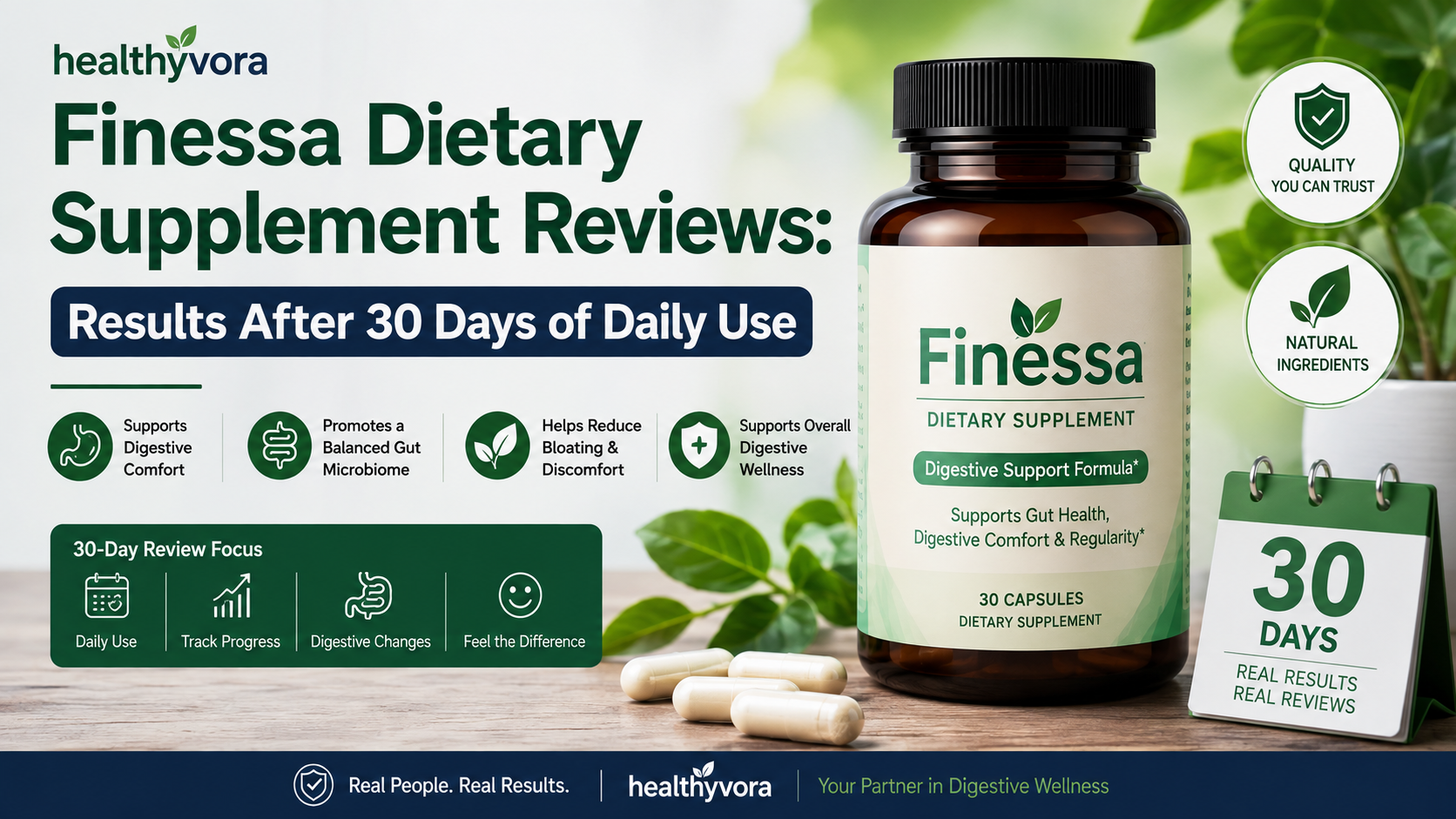
Finessa Dietary Supplement Reviews: Results After 30 Days of Daily Use
Finessa is marketed as a daily digestive-support supplement designed to support gut balance, digestive comfort, and regularity. But what can someone realistically expect after taking it consistently for 30 days? The most responsible answer is that results can vary substantially. Some users may notice changes in regularity or digestive comfort, while others may notice little difference. A 30-day trial also cannot establish guaranteed weight-loss, “detox,” or metabolic results.
This HealthyVora review examines Finessa from a practical U.S. consumer perspective, including its advertised ingredients, realistic 30-day expectations, potential limitations, safety considerations, and the questions worth asking before purchasing.
Visit Official Website
What Is Finessa Dietary Supplement?
Finessa is marketed as a digestive and gut-health dietary supplement. Current product information describes a formula built around botanical ingredients and digestive-support components, with versions of the product marketed around probiotics, prebiotics, dandelion, milk thistle or silymarin, turmeric, artichoke, cascara sagrada, and licorice.
The basic concept is to support several aspects of digestion rather than focusing on a single nutrient. Marketing around Finessa frequently discusses digestive comfort, bowel regularity, the gut microbiome, and the relationship between the digestive system and liver.
That distinction matters: supporting normal digestive function is different from treating a gastrointestinal disease. Finessa should not be viewed as a replacement for medical evaluation when symptoms are persistent, severe, or unexplained.
Finessa Results After 30 Days: What Should You Realistically Expect?
After 30 days of daily Finessa use, the most realistic areas to evaluate are bowel regularity, bloating, digestive comfort, tolerance, and consistency—not dramatic weight loss or a guaranteed physical transformation.
There does not appear to be sufficient publicly available product-specific clinical evidence to conclude that every Finessa user will achieve a defined result within exactly 30 days. Research on individual ingredients can help explain why a formula may have been developed, but evidence for an ingredient is not automatically evidence for the finished supplement.
| Area to Evaluate | What to Look for After 30 Days | Expectation |
|---|---|---|
| Digestive comfort | Changes in post-meal discomfort or fullness | Individual results vary |
| Bloating | Frequency and severity compared with baseline | May improve, remain unchanged, or fluctuate |
| Bowel regularity | Consistency and frequency of bowel movements | Potentially noticeable depending on formula and individual response |
| Gut support | Overall digestive tolerance and routine | Difficult to measure without clinical testing |
| Body weight | Changes measured under consistent conditions | Do not assume significant fat loss from a supplement alone |
| Energy | Subjective changes during normal daily activities | Highly individual and influenced by sleep, diet, and lifestyle |
A Practical Week-by-Week Look at a 30-Day Finessa Trial
A useful supplement review should separate what is possible from what is guaranteed. Instead of assuming everyone follows the same timeline, consumers can use four weeks to systematically observe their own response.
Days 1–7: Focus on Tolerance
The first week is primarily about determining how your digestive system responds. Changes in bowel habits, abdominal sensations, gas, or stool consistency are more useful observations than expecting visible body-composition changes.
Botanical ingredients and products affecting bowel regularity can produce different responses from one person to another. A new supplement should not be interpreted as “working better” simply because it produces a stronger gastrointestinal effect.
Days 8–14: Look for Patterns
By the second week, compare your experience with your normal baseline. Are bowel movements more predictable? Has bloating changed? Are you experiencing new discomfort?
Keep other lifestyle variables reasonably consistent where practical. Dramatically changing your diet, exercise routine, sleep schedule, and supplement regimen simultaneously makes it difficult to determine what caused a change.
Days 15–21: Evaluate Consistency
A single good or bad digestive day provides limited information. During week three, look for recurring patterns rather than isolated experiences.
If probiotics are part of the current formulation, remember that probiotic effects can be strain-specific. The NIH Office of Dietary Supplements notes that different probiotic strains can have different effects, meaning the word “probiotic” alone does not establish a particular health outcome.
Days 22–30: Compare With Your Starting Point
At the end of 30 days, evaluate the same factors you recorded at the beginning. This makes your assessment more useful than relying on memory alone.
The key question is not simply, “Did I feel something?” It is: “Did a meaningful and consistent improvement occur without unacceptable side effects?”
How to Track Finessa Results for 30 Days
The easiest way to judge Finessa is to establish a baseline and track a small number of relevant measurements consistently.
- Record your normal level of bloating and digestive comfort before starting.
- Track bowel frequency and major changes in stool consistency.
- Record any new gastrointestinal symptoms or other unwanted effects.
- Keep notes on major dietary changes that could influence digestion.
- If weight is relevant to your goal, measure it under comparable conditions rather than repeatedly throughout the day.
- Review your notes at days 7, 14, 21, and 30.
- Stop and seek professional advice if you develop concerning or persistent symptoms.
This approach does not turn a personal experiment into a clinical study, but it can reduce recall bias and make your decision after 30 days more objective.
What Ingredients Are Associated With Finessa?
Current Finessa marketing materials describe various plant-based and digestive-support ingredients. Because supplement formulas and labels can change, U.S. buyers should verify the actual Supplement Facts panel on the product they intend to purchase rather than relying exclusively on a review article.
Probiotics and Prebiotics
Probiotics are live microorganisms that can provide health benefits when consumed in adequate amounts. They primarily act in the digestive tract, but their effects depend on factors such as the microorganism and strain.
That is why consumers should look beyond a large CFU number. The strain identity, storage requirements, amount available through shelf life, and evidence related to that particular strain can all matter.
Dandelion
Dandelion is a botanical with a history of traditional use and contains various plant compounds. Its presence in a supplement should not, however, be interpreted as proof that the complete product has been clinically demonstrated to produce a specific digestive outcome.
Milk Thistle and Silymarin
Milk thistle is commonly associated with liver-focused supplements, while silymarin refers to a group of compounds obtained from milk thistle. Finessa’s marketing of the “gut-liver” concept helps explain why an ingredient of this type may appear in the formula.
Turmeric
Turmeric contains curcuminoids, including curcumin, and is widely used in dietary supplements. Research on curcumin does not automatically establish the effectiveness of a multi-ingredient Finessa formula because dosage, formulation, absorption, and other ingredients can affect outcomes.
Artichoke Extract
Artichoke is another botanical frequently marketed for digestive support. As with the other ingredients, consumers should check the exact quantity and form provided on the current label.
Cascara Sagrada
Cascara sagrada deserves particular attention because it is associated with laxative effects. A change in bowel movements after taking a product containing cascara should therefore not automatically be described as evidence that the gut microbiome has been “repaired” or that body fat has been lost.
If the current Finessa product you are considering contains cascara sagrada, discuss prolonged or frequent use with an appropriate healthcare professional, particularly if you already experience gastrointestinal problems.
Does Finessa Work for Bloating and Digestive Health?
Finessa may provide digestive support for some people, but there is not enough product-specific evidence to guarantee that it will reduce bloating or improve digestion for every user.
Bloating itself can have many causes. Meal size, fiber intake, constipation, food intolerance, carbonated beverages, gastrointestinal disorders, and other factors can influence symptoms.
This is also why online Finessa reviews should be interpreted carefully. A person’s improvement may be genuine while still not proving that another person will experience the same result.
Does Finessa Cause Weight Loss After 30 Days?
Finessa should not be expected to produce guaranteed or substantial fat loss within 30 days. Any claim that a digestive supplement automatically causes dramatic weight reduction should be approached cautiously.
Changes in bowel contents, hydration, food intake, and bloating can affect scale weight and waist measurements without representing an equivalent reduction in body fat.
The NIH Office of Dietary Supplements notes that research on probiotics and body weight has produced mixed findings: some studies suggest small reductions, while others show no benefit or even increases. This makes dramatic weight-loss conclusions inappropriate based simply on the presence of probiotics.
A flatter-feeling abdomen after reduced bloating is not the same biological outcome as losing a significant amount of body fat.
Finessa Reviews: How Much Should You Trust Customer Testimonials?
Customer reviews can help identify patterns involving taste, convenience, delivery, tolerance, or general experience. They are much weaker evidence for establishing whether a dietary supplement causes a specific medical or physiological result.
Positive and negative reviews can both be affected by expectations, lifestyle changes, individual health differences, selection bias, and marketing practices.
When reading Finessa supplement reviews, prioritize detailed accounts that explain how long the product was used, what changed, whether other habits changed simultaneously, and whether the reviewer discloses an affiliate or commercial relationship.
Be particularly cautious with testimonials promising effortless major weight loss, cures, guaranteed “detoxification,” or identical results for everyone.
Is Finessa FDA Approved?
No dietary supplement should be described as FDA-approved for safety and effectiveness in the way an approved drug is. In the United States, the FDA does not approve dietary supplements for safety and effectiveness before they are marketed.
This distinction is especially important because supplement websites sometimes refer to products as being manufactured in an “FDA-registered” facility. Facility registration does not mean that the FDA has approved the supplement or endorsed its health claims. see also.
For U.S. consumers—from New York and Florida to Texas and California—the more useful questions involve label transparency, manufacturing standards, ingredient quantities, appropriate claims, and whether the supplement is suitable for the individual’s circumstances.
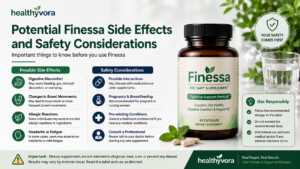
Potential Finessa Side Effects and Safety Considerations
“Natural” does not automatically mean risk-free. Botanical ingredients, probiotics, and other dietary supplement components can produce unwanted effects or interact with medications.
Depending on the exact current formula and individual sensitivity, digestive products may be associated with changes such as gas, cramping, loose stools, or altered bowel habits.
Before using Finessa, consider professional medical advice if you:
- take prescription or over-the-counter medications regularly;
- are pregnant or breastfeeding;
- have a diagnosed gastrointestinal, liver, kidney, or other medical condition;
- have unexplained or persistent digestive symptoms;
- are already taking laxatives or multiple digestive supplements; or
- have previously reacted to botanical or probiotic products.
The FDA advises consumers to discuss dietary supplements with a doctor, pharmacist, or other healthcare professional because supplements can involve health risks and interactions.
Visit Official Website
Why U.S. Consumers Should Examine the Supplement Facts Label
American consumers have access to an enormous dietary supplement market, but the regulatory framework differs significantly from prescription medications.
The FDA states that dietary supplement labels are required to provide a Supplement Facts panel containing information such as serving size, dietary ingredients, and amounts per serving. Checking that panel is one of the most important steps before purchasing. see also.
Look for the exact ingredients and quantities, serving instructions, manufacturer or distributor information, warnings, allergen information where relevant, lot and expiration information, and any available independent quality-testing information.
Why Read HealthyVora’s Finessa Review Before Making a Decision?
HealthyVora approaches Finessa as a product that should be evaluated rather than automatically promoted. For supplements, that means separating marketing claims from reasonable expectations and distinguishing evidence about individual ingredients from evidence about the finished formula.
A useful review should also acknowledge uncertainty. If reliable product-specific clinical data are unavailable, the responsible approach is to say so rather than converting customer testimonials or ingredient studies into guaranteed Finessa results.
This evidence-aware approach gives consumers a clearer framework for deciding whether Finessa fits their personal wellness goals.
What to Check Before Buying Finessa
Before purchasing, verify the current product information directly from the label and seller. Formulas, pricing, promotions, and policies can change.
- Supplement Facts: Confirm every ingredient and amount per serving.
- Probiotic details: Look for strains rather than relying only on a general probiotic claim.
- Serving instructions: Never assume that taking more will produce faster results.
- Warnings: Review contraindications and medication considerations.
- Seller identity: Know who is actually processing and fulfilling the order.
- Return policy: Read the current terms rather than relying on an older review.
- Marketing claims: Treat guaranteed weight-loss or disease-treatment promises as warning signs.
Common Mistakes When Trying Finessa for 30 Days
Expecting a Dramatic Transformation
Thirty days is better viewed as an initial evaluation period than a deadline for major physical transformation.
Confusing Regularity With Fat Loss
More frequent bowel movements can change scale weight temporarily, but that does not establish a corresponding reduction in body fat.
Changing Everything at Once
Starting a restrictive diet, several supplements, and a new training program on the same day makes it difficult to determine what influenced your results.
Ignoring the Product Label
An online article should never replace the current Supplement Facts panel. Always evaluate the product actually being sold.
Continuing Despite Concerning Symptoms
Persistent pain, severe diarrhea, bleeding, significant vomiting, or other concerning symptoms deserve appropriate medical attention rather than simply increasing or continuing a supplement.
Finessa Dietary Supplement Review: Final Verdict After 30 Days
Finessa is best evaluated as a digestive-support supplement rather than a guaranteed 30-day weight-loss solution. Its marketed combination of botanical and gut-focused ingredients provides a plausible reason for consumer interest, but individual ingredient research should not be mistaken for clinical proof of the finished product.
A sensible 30-day evaluation focuses on digestive comfort, bowel regularity, bloating, tolerance, and whether any improvement is consistent enough to matter. Results will vary based on diet, baseline digestive health, medications, lifestyle, and the exact formulation used.
U.S. consumers should also remember that dietary supplements are not FDA-approved for safety and effectiveness before reaching the market. Verify the current label, ingredient quantities, warnings, seller, and return terms before purchasing.
For readers comparing Finessa reviews and trying to separate marketing claims from realistic expectations, HealthyVora recommends making the decision based on transparent product information, personal health needs, and appropriate professional guidance—not dramatic testimonials alone.
Frequently Asked Questions About Finessa
1. What results can I expect from Finessa after 30 days?
Results vary. The most relevant changes to monitor are digestive comfort, bloating, bowel regularity, and tolerance. There is no reliable basis for guaranteeing identical 30-day results for every user.
2. Does Finessa really work?
Some ingredients associated with Finessa have been researched individually, but that does not prove that the complete Finessa formula will produce a specific result for everyone.
3. Can Finessa reduce belly fat in 30 days?
Finessa should not be treated as a guaranteed belly-fat-loss product. Reduced bloating or changes in bowel contents are not equivalent to losing body fat.
4. Is Finessa a probiotic?
Current Finessa marketing describes probiotics as part of its digestive-support approach. Check the latest Supplement Facts label for the exact organisms, strains, amounts, and formulation.
5. How long does Finessa take to work?
There is no scientifically established universal Finessa timeline. Individual responses can depend on the ingredients, dosage, baseline health, diet, and other factors.
6. Is Finessa FDA approved?
No dietary supplement is FDA-approved for safety and effectiveness before marketing in the same manner as an approved drug. An FDA-registered manufacturing facility should not be confused with FDA product approval.
7. Can Finessa cause side effects?
Potential effects depend on the current formula and the individual. Digestive supplements can cause changes such as gas, cramping, loose stools, or altered bowel habits in some people.
8. Can I take Finessa with medications?
Do not assume that a natural supplement cannot interact with medication. Ask a doctor or pharmacist to review the current ingredient label if you take medications.
9. Are Finessa customer reviews reliable?
Reviews can describe personal experiences but cannot prove effectiveness. Look for detailed, transparent reviews and distinguish testimonials from controlled clinical evidence.
10. Is Finessa worth trying for 30 days?
That depends on your goals, the current formula, cost, health status, and expectations. If you try it, track measurable digestive outcomes and evaluate the experience objectively rather than expecting guaranteed weight loss.
Make an Informed Decision With HealthyVora
If you are considering Finessa, use the current ingredient label, realistic expectations, and your own health circumstances as the basis for your decision. HealthyVora helps readers evaluate dietary supplements with a practical focus on ingredients, evidence, safety, and transparent claims so the next step is informed rather than driven by hype.