
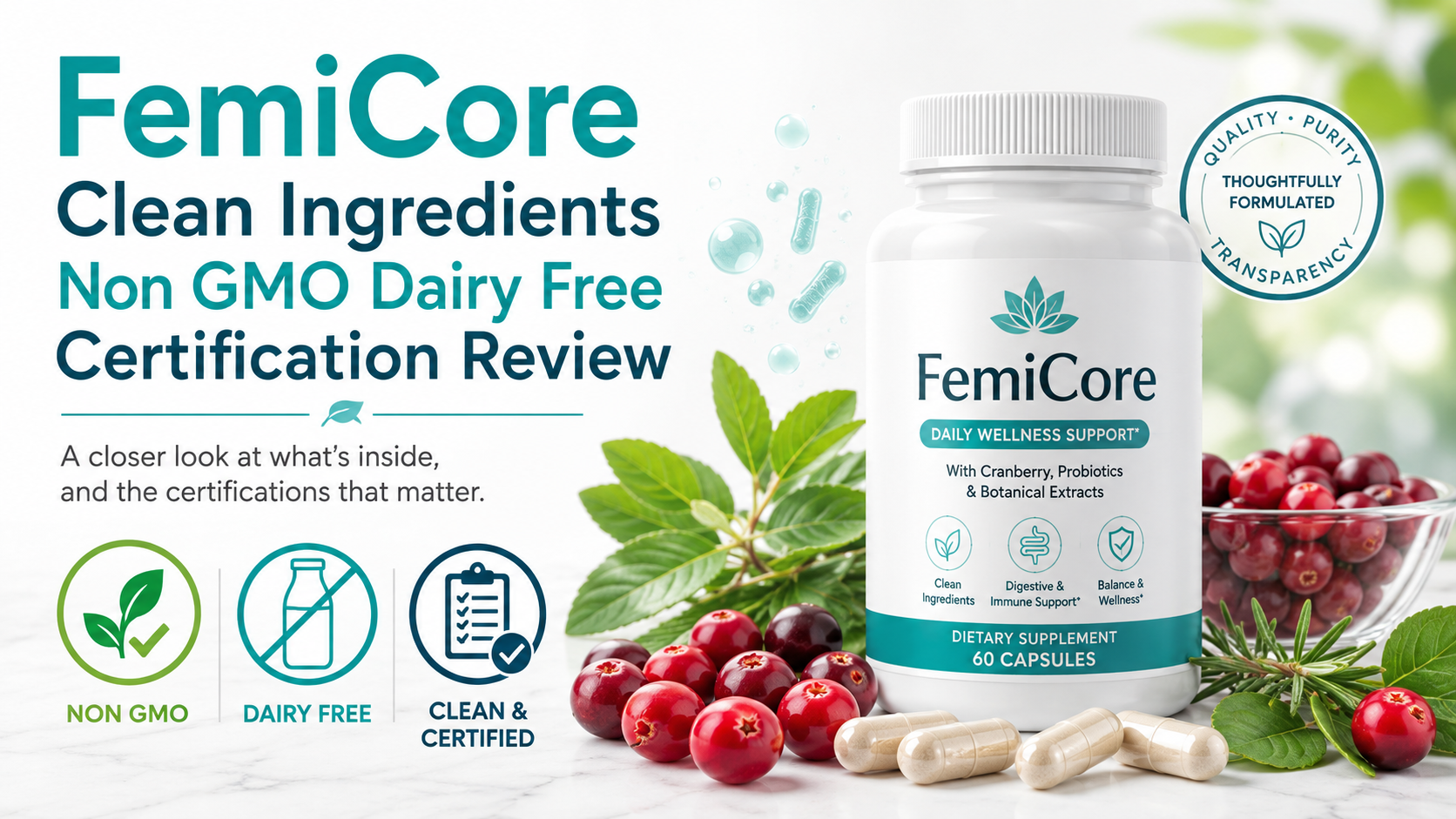
FemiCore Clean Ingredients Non GMO Dairy Free Certification Review
FemiCore is marketed in the United States as a women’s dietary supplement made with botanical ingredients and Lactobacillus probiotics, and its current product website describes the formula as non-GMO and manufactured according to Good Manufacturing Practices. However, consumers should distinguish these manufacturer claims from independent certification. HealthyVora’s review found clear support for the non-GMO marketing claim, but we did not find sufficient public evidence to describe FemiCore as independently Non-GMO Project Verified or formally dairy-free certified.
ORDER TODAY
What Does “Clean Ingredients” Mean for FemiCore?
For FemiCore, “clean ingredients” is best understood as a description of the formula rather than an official certification. The phrase “clean ingredients” does not automatically prove that a supplement meets a single government-defined clean-label standard. Consumers should therefore evaluate the actual Supplement Facts panel, additional ingredients, allergen information, manufacturing standards, and independent certifications instead of relying on the word “clean” alone.
The current FemiCore product information lists a botanical-and-probiotic formula. One current label presentation identifies a 350 mg herbal blend containing Mimosa pudica seed extract, cranberry extract standardized to 30% proanthocyanidins, bearberry leaf, and berberine hydrochloride extract. It also identifies a 50 mg probiotic blend containing five Lactobacillus strains.
The additional ingredients reported with the current formula include gelatin, brown rice flour, magnesium stearate, olive oil, and silicon dioxide. This is important for shoppers because “natural” or “clean” should never be interpreted as meaning that a capsule contains nothing beyond its headline botanical ingredients.
FemiCore Ingredients at a Glance
| Ingredient or Formula Component | What the Current Label Indicates | What Consumers Should Know |
|---|---|---|
| Mimosa pudica seed extract | Part of the herbal blend | Botanical ingredient; do not assume a clinically tested individual dose because the blend does not disclose every ingredient amount separately. |
| Cranberry extract | Listed as standardized to 30% proanthocyanidins in current label information | Commonly associated with urinary wellness formulations. |
| Bearberry / Uva ursi | Part of the herbal blend | A botanical that deserves additional caution for people taking medications or managing medical conditions. |
| Berberine | Included in the herbal blend | May interact with medicines, making professional guidance important for some users. |
| Lactobacillus crispatus | Part of the probiotic blend | One of several Lactobacillus strains used in microbiome-focused products. |
| L. acidophilus, L. plantarum, L. gasseri and L. casei | Included in the probiotic blend | The current presentation identifies the strains but does not provide an individual CFU count for each strain. |
| Gelatin | Reported as a capsule ingredient | Means the current capsule should not automatically be considered vegan or vegetarian. |
The biggest transparency limitation is the use of proprietary blends. The total quantities of the herbal and probiotic blends may be listed, while the amount of each individual botanical and probiotic strain is not necessarily disclosed separately. This makes it harder to compare each ingredient with quantities used in published studies.
Is FemiCore Non-GMO?
FemiCore is currently marketed as non-GMO, but a non-GMO claim should not automatically be treated as proof of independent Non-GMO Project verification.
The current FemiCore website explicitly describes the ingredients as non-GMO. That supports describing FemiCore as manufacturer-claimed non-GMO.
Independent certification is a different question. The Non-GMO Project operates a formal Product Verification Program under its own standard. A product enrolled and successfully verified through that program can carry the organization’s recognized verification mark.
For shoppers, the practical difference is simple:
- “Non-GMO” on product marketing: a claim made about the ingredients or formula.
- “Non-GMO Project Verified”: evidence that the product has completed the organization’s verification process.
HealthyVora did not locate sufficient public evidence during this review to confirm that the current FemiCore formula carries Non-GMO Project Verified status. Unless the current bottle, manufacturer documentation, or verification database confirms it, consumers should not treat the two descriptions as interchangeable.
Is FemiCore Dairy-Free?
A definitive dairy-free certification for FemiCore could not be confirmed from the current public product information reviewed by HealthyVora.
The ingredient information we reviewed lists gelatin, brown rice flour, magnesium stearate, olive oil, and silicon dioxide among the additional ingredients, without listing an obvious milk-derived ingredient. However, an ingredient list that does not visibly contain milk is not the same thing as a certified dairy-free claim.
This distinction is particularly important for people with a medically diagnosed milk allergy. In the United States, milk is one of the major food allergens covered by federal labeling requirements, and FDA advises consumers with allergies to review the complete ingredient and allergen information rather than relying on front-label marketing alone.
If avoiding dairy is medically necessary rather than a personal preference, confirm the current bottle’s allergen statement and manufacturing information before use.
Also remember that dairy-free and vegan are different claims. Gelatin is not a dairy ingredient, but conventional gelatin is animal-derived. Because gelatin is reported in the current FemiCore capsule, the product should not automatically be described as vegan.
Is FemiCore FDA Approved?
No dietary supplement should be described as FDA approved in the same way an FDA-approved drug is. The FDA explicitly states that it does not approve dietary supplements for safety and effectiveness before they are marketed.
This point matters because supplement websites sometimes display language such as “FDA approved,” “FDA registered,” “FDA compliant facility,” or similar phrases. These terms do not mean the same thing.
The current FemiCore website says the supplement is made in an FDA-compliant facility and separately displays an “FDA Approved” heading. For U.S. consumers, the more accurate interpretation is that facility registration or regulatory compliance does not represent FDA premarket approval of FemiCore itself.
FDA explains that dietary supplement manufacturers and distributors are primarily responsible for ensuring their products meet applicable safety and labeling requirements before marketing. FDA oversight includes inspections, marketplace monitoring, adverse-event review, and enforcement when products violate federal requirements.
What Does FemiCore GMP Certification Mean?
GMP relates to manufacturing controls and product consistency; it does not prove that a supplement delivers a specific health result.
FemiCore’s current website states that the product follows Good Manufacturing Practices and describes its manufacturing as GMP certified. In the United States, dietary supplement manufacturing is subject to current Good Manufacturing Practice requirements under 21 CFR Part 111. These rules address manufacturing, packaging, labeling, quality processes, and recordkeeping.
A GMP claim is therefore relevant when assessing manufacturing quality, but it should not be interpreted as clinical certification of effectiveness. Buyers who want the strongest verification can ask who issued the GMP certification, whether the facility is independently audited, and whether a current certificate is available.
Why Ingredient and Certification Transparency Matters in the United States
American supplement shoppers face a marketplace very different from the prescription-drug system. Dietary supplements generally do not go through FDA premarket approval for effectiveness, so label literacy and manufacturer transparency become especially important.
Whether someone is ordering from California, Texas, Florida, New York, or elsewhere in the United States, the same core questions are worth asking: What is actually on the Supplement Facts panel? Are individual doses disclosed? Are dietary claims independently verified? Does the label identify allergens? What organization stands behind a certification logo?
This approach is more useful than choosing a supplement because of words such as “premium,” “natural,” or “clean.” Those descriptions can provide context, but specific label information is what allows meaningful comparison.
ORDER TODAY
How to Verify FemiCore Before Buying
A careful review takes only a few steps and can prevent confusion between marketing claims and documented certifications.
- Read the current Supplement Facts panel. Formulas can change, so prioritize the bottle you are actually purchasing.
- Check the complete “Other Ingredients” section. This can reveal capsule materials, fillers, flow agents, and ingredients relevant to dietary preferences.
- Look for a milk or allergen statement. This is especially important for anyone with a food allergy.
- Identify the certification organization. Do not assume every GMP or non-GMO icon represents the same type of independent verification.
- Verify third-party seals independently. If a product claims Non-GMO Project verification or another recognized certification, check the certifier rather than relying solely on a retailer page.
- Review medication interactions. Botanicals such as berberine and bearberry deserve additional attention if you take prescription medicines.
- Discuss persistent urinary symptoms with a clinician. A supplement is not a substitute for diagnosis of urinary tract infection, incontinence, kidney disease, or another medical condition.
Potential Advantages of the FemiCore Formula
- The formula combines botanical ingredients and Lactobacillus probiotics rather than relying on a single ingredient.
- The current marketing explicitly identifies the product as non-GMO.
- Current product information provides recognizable ingredient names rather than describing the entire formula only as an unnamed proprietary complex.
- Cranberry extract is standardized to a stated proanthocyanidin percentage in the label information reviewed.
- FemiCore states that it follows GMP manufacturing practices.
These are useful characteristics, but none should be converted into a guarantee of medical results. Ingredient quality, dosage, individual health status, medication use, and the evidence for the finished formulation all matter.
Limitations Buyers Should Understand
The main limitation is dosage transparency. Proprietary blends make it difficult to determine how much of each individual botanical or probiotic strain a serving contains.
There is also an important certification gap. While FemiCore is marketed as non-GMO, HealthyVora could not verify an independent Non-GMO Project certification from the information reviewed. Similarly, a formal dairy-free certification was not confirmed. see also.
Finally, ingredient research should not be confused with evidence for the finished product. Research involving cranberry, Lactobacillus species, or another individual component does not automatically prove that the complete FemiCore formula will produce a particular outcome for every user.
Why Use HealthyVora When Researching FemiCore?
HealthyVora focuses on separating verifiable product information from promotional interpretation. That is particularly useful with dietary supplements, where similar-looking claims can have very different meanings.
Instead of treating “non-GMO,” “GMP,” “FDA,” and “dairy-free” as interchangeable quality badges, HealthyVora evaluates each claim independently. The goal is to help U.S. readers understand what the label says, what a certification actually represents, and where additional verification is appropriate before buying.
This approach does not require calling FemiCore either perfect or ineffective. A useful supplement review should make the evidence easier to understand so consumers can decide whether the formula, ingredient transparency, dietary characteristics, and safety considerations fit their own needs.
Common Mistakes to Avoid When Evaluating FemiCore
- Assuming “FDA registered” means FDA approved. Dietary supplements are not pre-approved by FDA for safety and effectiveness.
- Treating a non-GMO claim as independent certification. Ask which organization verified the claim.
- Assuming dairy-free because milk is not obvious in the headline ingredients. Check the complete allergen statement.
- Calling FemiCore vegan. Current ingredient information reports a gelatin capsule.
- Ignoring proprietary-blend limitations. Total blend weight does not tell you the exact quantity of every ingredient.
- Using a supplement to self-treat unexplained urinary symptoms. Persistent, painful, bloody, or rapidly worsening urinary symptoms warrant professional assessment.
FemiCore Clean Ingredients and Certification Review: Final Verdict
FemiCore has several clean-label characteristics that may appeal to U.S. supplement shoppers, but its certification claims should be interpreted carefully. The current product information supports describing the formula as manufacturer-claimed non-GMO and identifies botanical ingredients plus five Lactobacillus strains. It also states that FemiCore follows GMP manufacturing practices.
What should not be overstated is equally important. We did not verify an independent Non-GMO Project seal or a formal dairy-free certification from the current public information reviewed. The reported gelatin capsule also means shoppers should not assume the product is vegan.
The best purchasing decision therefore comes from reading the current bottle rather than relying only on promotional badges. Compare the Supplement Facts panel, allergen information, manufacturing documentation, certification issuer, and your own health considerations.
If you are researching FemiCore or comparing women’s wellness supplements in the United States, use HealthyVora to review ingredient details, label claims, certification terminology, and safety considerations before deciding what fits your needs. When medications, allergies, pregnancy, or persistent urinary symptoms are involved, discussing the product with a qualified healthcare professional is the logical next step.
Frequently Asked Questions About FemiCore Ingredients and Certifications
1. Is FemiCore non-GMO?
FemiCore is currently marketed by the product website as non-GMO. However, HealthyVora did not verify independent Non-GMO Project certification during this review.
2. Is FemiCore Non-GMO Project Verified?
We did not find sufficient public evidence to confirm current Non-GMO Project Verified status. A manufacturer’s non-GMO claim and independent Non-GMO Project verification are not the same thing.
3. Is FemiCore dairy-free?
The reviewed ingredient information does not list an obvious dairy ingredient, but HealthyVora could not confirm a formal dairy-free certification. Anyone with a milk allergy should verify the current product label and allergen statement.
4. Is FemiCore vegan?
Current ingredient information lists gelatin as part of the capsule, so FemiCore should not be assumed to be vegan.
5. What are the main FemiCore ingredients?
Current label information lists Mimosa pudica, cranberry extract, bearberry, berberine, and five Lactobacillus probiotic strains.
6. Is FemiCore FDA approved?
No dietary supplement is FDA approved for safety and effectiveness before marketing in the same way an approved drug is. FDA explicitly states that it does not pre-approve dietary supplements.
7. Is FemiCore GMP certified?
The current FemiCore website states that the supplement follows GMP standards and describes it as GMP certified. Buyers seeking independent verification can request details about the certifying organization and facility audit.
8. Does FemiCore disclose every ingredient dose?
No. Current label information gives total weights for the herbal and probiotic proprietary blends but does not disclose a separate quantity for every individual ingredient.
9. Does FemiCore contain probiotics?
Yes. Current product information lists five Lactobacillus strains, including L. crispatus, L. acidophilus, L. plantarum, L. gasseri, and L. casei.
10. What should I check before taking FemiCore?
Review the current label, ingredients, allergen information, dosage directions, and certifications. Speak with a healthcare professional if you take medication, are pregnant or nursing, have allergies, or have ongoing urinary symptoms.