
Arctic Blast vs Biofreeze: DMSO Drops vs Menthol Gel, Price & Safety
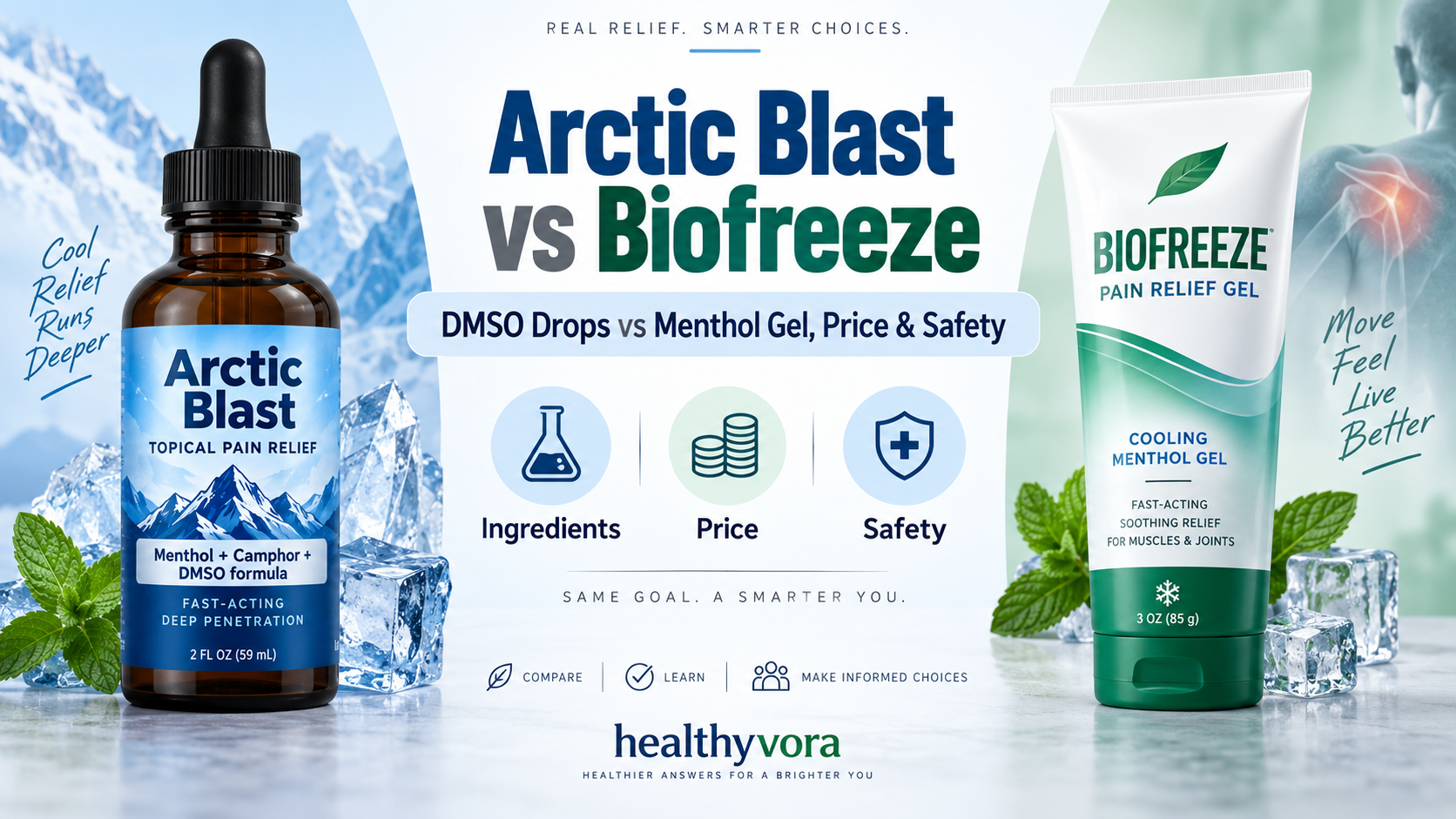
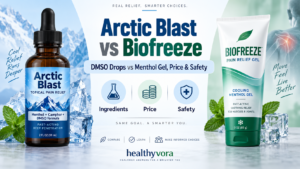
Arctic Blast and Biofreeze are both topical products for temporary muscle and joint pain relief, but they differ significantly in formulation, format, price, and how their labels describe their active ingredients. Arctic Blast is a liquid applied in drops and contains DMSO in its formula; however, its current U.S. Drug Facts label identifies menthol 10% and camphor 3% as the active analgesic ingredients, while DMSO is listed among the inactive ingredients. Biofreeze standard gel uses menthol 4% as its active ingredient. For most U.S. shoppers, Biofreeze is also considerably less expensive and easier to find locally.
Visit Official Website
Arctic Blast vs Biofreeze: Quick Answer
Bottom line: Biofreeze is the more straightforward choice if you want a widely available, lower-cost menthol gel with simple OTC labeling. Arctic Blast may appeal to shoppers specifically interested in a concentrated liquid formula containing DMSO, menthol, and camphor, but it costs substantially more and DMSO should not be treated as a proven topical treatment for arthritis or musculoskeletal disease.
Both products are intended for temporary relief rather than treatment of the underlying cause of chronic joint or muscle pain. Their labels cover conditions such as simple backache, arthritis-related aches, strains, bruises, and sprains.
Arctic Blast vs Biofreeze Comparison Table
| Feature | Arctic Blast | Biofreeze Gel |
|---|---|---|
| Product type | Topical liquid/dropper | Topical gel |
| Current labeled active ingredients | Menthol 10%, Camphor 3% | Menthol 4% |
| DMSO | Yes, listed as an inactive ingredient | No DMSO listed in standard gel |
| Primary sensation | Strong cooling/counterirritant effect | Cooling menthol effect |
| Typical application | Small amount of liquid to affected area | Thin film of gel to affected area |
| OTC labeled use | Temporary relief of minor muscle and joint aches | Temporary relief of minor muscle and joint aches |
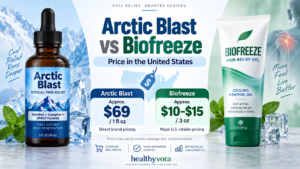
| Approximate U.S. price checked Sept. 2026 | $69 for one 1-fl-oz bottle from the manufacturer | About $10–$15 for many 3-fl-oz gel options at major retailers |
| Availability | Primarily direct-to-consumer/online | Widely available online and in U.S. retail pharmacies and stores |
Arctic Blast’s current manufacturer page lists one bottle at $69, with lower per-bottle pricing for multi-bottle purchases. Current Walmart listings place several 3-oz Biofreeze gel products around the $10–$15 range, depending on formula and promotion. Prices can change by retailer, location, package size, and sale period.
What Is Arctic Blast?
Arctic Blast is a topical pain-relieving liquid sold in a 1-fl-oz dropper bottle. Its current DailyMed listing classifies it as an OTC topical analgesic and identifies menthol 10% and camphor 3% as the active ingredients. Its labeled uses include temporary relief of minor pain associated with arthritis, sprains, strains, bruises, and simple backache.
The formula also contains DMSO, or dimethyl sulfoxide, along with ingredients such as aloe vera, arnica, calendula, emu oil, glycerin, St. John’s wort, methyl salicylate, olive-derived ingredients, and alcohol. Importantly, the Drug Facts record lists DMSO among the inactive ingredients, not as one of the product’s active OTC analgesic ingredients.
Why Is Arctic Blast Often Called a DMSO Pain Relief Product?
The manufacturer emphasizes DMSO in its marketing because DMSO readily crosses biological membranes and is frequently discussed in connection with topical absorption. That marketing emphasis explains why users commonly search for terms such as “Arctic Blast DMSO drops.” It does not change the current Drug Facts classification of menthol and camphor as the active analgesic ingredients.
What Is Biofreeze Gel?
Standard Biofreeze Pain Relief Gel is a topical OTC analgesic centered on menthol 4%. Biofreeze describes the gel as suitable for sore muscles and joints, simple backache, arthritis, strains, bruises, and sprains. It is available in several formats, including gel tubes, pumps, roll-ons, sprays, and other formulas.
The standard gel is therefore easier to understand from an ingredient perspective: its primary labeled analgesic is menthol. Biofreeze also sells other products with different active-ingredient combinations, so shoppers should not assume every product carrying the Biofreeze name has the same formula.
DMSO Drops vs Menthol Gel: How Are They Different?
1. Arctic Blast Is Not Simply DMSO Versus Menthol
The phrase “DMSO drops vs menthol gel” is useful for describing how consumers perceive these two products, but chemically it oversimplifies the comparison. Arctic Blast itself contains substantially more menthol than standard Biofreeze—10% versus 4%—and also includes 3% camphor. DMSO is an additional component of the Arctic Blast formulation rather than its labeled active OTC analgesic.
2. Menthol Works as a Topical Counterirritant
Menthol produces a cooling sensation by stimulating temperature-sensitive receptors in the skin. That sensory input can temporarily reduce how strongly minor muscle or joint discomfort is perceived. Biofreeze builds its standard gel around this mechanism, while Arctic Blast combines a higher menthol concentration with camphor and additional ingredients.
3. Neither Product Fixes the Cause of Chronic Pain
Topical OTC analgesics are designed for symptomatic, temporary relief. They should not delay evaluation of persistent arthritis symptoms, significant injuries, unexplained swelling, progressive weakness, severe back pain, or recurring pain without a clear cause.
Is DMSO Proven for Topical Joint or Muscle Pain?
Evidence for DMSO as a treatment for musculoskeletal pain remains limited. The National Center for Complementary and Integrative Health states that only a small amount of research has examined DMSO for osteoarthritis and that firm conclusions about its usefulness cannot be made. Reported DMSO effects can include skin irritation, digestive symptoms, and a garlic-like taste, breath, or body odor.
This distinction is especially important in the United States. FDA-approved medical DMSO is used for symptomatic relief of interstitial cystitis through administration into the bladder. That approval should not be interpreted as FDA approval of DMSO itself as a topical treatment for arthritis, muscle injuries, or general joint pain. FDA regulatory records specifically distinguish the approved intravesical use from proposed topical uses.
Likewise, the presence of a product in DailyMed or its marketing under an OTC monograph should not be described as proof that every marketing statement about that product has been individually approved by the FDA.
Arctic Blast vs Biofreeze Price in the United States
Biofreeze has a major price advantage for most U.S. consumers. As checked in September 2026, the Arctic Blast manufacturer listed one 1-fl-oz bottle for $69, three for $147, and six for $234. That brings the multi-bottle price down to roughly $49 or $39 per bottle, respectively.
By comparison, current U.S. retail listings show common Biofreeze 3-fl-oz gels around $10–$15, although specialty formulas may cost more. For example, Walmart listed a 3-oz Professional Gel at $14.98, while some standard Biofreeze gel listings were lower.
That means shoppers should compare price per ounce, not merely bottle or tube price. Arctic Blast may require only drops per application, while Biofreeze is spread as a film, so usage rate will vary. Still, the upfront purchase price is clearly higher for Arctic Blast.
Visit Official Website
Which Product Has the Better Safety Profile?
There is no responsible way to call either product universally “safer” for every person. The better question is which formula has warnings and ingredients that fit your health history, skin sensitivity, medications, and intended use.
Arctic Blast Safety
The Arctic Blast label says it is for external use only, should not be applied to wounds or damaged skin, should be kept away from flames and heated surfaces, and should not be tightly bandaged. Adults are directed to apply it no more than three to four times daily. Pregnancy or breastfeeding warrants consultation with a health professional.
DMSO also deserves additional caution because research on routine topical use for osteoarthritis is limited. Its ability to cross the skin is one reason consumers should resist experimenting with it on contaminated skin or mixing it with unapproved substances.
Biofreeze Safety
Biofreeze’s current label similarly warns against use on damaged or irritated skin, contact with eyes and mucous membranes, tight bandaging, and use with a heating pad or heating device. Users should stop and seek medical advice if they develop pain, swelling, blistering, worsening symptoms, or persistent symptoms.
Heating Pads Are a Common Mistake
Do not assume that adding external heat will make a topical pain reliever work better. Biofreeze explicitly warns against using its gel with a heating device, and Arctic Blast should also be kept away from fire, flames, sparks, and heated surfaces. Follow the exact product label rather than improvising combinations.
Why This Comparison Matters for U.S. Shoppers
Americans can buy topical analgesics through pharmacies, major retailers, sports stores, online marketplaces, and direct-to-consumer websites. That easy availability can make very different products look equivalent when they are not.
A shopper in New York, California, Texas, Florida, or anywhere else in the United States should check the Drug Facts panel rather than relying only on advertising phrases such as “natural,” “deep penetrating,” or “fast acting.” Concentration, active ingredients, warnings, package size, and cost per ounce provide more useful comparison points.
Biofreeze also has an accessibility advantage because it is widely distributed through U.S. retailers, whereas Arctic Blast is sold more heavily through direct online channels. Biofreeze’s U.S. website currently lists multiple gels and other application formats.
Arctic Blast or Biofreeze: Which Should You Choose?
Choose based on formulation, budget, application preference, and medical context—not marketing intensity.
- Consider Biofreeze if you want an inexpensive, widely available menthol gel with a comparatively simple active-ingredient profile.
- Consider Arctic Blast if you specifically prefer a concentrated liquid/dropper format and understand that its current OTC active ingredients are menthol and camphor, with DMSO included elsewhere in the formula.
- Ask a pharmacist or clinician first if you have highly sensitive skin, are pregnant or breastfeeding, take medications that raise interaction concerns, have chronic unexplained pain, or are considering frequent long-term use.
- Seek medical evaluation rather than repeatedly masking symptoms when pain is severe, worsening, associated with significant swelling or weakness, or keeps returning.
How to Use a Topical Pain Reliever More Safely
- Read the current Drug Facts label before the first application.
- Apply only to intact, clean skin.
- Use the smallest amount directed by the manufacturer.
- Keep the product away from eyes, mouth, and other mucous membranes.
- Wash your hands after application unless your hands are the treated area.
- Do not cover the area tightly unless the label specifically permits it.
- Do not combine the product with a heating pad.
- Stop using it if significant burning, swelling, blistering, or irritation develops.
- Follow the labeled maximum number of daily applications.
- Get medical advice if symptoms persist beyond the period specified on the label.
Common Mistakes to Avoid
One common mistake is assuming a stronger cooling sensation automatically means better treatment. Sensation intensity does not tell you whether the underlying injury or condition is improving.
Another is confusing “FDA registered,” “listed on DailyMed,” or “OTC monograph” terminology with individual FDA approval of every claim made in an advertisement. Those concepts are not interchangeable.
Consumers should also avoid treating DMSO as proof that Arctic Blast is inherently superior to conventional menthol products. DMSO is scientifically interesting, but the evidence supporting its routine use for osteoarthritis or musculoskeletal pain remains insufficient for firm conclusions. see also.
Why Use healthyvora When Comparing Topical Pain Products?
healthyvora approaches product comparisons by separating the current Drug Facts label from promotional claims. That matters with products such as Arctic Blast, where DMSO features prominently in marketing even though the official label identifies menthol and camphor as the active analgesics.
The goal is not to declare one brand universally superior. It is to help U.S. consumers compare active ingredients, safety instructions, real-world price, application format, and evidence before spending money or applying a product to their skin.
Final Verdict: Arctic Blast vs Biofreeze
For value, availability, and simplicity, Biofreeze is likely to make more sense for many U.S. shoppers. Its standard gel relies on menthol 4%, is widely sold, and generally costs far less per package. Arctic Blast offers a different experience: a concentrated dropper liquid containing menthol 10%, camphor 3%, DMSO, and several additional ingredients.
The strongest reason to avoid oversimplifying this comparison is safety. Arctic Blast should not be described merely as “DMSO drops,” and DMSO’s presence should not be presented as proof of superior effectiveness. For occasional minor aches, either product may fit its labeled purpose when used correctly. Persistent or unexplained pain deserves a diagnosis rather than an endless cycle of topical pain relievers.
Frequently Asked Questions
1. Is Arctic Blast better than Biofreeze?
Not universally. Arctic Blast offers a stronger menthol/camphor liquid formula, while Biofreeze is cheaper, simpler, and more widely available. The better option depends on your needs and tolerance.
2. Does Arctic Blast contain DMSO?
Yes. Arctic Blast contains dimethyl sulfoxide, but its current DailyMed label lists DMSO as an inactive ingredient. Menthol 10% and camphor 3% are the active ingredients.
3. What is the active ingredient in Biofreeze?
Standard Biofreeze Pain Relief Gel currently contains menthol 4% as its active ingredient. Other Biofreeze products may use different formulas.
4. Is DMSO FDA approved for arthritis pain?
No. FDA-approved medical DMSO is used for interstitial cystitis through bladder instillation, not as an approved topical arthritis treatment.
5. How much does Arctic Blast cost?
As checked in September 2026, the manufacturer’s site listed one bottle at $69, with lower per-bottle prices for three- and six-bottle packages.
6. How much does Biofreeze cost?
Many 3-oz Biofreeze gels sell for roughly $10–$15 at major U.S. retailers, although price varies by formula, store, and promotion.
7. Can I use Biofreeze with a heating pad?
No. The Biofreeze Drug Facts label specifically warns against using the product with a heating pad or heating device.
8. Can Arctic Blast be applied to broken skin?
No. Its label states that it should not be applied to wounds or damaged skin.
9. Can I use Arctic Blast or Biofreeze during pregnancy?
Both labels advise consulting a health professional before use during pregnancy or breastfeeding.
10. Which is better for chronic arthritis pain?
Neither should replace medical management of chronic arthritis. They are intended for temporary symptom relief; persistent arthritis pain should be discussed with a healthcare professional.
Make a More Informed Choice with healthyvora
If you are comparing topical pain-relief products, start with the label, your health needs, and the true cost—not the biggest advertising claim. Explore healthyvora for clear, evidence-aware comparisons that help you evaluate ingredients, warnings, and value before deciding what belongs in your medicine cabinet.