
iGenics vs SightCare Comprehensive Eye Health and Macula Comparison
For shoppers comparing iGenics vs SightCare, the biggest difference is their nutritional approach. iGenics currently emphasizes a broader eye-support formula containing major macular nutrients such as lutein and zeaxanthin alongside vitamin C, vitamin E, zinc, copper, and botanical ingredients. SightCare’s current ingredient page instead centers on alpha-lipoic acid, quercetin, lycopene, vitamin B12, and vitamin E. For people specifically interested in nutritional support for the macula, iGenics therefore has the more directly relevant ingredient profile on paper. However, neither supplement should automatically be considered a substitute for a medically recommended AREDS2 product or professional eye care.
In this HealthyVora comparison, we examine the formulas from an evidence-focused perspective rather than judging them by promotional claims alone. The goal is to help U.S. consumers understand which ingredients matter, how the products differ, where AREDS2 fits into the discussion, and what to verify before spending money on an eye health supplement.
iGenics vs SightCare at a Glance
iGenics appears more focused on broad retinal and macular nutrition, while SightCare takes a general antioxidant-oriented approach. That distinction matters because the macula—the small central area of the retina responsible for detailed central vision—contains high concentrations of specific carotenoids, especially lutein and zeaxanthin.
| Comparison Point | iGenics | SightCare |
|---|---|---|
| Primary approach | Vitamins, minerals, carotenoids and botanicals | Antioxidants, vitamin E, B12 and plant compounds |
| Lutein | Listed by manufacturer | Not listed on current official ingredient page |
| Zeaxanthin | Listed by manufacturer | Not listed on current official ingredient page |
| Vitamin C | Listed | Not listed on current ingredient page |
| Vitamin E | Listed | Listed at 50 mg per serving |
| Zinc | Listed | Not listed on current ingredient page |
| Copper | Listed | Not listed on current ingredient page |
| Botanical ingredients | Includes ingredients such as bilberry and turmeric | Includes quercetin and antioxidant compounds |
| Macula-focused profile | More directly aligned | Less specifically targeted |
| Equivalent to AREDS2? | Not automatically | No evidence of a complete AREDS2 formula |
The Science Genics product page currently describes iGenics as a 12-ingredient formula and specifically lists lutein, zeaxanthin, vitamin E, vitamin C, copper, and zinc among its AREDS2-related ingredients. SightCare’s official ingredient page currently lists alpha-lipoic acid at 100 mg, quercetin at 100 mg, lycopene 10% at 50 mg, vitamin B12 at 24 mcg, and vitamin E at 50 mg per serving.
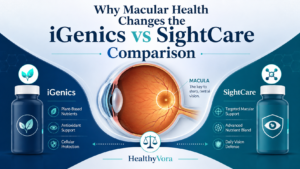
Why Macular Health Changes the iGenics vs SightCare Comparison
The macula is located near the center of the retina and is essential for tasks such as reading, recognizing faces, driving, and seeing fine detail. When someone searches for an eye supplement specifically because they are concerned about aging eyes or macular health, the ingredient comparison should therefore focus on nutrients that have actually been studied in relation to the retina and age-related macular degeneration.
Lutein and zeaxanthin are especially relevant because they naturally accumulate in the retina and lens. The National Eye Institute explains that these carotenoids may function as antioxidants and absorb high-energy blue and ultraviolet light.
This does not mean that simply taking lutein or zeaxanthin can prevent macular degeneration. It means that these nutrients have a stronger direct connection to macular nutrition than many general antioxidant ingredients.
A supplement containing recognizable eye-health nutrients may be nutritionally relevant, but ingredient relevance is not the same thing as proof that the finished supplement prevents or treats an eye disease.
iGenics Ingredients: What Stands Out?
According to the current Science Genics product information, iGenics combines 12 ingredients and includes several nutrients associated with traditional eye-health formulas: lutein, zeaxanthin, vitamin C, vitamin E, zinc, and copper. Its formula also includes botanical components such as bilberry and turmeric.
Lutein and Zeaxanthin
Lutein and zeaxanthin are arguably the most important differentiators in this comparison. These carotenoids are concentrated in the macular region and are part of the evidence-based AREDS2 formulation studied by the National Eye Institute.
The presence of both ingredients gives iGenics a clearer macula-focused nutritional profile than SightCare’s currently published ingredient list.
Vitamin C, Vitamin E, Zinc and Copper
iGenics also lists vitamin C, vitamin E, zinc, and copper. These nutrients are notable because the clinically studied AREDS2 combination includes all four alongside lutein and zeaxanthin.
However, ingredient names alone are not enough. The exact dosage matters. An eye supplement can contain the same nutrients as AREDS2 while delivering very different quantities.
Bilberry and Botanical Support
Bilberry and other botanical ingredients broaden the iGenics formula beyond a conventional vitamin-and-mineral eye supplement. These ingredients may contribute antioxidant compounds, but consumers should distinguish between ingredient-level research and direct evidence proving that the complete iGenics formula produces a specific clinical outcome.
SightCare Ingredients: What Does the Formula Emphasize?
SightCare currently takes a noticeably different approach. Its official ingredient page lists five principal ingredients: alpha-lipoic acid, quercetin, lycopene, vitamin B12, and vitamin E.
Alpha-Lipoic Acid
Alpha-lipoic acid is an antioxidant compound involved in cellular metabolism. SightCare provides 100 mg per serving according to its current product information. While antioxidant activity is relevant to general cellular health, ALA is not one of the six nutrients in the standard AREDS2 formula.
Quercetin
SightCare contains 100 mg of quercetin. Quercetin is a plant flavonoid with antioxidant properties. It is commonly discussed in the context of oxidative stress, although consumers should not interpret its presence as evidence that SightCare has been clinically proven to prevent retinal disease.
Lycopene
The current SightCare formula lists 50 mg of a 10% lycopene ingredient. Lycopene is another antioxidant carotenoid, but it is biologically distinct from lutein and zeaxanthin and is not included in the standard AREDS2 combination.
Vitamin B12 and Vitamin E
Vitamin B12 plays an important role in normal neurological and red blood cell function, while vitamin E functions as an antioxidant. SightCare currently lists 24 mcg of vitamin B12 and 50 mg of vitamin E.
Vitamin E is also present in AREDS2, but again, having one overlapping ingredient does not make a formula equivalent to AREDS2.
iGenics vs SightCare for Macular Support: Which Formula Makes More Sense?
If macular nutrition is the primary comparison criterion, iGenics has the stronger ingredient profile. Its inclusion of lutein and zeaxanthin is particularly important because both nutrients are concentrated in the macula and are included in the National Eye Institute’s AREDS2 formulation.
SightCare offers several antioxidant ingredients, but its currently published formula does not list lutein, zeaxanthin, vitamin C, zinc, or copper. That makes it less closely aligned with the nutrients most often discussed in evidence-based macular supplementation.
This conclusion is about formula alignment, not about proving that iGenics will produce better vision or prevent age-related macular degeneration.
How Do iGenics and SightCare Compare With AREDS2?
Neither product should be called an AREDS2 equivalent unless its current Supplement Facts panel matches the complete AREDS2 formula and doses.
The National Eye Institute identifies the AREDS2 formula as:
- Vitamin C — 500 mg
- Vitamin E — 400 IU
- Lutein — 10 mg
- Zeaxanthin — 2 mg
- Zinc — 80 mg
- Copper — 2 mg
AREDS2 supplements are not recommended simply because someone wants healthier eyes. The NEI states that the clinical benefit was demonstrated primarily for people with intermediate AMD or certain cases involving late AMD, while the formulas did not prevent AMD from developing in people without the disease.
Therefore, a U.S. consumer diagnosed with macular degeneration should not replace an ophthalmologist-recommended AREDS2 formula with iGenics or SightCare based only on online marketing.
Can Either Supplement Prevent or Treat Macular Degeneration?
No dietary supplement should be assumed to prevent, cure, or treat age-related macular degeneration.
The National Eye Institute makes an important distinction: AREDS2 can slow progression in certain people who already have intermediate or late AMD, but nutritional supplements do not prevent AMD from occurring in the first place. see also.
That distinction is particularly important when evaluating supplement advertising. Statements such as “supports macular health” are fundamentally different from claims that a product restores damaged eyesight, cures AMD, or replaces treatment.
The FDA also does not approve dietary supplements for safety and effectiveness before they reach the market. A manufacturing facility being registered with the FDA should therefore not be interpreted as meaning that the supplement itself is “FDA approved.”
Why Eye Supplement Selection Matters in the United States
American consumers have access to an enormous number of vision supplements through online marketplaces, direct-to-consumer websites, pharmacies, and health stores. The challenge is not finding an eye supplement; it is determining whether the formula matches the reason you are considering supplementation.
A younger adult in New York working ten hours a day at a computer may have very different needs from a 70-year-old in Florida who has been diagnosed with intermediate AMD. Likewise, blurred vision, sudden floaters, distorted central vision, or unexplained vision loss should not be treated as simple nutrition problems.
For U.S. consumers, the safest approach is to identify the goal first:
- Determine whether you want general nutritional support or management of a diagnosed eye condition.
- Check the complete Supplement Facts label rather than relying on the front of the bottle.
- Compare ingredient amounts, not simply the number of ingredients.
- Review medications and existing supplements for potential overlap or interactions.
- Ask an optometrist, ophthalmologist, physician, or pharmacist when you have an eye disease or take prescription medication.
Who Might Prefer iGenics?
iGenics may appeal more to someone who wants a broader eye-focused nutritional formula containing lutein, zeaxanthin, antioxidant vitamins, minerals, and botanical ingredients in one product.
It may be especially attractive to consumers whose primary comparison criterion is macular carotenoid content. Its formula is more directly structured around nutrients commonly associated with retina and macula nutrition.
Still, consumers should verify the current bottle label because supplement formulas, quantities, serving sizes, and packaging can change.
Who Might Prefer SightCare?
SightCare may make more sense for someone specifically interested in its antioxidant blend of alpha-lipoic acid, quercetin, lycopene, vitamin B12, and vitamin E rather than an AREDS2-inspired nutrient profile.
Its formula is simpler in terms of the number of highlighted ingredients, which may also make label comparison easier. However, a consumer primarily seeking lutein and zeaxanthin for macular nutrition would need to recognize that these nutrients are not listed on SightCare’s current official ingredient page.
Safety and Medication Considerations
Eye supplements can still interact with medications even when the ingredients are described as natural.
The FDA advises consumers to discuss dietary supplements with a doctor, pharmacist, or other healthcare professional because supplements can alter how medications are absorbed, metabolized, or eliminated.
This deserves extra attention with formulas containing multiple vitamins, minerals, antioxidants, and botanicals. For example, FDA guidance specifically notes that vitamin E and ginkgo biloba can raise concerns when combined with blood-thinning medications.
Before starting iGenics, SightCare, or another vision supplement, check with a healthcare professional if you:
- take warfarin or another anticoagulant;
- take multiple prescription medications;
- already use a multivitamin or AREDS2 supplement;
- are preparing for surgery;
- have a diagnosed retinal or optic nerve condition;
- are pregnant or breastfeeding;
- have experienced unexplained changes in vision.
Common Mistakes When Comparing iGenics vs SightCare
Assuming More Ingredients Automatically Means Better Results
A long ingredient list may look impressive, but effective nutrition depends on ingredient selection, dosage, bioavailability, safety, and the user’s actual needs.
Treating “AREDS2 Ingredients” as the Same as “AREDS2 Formula”
A supplement can contain lutein, zeaxanthin, zinc, copper, vitamin C, and vitamin E yet still differ significantly from the clinically studied AREDS2 dosages.
Believing FDA Registration Means FDA Approval
The FDA does not pre-approve dietary supplements for safety and effectiveness. Facility registration and product approval are not interchangeable concepts.
Expecting Supplements to Replace Glasses or Medical Treatment
Nutritional supplements cannot correct refractive errors such as nearsightedness or farsightedness, and they should not replace treatment for retinal disease, glaucoma, cataracts, or other diagnosed eye conditions.
Ignoring the Supplement Facts Label
Marketing pages can change. Always compare the actual product label delivered to you with the ingredient information you reviewed before ordering.
Why Use HealthyVora When Comparing Eye Health Supplements?
HealthyVora approaches supplement comparisons by separating three things that are often mixed together online: what a manufacturer says, what the ingredient label shows, and what clinical evidence actually supports.
That distinction is especially important with vision products because terms such as “eye support,” “macular support,” and “AREDS2-inspired” can sound similar while representing very different formulas.
Rather than choosing iGenics or SightCare based only on testimonials or promotional language, HealthyVora encourages readers to compare the ingredients, confirm dosages, understand the intended use of clinically studied formulations, and involve an eye-care professional when a medical condition is present.
Final Verdict: iGenics or SightCare?
In a direct iGenics vs SightCare comparison focused on comprehensive eye nutrition and the macula, iGenics currently has the more relevant ingredient profile. Its manufacturer lists lutein, zeaxanthin, vitamin C, vitamin E, zinc, and copper alongside additional botanical ingredients, giving it broader overlap with nutrients commonly associated with retinal and macular nutrition.
SightCare takes a different route, emphasizing alpha-lipoic acid, quercetin, lycopene, B12, and vitamin E. This may appeal to consumers interested in a general antioxidant formula, but it is less directly aligned with the lutein-zeaxanthin-centered approach commonly associated with macular supplementation.
The most important limitation is that ingredient overlap does not make either supplement a proven treatment for AMD. People with intermediate or late age-related macular degeneration should discuss the clinically studied AREDS2 formula with their ophthalmologist rather than choosing a general supplement on their own.
HealthyVora’s practical recommendation: if you are shopping for general eye nutrition, compare the latest labels carefully. If your priority is macular carotenoids, iGenics currently stands out more clearly. If you have diagnosed AMD or unexplained vision changes, make professional eye care—not supplement marketing—the next step.
Frequently Asked Questions About iGenics vs SightCare
1. Is iGenics better than SightCare for macular health?
Based on their currently published ingredient profiles, iGenics is more directly focused on macular nutrition because it lists lutein and zeaxanthin alongside other eye-related vitamins and minerals.
2. Does iGenics contain lutein and zeaxanthin?
Yes. The current Science Genics product information lists both lutein and zeaxanthin in the iGenics formula.
3. Does SightCare contain lutein?
Lutein is not listed on SightCare’s current official ingredient page, which presently highlights ALA, quercetin, lycopene, vitamin B12, and vitamin E.
4. Is iGenics the same as AREDS2?
No. Although iGenics lists the six nutrients associated with AREDS2, consumers should not assume it is equivalent unless the current label matches the clinically studied ingredient amounts.
5. Is SightCare an AREDS2 supplement?
No. Its currently published ingredient list does not contain the complete AREDS2 nutrient combination.
6. Can iGenics treat macular degeneration?
No dietary supplement should be considered a treatment or cure for AMD unless supported by appropriate clinical evidence and medical guidance.
7. Can SightCare restore eyesight?
There is no reliable basis for assuming that SightCare can restore lost vision. Persistent or worsening vision changes require professional evaluation.
8. What nutrients have the strongest connection to AREDS2?
The standard AREDS2 formula contains vitamin C, vitamin E, lutein, zeaxanthin, zinc, and copper in specific amounts established in National Eye Institute research.
9. Are eye supplements FDA approved?
No. The FDA does not approve dietary supplements for safety and effectiveness before they are marketed.
10. Should I ask my eye doctor before taking iGenics or SightCare?
Yes, especially if you have AMD, another diagnosed eye condition, take prescription medication, or already use other vitamin or mineral supplements.
HealthyVora Next Step
Before choosing between iGenics and SightCare, use HealthyVora as your comparison checkpoint: review the latest Supplement Facts panel, identify whether your goal is general eye nutrition or macular support, and compare the actual amounts of lutein, zeaxanthin, vitamins, minerals, and botanical ingredients. If you are managing AMD or another diagnosed vision condition, take that information to your ophthalmologist or pharmacist before adding a new supplement to your routine.