
VisiFlora Eye Probiotic Formula Reviews: Does It Really Improve Vision Clarity?
VisiFlora may provide nutritional support for eye health, but there is not enough product-specific clinical evidence to conclude that it reliably improves vision clarity. The formula is marketed around carotenoids, antioxidants, minerals, botanicals, and the emerging gut-eye connection. Some ingredients—particularly lutein and zeaxanthin—have legitimate research behind their roles in retinal and macular nutrition. That evidence, however, should not be confused with proof that the complete VisiFlora formula restores eyesight, corrects refractive errors, or produces measurable visual improvement in every user.
This Healthyvora review examines what VisiFlora appears to contain, whether calling it an “eye probiotic” is accurate, what current science says about the gut-eye axis, and what U.S. consumers should check before spending money on the supplement.
What Is VisiFlora?
VisiFlora is marketed as a daily dietary supplement for adults interested in maintaining visual comfort, macular nutrition, antioxidant protection, and healthy vision as they age. Current product information describes a multi-ingredient formula containing carotenoids, antioxidant nutrients, minerals, and botanical extracts such as lutein, zeaxanthin, astaxanthin, bilberry, saffron, zinc, vitamins C and E, grape seed extract, quercetin, taurine, and ginkgo biloba.
Rather than presenting itself as only another lutein supplement, VisiFlora is marketed around a broader idea: nutritional support for the eyes combined with support for pathways associated with the so-called gut-eye axis.
That distinction sounds promising, but it is important to separate a biologically plausible concept from a clinically proven outcome.
Quick answer: VisiFlora is best viewed as a multi-ingredient vision-support supplement. It should not be considered a treatment for blurry vision, macular degeneration, glaucoma, cataracts, or another diagnosed eye disease.
Is VisiFlora Really an Eye Probiotic Formula?
Based on currently accessible ingredient information, VisiFlora does not look like a conventional probiotic supplement. A true probiotic product normally identifies live microorganisms by strain and commonly provides a colony-forming unit, or CFU, quantity.
The accessible VisiFlora ingredient information reviewed for this article lists carotenoids, vitamins, minerals, antioxidant compounds, amino-acid-related nutrients, and botanical extracts. It does not clearly identify named probiotic organisms such as specific Lactobacillus or Bifidobacterium strains or provide a CFU count.
Therefore, search phrases such as “VisiFlora eye probiotic formula” can be misleading if interpreted literally. VisiFlora is more accurately described as a gut-eye–positioned nutritional eye formula unless the current Supplement Facts label specifically confirms probiotic strains.
Why Does VisiFlora Talk About the Gut-Eye Connection?
The gut-eye axis is a legitimate area of scientific investigation. Researchers are studying how intestinal microbiota, immune signaling, inflammation, gut-barrier integrity, short-chain fatty acids, and other microbial metabolites may influence ocular tissues.
Recent scientific reviews describe plausible links between gut dysbiosis and retinal or ocular disorders. At the same time, researchers emphasize that much of the human evidence remains associative and that controlled intervention studies are still needed before microbiome manipulation can be considered an established eye treatment.
In other words, the gut-eye axis is scientifically interesting. It does not automatically prove that a supplement marketed around that concept improves eyesight.
Does VisiFlora Really Improve Vision Clarity?
There is currently insufficient evidence to say that the finished VisiFlora formula has been clinically proven to improve visual acuity or restore clearer eyesight.
This distinction matters because “vision clarity” can describe several different things:
- Visual acuity—how clearly a person sees letters or fine detail.
- Contrast sensitivity—the ability to distinguish an object from its background.
- Eye comfort after extended screen use.
- Glare sensitivity or adaptation to different lighting conditions.
- Subjective feelings of sharper or less tired vision.
A user saying that their eyes “feel clearer” is not necessarily experiencing a measurable change in visual acuity. Likewise, improved comfort after reducing digital eye strain does not mean a supplement has corrected nearsightedness, farsightedness, astigmatism, cataracts, or retinal disease.
Customer testimonials can be useful for understanding subjective experiences, but they cannot establish causation. Results may also be influenced by changes in sleep, hydration, diet, screen habits, glasses prescriptions, dry-eye treatment, or natural fluctuations in symptoms.
What Does the Research Say About Key VisiFlora Ingredients?
The strongest way to evaluate VisiFlora is to examine individual ingredients while remembering that evidence for an ingredient is not automatically evidence for the exact finished product.
| Ingredient or Concept | Potential Role | Evidence Perspective |
|---|---|---|
| Lutein | Macular pigment and antioxidant nutrition | Well studied in eye nutrition, including AREDS2 |
| Zeaxanthin | Concentrated in the macular region | Established nutritional relevance to the retina |
| Zinc | Essential mineral involved in normal cellular function | Included in the clinically studied AREDS2 combination |
| Bilberry and saffron | Botanical antioxidant and visual-wellness support | Interesting ingredient-level research, but results depend on dose and formulation |
| Ginkgo biloba | Often marketed for circulation and antioxidant support | Evidence for broad health claims remains inconsistent; interaction precautions matter |
| Gut-eye axis | Microbiome, immune and inflammatory signaling | Promising research field, but not proof of VisiFlora effectiveness |
Lutein and Zeaxanthin Have the Clearest Eye-Health Context
Lutein and zeaxanthin are naturally present in the retina and lens. The National Eye Institute’s AREDS2 research established an important role for a specific combination of lutein, zeaxanthin, vitamins, zinc, and copper in certain people with age-related macular degeneration.
However, AREDS2 does not demonstrate that every supplement containing lutein or zeaxanthin improves ordinary vision in healthy adults. The NEI specifically notes that the AREDS2 formulation is intended for particular stages of AMD rather than general prevention in everyone.
This is one of the most important points in any responsible VisiFlora review: ingredient-level credibility does not equal finished-product clinical proof.
What VisiFlora Reviews Can and Cannot Tell You
Positive VisiFlora reviews may describe less eye fatigue, greater comfort while using screens, easier reading, improved confidence when driving at night, or a subjective sense of sharper vision.
These experiences should be treated as anecdotal rather than clinical evidence. A useful supplement review should ask several questions before accepting a testimonial at face value:
- Was the reviewer independently verified?
- Was visual acuity measured before and after use?
- Were other eye treatments or lifestyle changes occurring at the same time?
- How long was the product used?
- Was the exact VisiFlora formula and dosage documented?
If these details are missing, the review may still describe a genuine personal experience, but it cannot prove that VisiFlora caused the reported result.
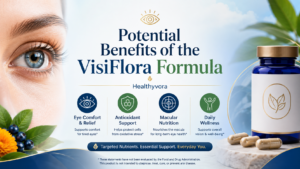
Potential Benefits of the VisiFlora Formula
With realistic expectations, VisiFlora may appeal to consumers looking for a convenient way to combine several nutrients commonly associated with eye-health nutrition.
1. Broad Antioxidant Nutritional Support
The formula includes multiple compounds marketed for antioxidant support. Oxidative stress is relevant to normal aging and retinal biology, making antioxidant nutrition a reasonable area of interest in eye wellness.
2. Macular Nutrition
Lutein and zeaxanthin have stronger scientific credibility than many ingredients commonly found in eye supplements because they are naturally concentrated in ocular tissues and have been extensively investigated.
3. Convenience
A combined formula may be easier for some consumers than purchasing numerous individual supplements. However, convenience only becomes an advantage when ingredient doses are appropriate and do not unnecessarily duplicate nutrients from other products.
4. A Broader Gut-Eye Research Angle
The gut-retina connection is an emerging scientific field involving microbiome composition, immune signaling, metabolic products, and inflammation. Research supports continued investigation of this connection, although clinical translation remains limited.
What VisiFlora Cannot Realistically Be Expected to Do
A nutritional eye supplement should not be expected to replace corrective lenses, medical treatment, or professional diagnosis.
- It cannot correct astigmatism.
- It cannot replace prescription glasses or contact lenses.
- It should not be expected to reverse cataracts.
- It is not an established treatment for glaucoma.
- It should not replace AMD treatment or an AREDS2 formula recommended by an ophthalmologist.
- It cannot safely explain sudden blurred vision, flashes, new floaters, eye pain, or sudden loss of vision.
Unexpected or rapidly changing vision symptoms require medical evaluation rather than experimentation with supplements.
Why VisiFlora Matters to U.S. Consumers
American consumers should understand an important regulatory distinction before evaluating VisiFlora or any similar product.
The U.S. Food and Drug Administration does not approve dietary supplements for safety and effectiveness before they are sold in the same way it approves pharmaceutical drugs. A facility can be FDA-registered or operate under applicable manufacturing requirements without the supplement itself being “FDA approved.”
For buyers in New York, California, Texas, Florida, or anywhere else in the United States, the practical lesson is the same: evaluate the Supplement Facts panel rather than relying solely on phrases such as “FDA registered facility,” “natural,” or “science-backed.”
Consumers should confirm the current formula, serving size, ingredient quantities, allergen information, return terms, seller identity, and medication interactions before ordering.
Is VisiFlora Safe? Side Effects and Interaction Considerations
Safety cannot be determined from an ingredient list alone. Dosage, medications, health conditions, allergies, pregnancy status, and other supplements all matter.
One notable ingredient appearing in current VisiFlora descriptions is ginkgo biloba. The National Center for Complementary and Integrative Health warns that ginkgo may increase bleeding risk in people using anticoagulants such as warfarin and may interact with other medications.
Zinc also deserves attention when someone is combining multiple supplements. The NIH Office of Dietary Supplements lists 40 mg per day as the adult tolerable upper intake level from normal food and supplement sources, except when higher doses are being used under medical supervision. Excessive supplemental zinc over time can interfere with copper absorption. see also.
Because complete ingredient quantities should be checked on the current VisiFlora Supplement Facts panel, consumers should avoid stacking VisiFlora with another eye formula or multivitamin without comparing overlapping nutrients.
Talk to a Healthcare Professional Before Using VisiFlora If You:
- Take prescription medications.
- Use anticoagulants or antiplatelet drugs.
- Already take an AREDS2 or multivitamin formula.
- Have a diagnosed retinal or eye condition.
- Are preparing for surgery.
- Are pregnant or breastfeeding.
- Have unexplained or changing vision symptoms.
The FDA also recommends discussing dietary supplements with a doctor, pharmacist, or other healthcare professional because supplements may interact with medicines or other supplements.
How Long Should You Take VisiFlora Before Judging It?
Do not expect an immediate change in eyesight from a nutritional supplement. Nutrient-based eye support is fundamentally different from putting on the correct prescription glasses, using artificial tears for dry eye, or receiving treatment for an eye disorder.
If someone chooses to try VisiFlora after checking its label and discussing relevant risks, a practical evaluation should focus on consistent use according to the current product directions rather than increasing the dose in an attempt to accelerate results.
Track specific outcomes instead of relying on a vague feeling that vision is “better.” Useful observations might include eye comfort after screen use, glare sensitivity, reading comfort, or changes documented during a professional eye examination.
How to Evaluate VisiFlora Before Buying
- Read the current Supplement Facts panel. Confirm ingredients and exact amounts rather than relying only on advertising copy.
- Check whether probiotic strains are actually listed. If there are no strain names and CFU values, do not assume it is a conventional probiotic.
- Compare the formula with supplements you already use. Look especially for zinc, vitamin A, vitamin E, copper, and other overlapping nutrients.
- Review medication interactions. This is particularly important when botanical extracts such as ginkgo are included.
- Set realistic expectations. Nutritional support is different from correcting blurry eyesight.
- Verify the seller and return policy. Save your receipt and the version of the terms shown when ordering.
- Keep regular eye examinations. Supplements should complement appropriate eye care, not replace it.
Common Mistakes When Reading VisiFlora Eye Probiotic Formula Reviews
Assuming “Probiotic” Automatically Means It Contains Live Bacteria
A gut-eye marketing concept is not the same thing as a conventional probiotic formulation. Look for named strains and CFU quantities.
Treating Ingredient Research as a Clinical Trial of VisiFlora
A study on lutein, saffron, or another isolated nutrient cannot automatically predict what a multi-ingredient capsule will do at different doses.
Expecting a Supplement to Fix a Prescription Problem
Blurry vision caused by refractive error requires an appropriate optical correction, not simply additional antioxidants.
Ignoring the Current Label
Supplement formulations can change. Always use the Supplement Facts panel on the bottle you are actually considering.
Doubling Up on Eye Supplements
More ingredients do not automatically produce better results. Combining several formulas may unnecessarily increase vitamin, mineral, or botanical intake.
Why Use Healthyvora When Evaluating Eye Supplements?
At Healthyvora, the useful question is not simply whether a supplement contains impressive-sounding ingredients. The more important questions are whether the formula matches the claim, whether the ingredient evidence applies to the actual product, what important information remains unclear, and what safety considerations a buyer should investigate.
That approach is particularly important with VisiFlora because its marketing combines established eye-health nutrients with the much newer gut-eye concept. Separating those two evidence levels makes it easier for consumers to make a measured decision instead of relying entirely on testimonials or promotional language.
VisiFlora Review Verdict: Is It Worth Considering?
VisiFlora is an interesting multi-ingredient eye-health supplement, but it should be considered nutritional support rather than a clinically proven way to restore or dramatically sharpen vision.
The strongest part of the formula is its inclusion of familiar eye-health nutrients such as lutein and zeaxanthin. The gut-eye axis also has genuine scientific relevance, although research is still developing and does not establish that VisiFlora itself changes the microbiome or improves eyesight through this pathway.
The biggest question for consumers searching for VisiFlora eye probiotic formula reviews is the word “probiotic.” Based on accessible ingredient information, VisiFlora appears to be better described as a vision-support supplement inspired by gut-eye research than a conventional probiotic containing clearly identified live microbial strains.
Before buying, verify the current Supplement Facts label, ingredient dosages, medication interactions, seller terms, and whether the formula addresses what you actually want from an eye supplement.
Most importantly, persistent or worsening blurry vision deserves an eye examination rather than a supplement experiment.
Frequently Asked Questions About VisiFlora
1. Does VisiFlora really improve vision clarity?
There is not enough finished-product clinical evidence to confirm that VisiFlora reliably improves visual acuity. Some ingredients have credible eye-health research, but results should not be interpreted as guaranteed clearer eyesight.
2. Is VisiFlora a probiotic?
Current accessible ingredient information does not clearly list named probiotic strains or CFU counts, so VisiFlora appears more accurately described as a gut-eye–focused vision supplement.
3. What are the main ingredients in VisiFlora?
Current product information commonly references lutein, zeaxanthin, astaxanthin, vitamins, zinc, copper, selenium, bilberry, saffron, grape seed extract, quercetin, taurine, ginkgo, and other botanical or antioxidant ingredients. Check the current label for the exact formula.
4. Can VisiFlora replace glasses?
No. Nutritional supplements do not correct refractive errors such as nearsightedness, farsightedness, or astigmatism.
5. Is VisiFlora the same as AREDS2?
No. AREDS2 is a specific clinically studied combination and dosage intended for certain people with AMD. Do not assume another eye supplement is equivalent unless its formula matches the recommended specification.
6. Does VisiFlora help the macula?
It contains nutrients such as lutein and zeaxanthin associated with macular nutrition, but this does not prove that the finished VisiFlora formula treats macular disease.
7. Can VisiFlora help digital eye strain?
Some users may report greater eye comfort, but digital eye strain is also strongly influenced by screen habits, blinking, dryness, lighting, ergonomics, and vision correction.
8. Does VisiFlora have side effects?
Possible effects depend on ingredient amounts and individual sensitivity. Botanical extracts and minerals may also interact with medications, so the current label should be reviewed carefully.
9. Can I take VisiFlora with other eye vitamins?
Compare both Supplement Facts panels first. Taking multiple formulas can duplicate nutrients such as zinc, vitamin A, vitamin E, or copper.
10. Who should talk to a doctor before taking VisiFlora?
People using prescription medications, blood thinners, multiple supplements, or treatment for an eye or medical condition should discuss the formula with a qualified healthcare professional before use.
Final Takeaway from Healthyvora
VisiFlora deserves a closer look for its broad nutrient profile, but the smartest purchase decision starts with evidence rather than promises. Review the current label, confirm whether the amounts match your needs, understand the limits of gut-eye research, and do not substitute supplementation for professional eye care.
Explore Healthyvora’s evidence-focused eye-health and supplement reviews before choosing your next formula, and use what you learn to have a more informed conversation with your eye doctor or healthcare professional.